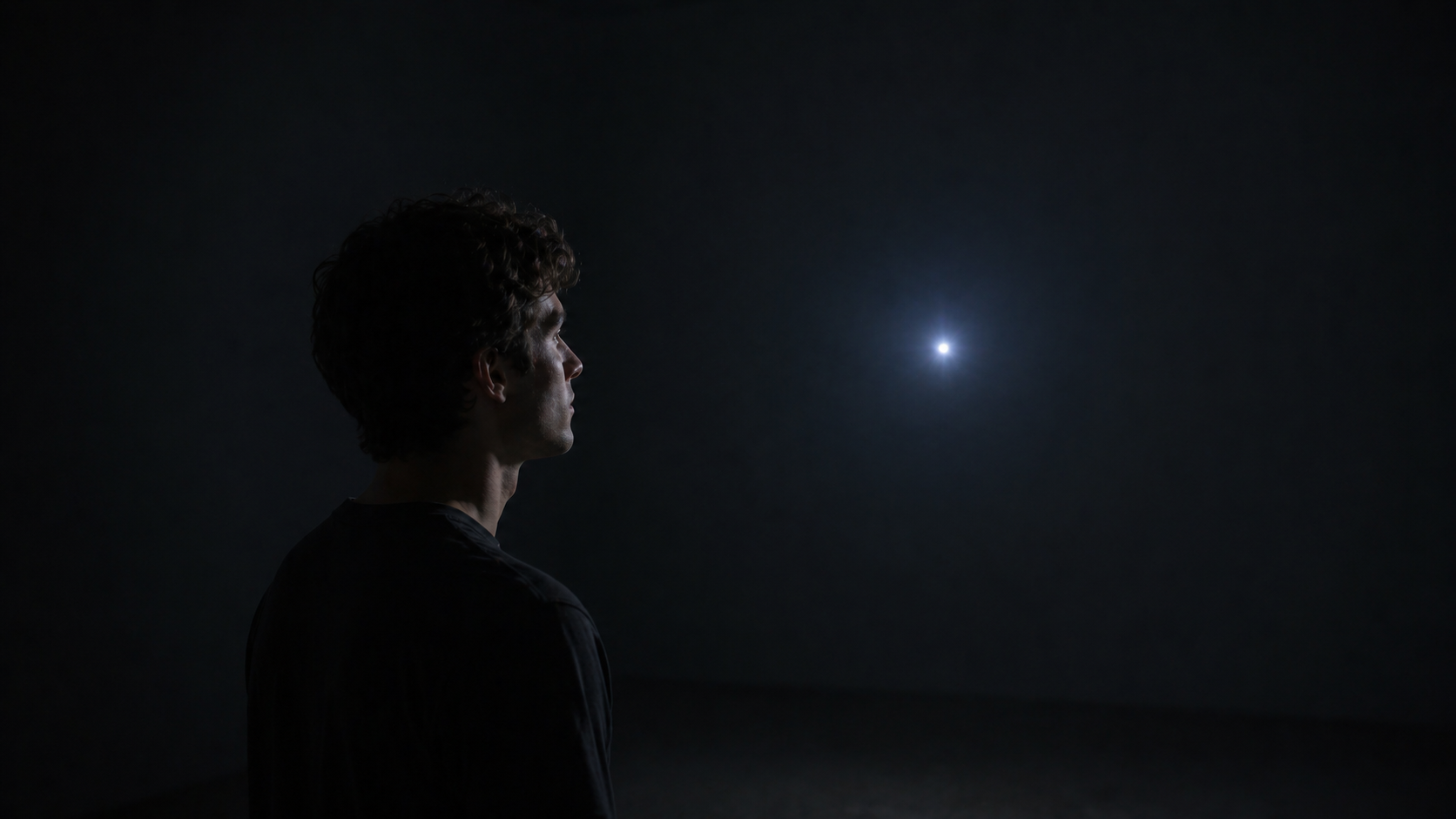
What if light had no source? Intersecting invisible beams could place illumination anywhere—no fixtures, no wires—turning rooms into programmable fields of floating light.
What began as a thought experiment is becoming the foundation of a new physical reality
By Futurist Thomas Frey
Part 1 of 3: The Point of Light
More than twenty years ago, I found myself staring at the ceiling of a room and thinking a thought that seemed, at the time, almost too simple to be interesting.
What if the light didn’t need to be there?
Not the light itself — the fixture. The bulb. The wire running through the wall to the panel in the basement. The entire physical infrastructure of illumination that we’ve inherited from Thomas Edison and that we’ve never seriously questioned because it works and because we built our entire civilization around it before anyone thought to ask whether there was another way.
The thought went like this. If two invisible beams of energy crossed at a point in space, and if something happened at that crossing point that produced visible light — no bulb, no filament, no surface, no wiring — then you could place a point of light anywhere in a room simply by directing two beams to intersect at that location. You could fill a room with floating points of light the way a night sky is filled with stars. You could light a space without touching it. Without installing anything in it. Without running a single wire.
I turned the thought over for years. It seemed physically plausible in outline, intuitively satisfying in a way that good ideas tend to feel, and practically very far from anything buildable. I filed it in the category of ideas worth watching and moved on.
What I didn’t anticipate was how quickly the underlying physics would go from theoretical to demonstrated — and how the demonstration would open a set of doors that lead somewhere considerably larger than a lighting fixture.
This is the first column in a three-part series about what happens when you follow that thought experiment all the way to its conclusions. The destination is more radical than the starting point suggests.
The Physics of the Floating Point
Start with the honest constraint, because understanding it is what makes the solution interesting.
Two ordinary beams of light crossing in empty air do not create a visible point at their intersection. This isn’t a technology failure — it’s fundamental physics. Photons don’t interact with each other under normal conditions. They pass through each other the way two radio signals can occupy the same space without interference. Shine two flashlights so their beams cross and nothing happens at the crossing point. The light continues on its way as if the other beam didn’t exist.
For a crossing point to glow, you need something more. You need a physical process that converts the combined energy of two intersecting beams into visible photons — what physicists call a nonlinear interaction. And this is where the thought experiment that seemed merely poetic turns out to have rigorous physical foundations.
There are several nonlinear mechanisms that work. Each one is real, each one is experimentally demonstrated, and each one represents a different engineering path toward the floating light.
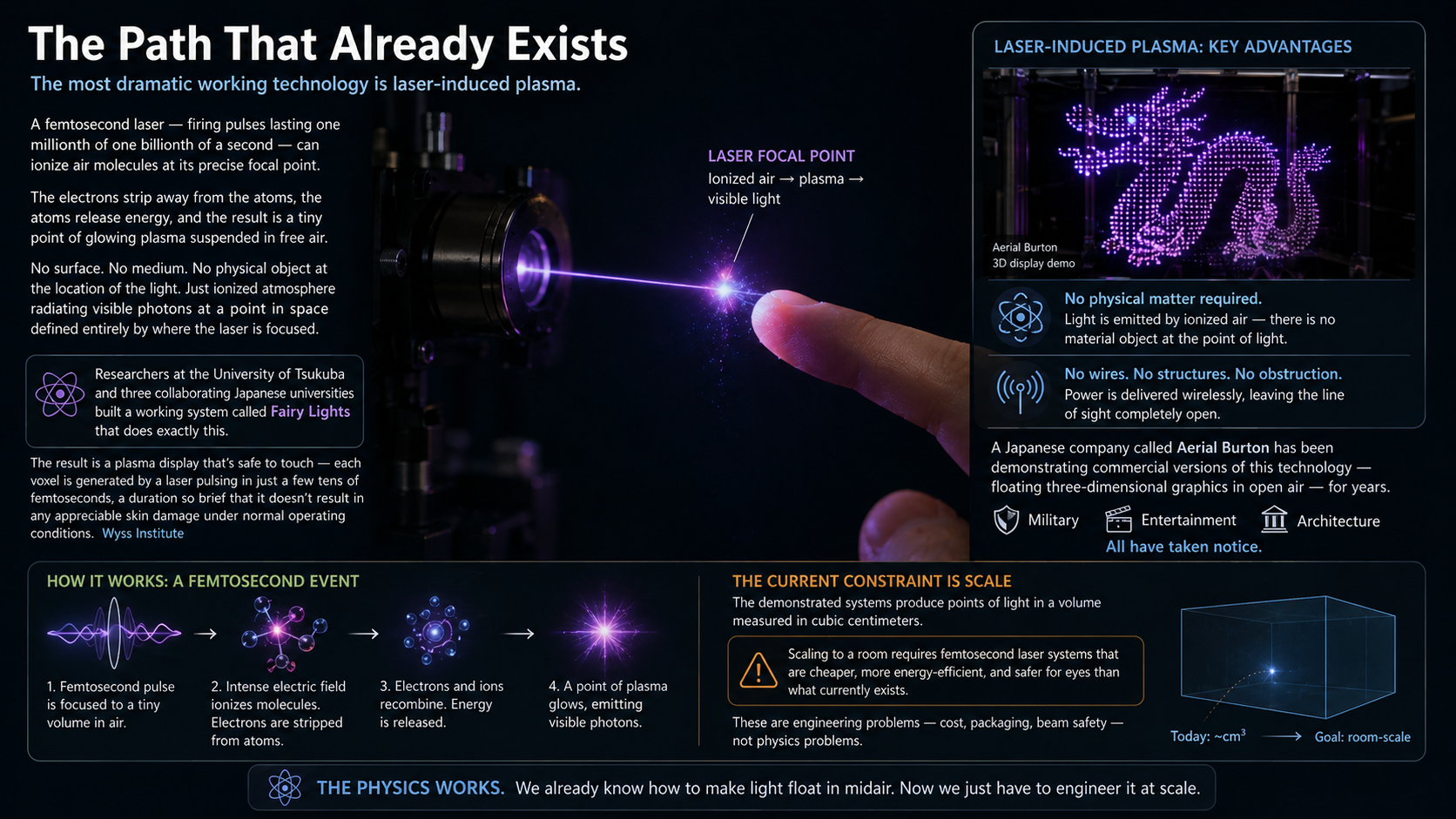
The Path That Already Exists
The most dramatic working technology is laser-induced plasma.
A femtosecond laser — firing pulses lasting one millionth of one billionth of a second — can ionize air molecules at its precise focal point. The electrons strip away from the atoms, the atoms release energy, and the result is a tiny point of glowing plasma suspended in free air. No surface. No medium. No physical object at the location of the light. Just ionized atmosphere radiating visible photons at a point in space defined entirely by where the laser is focused.
Researchers at the University of Tsukuba and three collaborating Japanese universities built a working system called Fairy Lights that does exactly this. The result is a plasma display that’s safe to touch — each voxel is generated by a laser pulsing in just a few tens of femtoseconds, a duration so brief that it doesn’t result in any appreciable skin damage under normal operating conditions.
Laser-induced plasma has fundamental advantages: it does not require physical matter arranged and suspended in air to emit light, and it does not require wires or structures that could obstruct the line of sight, because power is transmitted wirelessly.
A Japanese company called Aerial Burton has been demonstrating commercial versions of this technology — floating three-dimensional graphics in open air — for years. The military, the entertainment industry, and the architectural world have all taken notice.
The current constraint is scale. The demonstrated systems produce points of light in a volume measured in cubic centimeters. Scaling to a room requires femtosecond laser systems that are cheaper, more energy-efficient, and safer for eyes than what currently exists. These are engineering problems — cost, packaging, beam safety — not physics problems. The physics works.
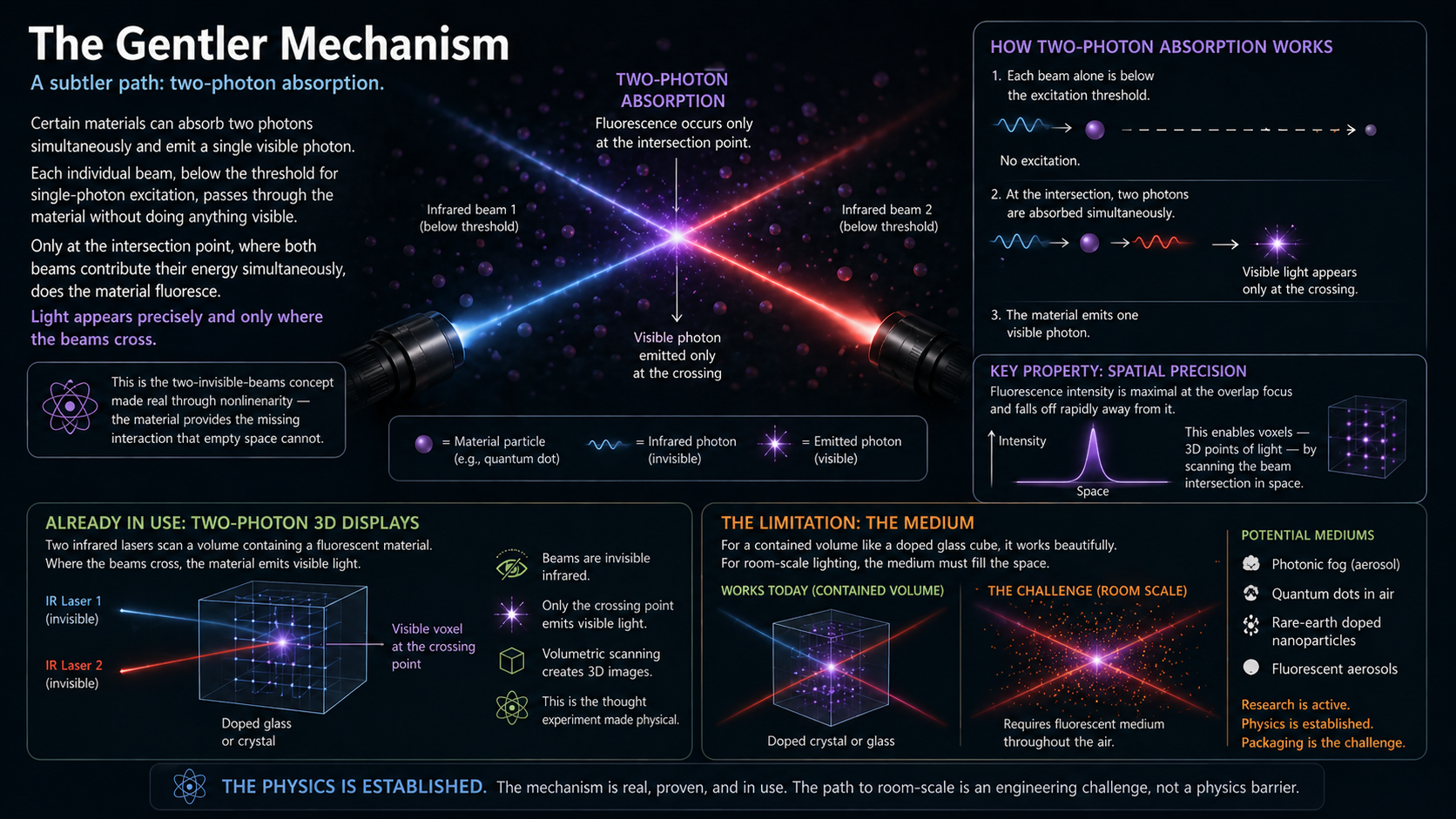
The Gentler Mechanism
There is a subtler approach that fits the two-invisible-beams concept even more precisely: two-photon absorption.
Certain materials — quantum dots, rare-earth doped crystals, specific fluorescent compounds — can absorb two photons simultaneously and emit a single visible photon. The mechanism has an elegant property: each individual beam, below the threshold for single-photon excitation, passes through the material without doing anything visible. Only at the intersection point, where both beams contribute their energy simultaneously, does the material fluoresce. Light appears precisely and only where the beams cross.
This is already being used in at least two different types of 3D displays. One uses two infrared lasers scanning a glass cube doped with a material that fluoresces visibly when illuminated by both simultaneously. The beams themselves are invisible infrared. The crossing point emits visible light. This is the thought experiment made physical — two invisible beams, one visible point, located precisely where the beams meet.
The limitation is the medium. For a contained display volume like a doped glass cube, it works beautifully. For a room-scale lighting system, you’d need the room’s atmosphere to carry the fluorescent medium — a photonic fog, an aerosol, quantum dots suspended in air. Researchers are working on exactly this. The physics is established. The packaging is the challenge.
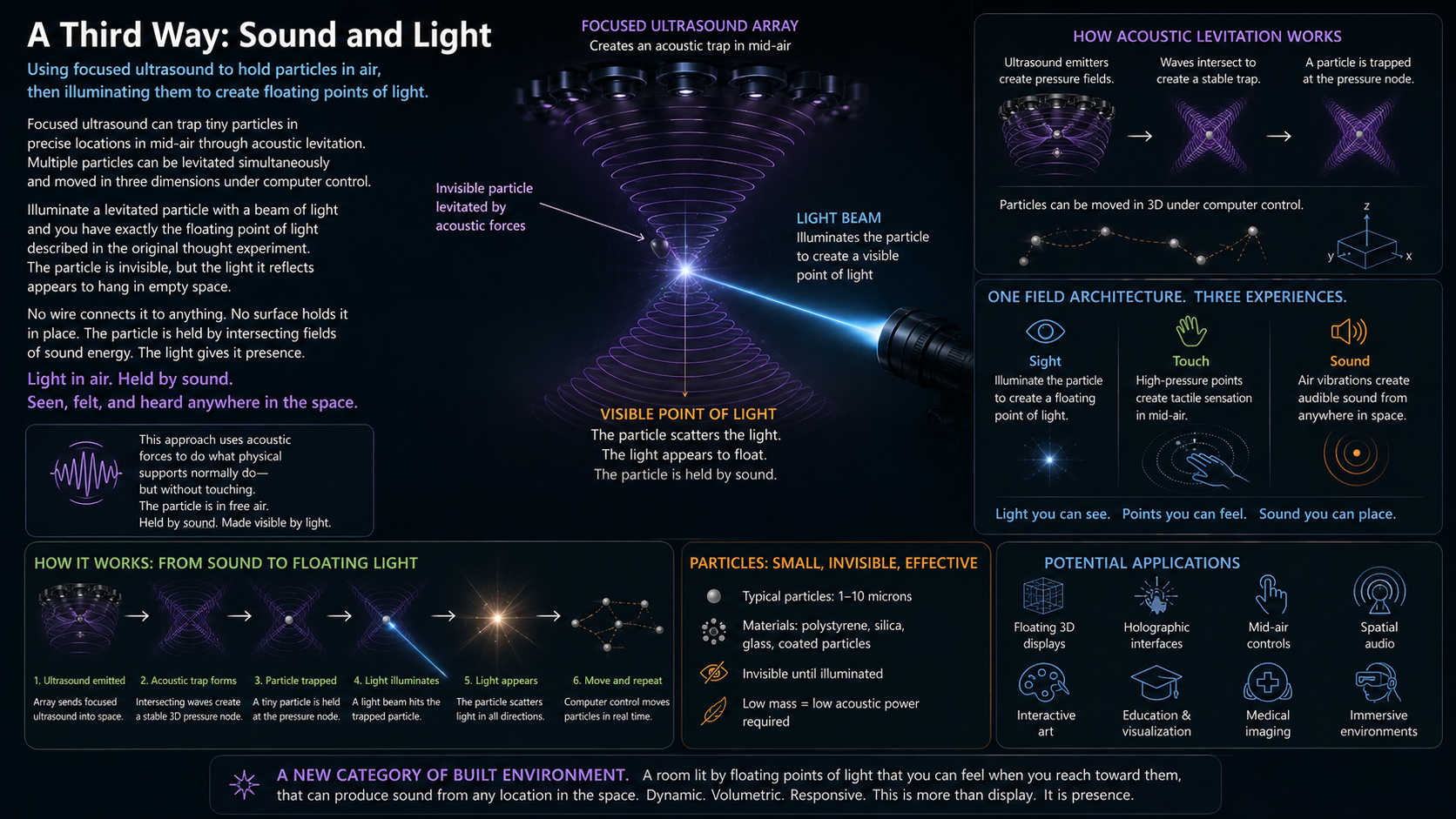
A Third Way: Sound and Light
The most immediately practical approach for certain environments combines acoustics and optics in a way that feels almost counterintuitive.
Focused ultrasound — beams of sound energy above the range of human hearing — can trap tiny particles in precise locations in mid-air through acoustic levitation. Multiple particles can be levitated simultaneously and moved in three dimensions under computer control. The particles themselves are invisible.
Illuminate a levitated particle with a beam of light and you have exactly the floating point of light described in the original thought experiment. No wire connects it to anything. No surface holds it in place. The light appears to hang in empty space because the particle that’s reflecting or scattering the light is itself hanging in empty space, held there by intersecting fields of sound energy.
This approach can also create high-pressure points that hands can feel and induce air vibrations that create audible sound — meaning the same field architecture that produces floating light can simultaneously produce floating tactile sensation and floating audio. A room lit by floating points of light that you can feel when you reach toward them, that can produce sound from any location in the space. That’s a different category of built environment than anything we currently inhabit.
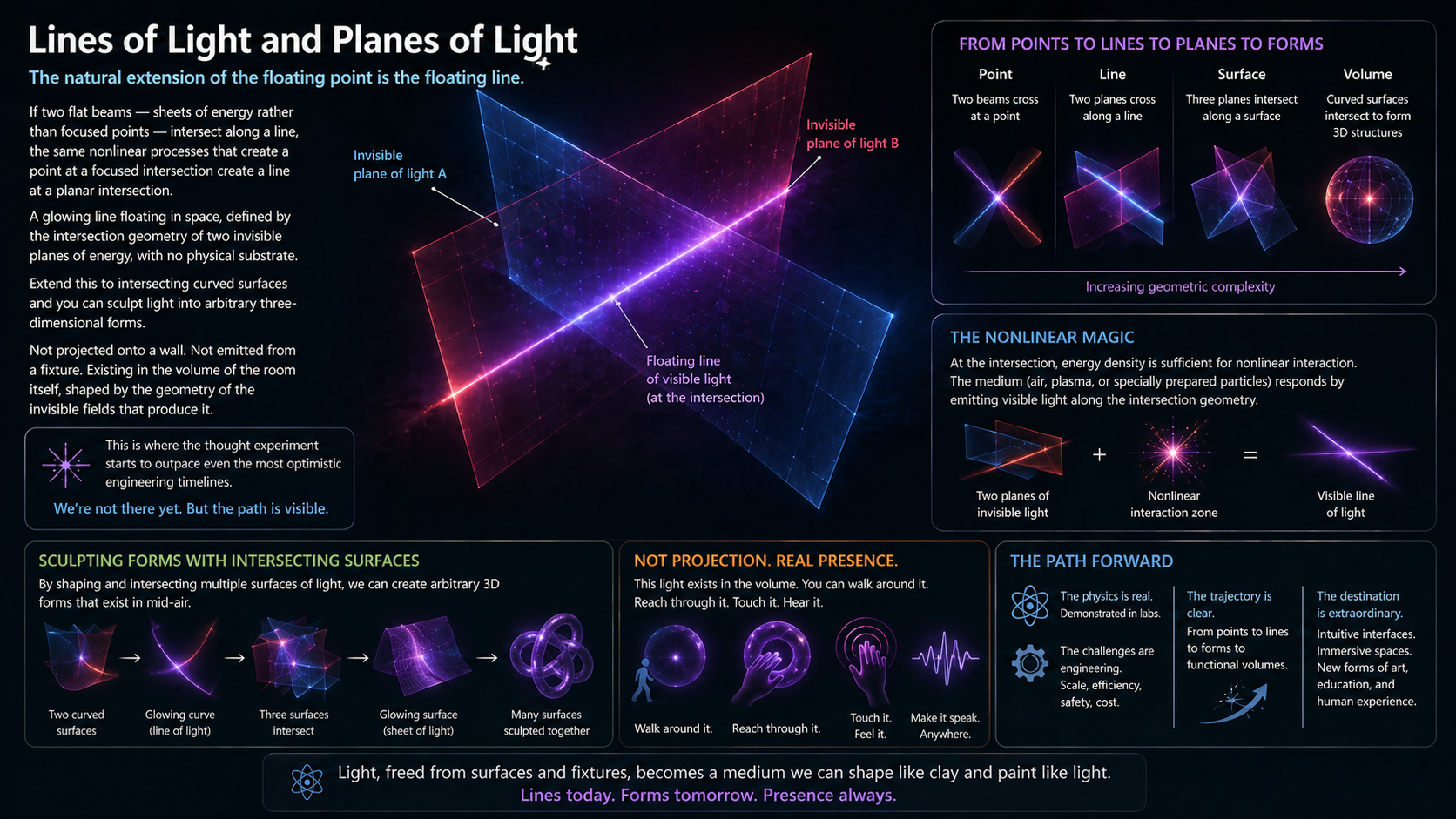
Lines of Light and Planes of Light
The natural extension of the floating point is the floating line.
If two flat beams — sheets of energy rather than focused points — intersect along a line, the same nonlinear processes that create a point at a focused intersection create a line at a planar intersection. A glowing line floating in space, defined by the intersection geometry of two invisible planes of energy, with no physical substrate.
Extend this to intersecting curved surfaces and you can sculpt light into arbitrary three-dimensional forms. Not projected onto a wall. Not emitted from a fixture. Existing in the volume of the room itself, shaped by the geometry of the invisible fields that produce it.
This is where the thought experiment starts to outpace even the most optimistic engineering timelines. We’re not there yet. But the path is visible.
How Far From the Lit Room?
The honest answer: closer to demonstration than to product, but with a clear and accelerating trajectory.
The fundamental physics is proven across multiple mechanisms. The demonstrations exist in research settings. The components — femtosecond lasers, acoustic levitation arrays, two-photon fluorescent materials, computer-controlled beam steering — are commercially available in research-grade forms and improving rapidly in cost and efficiency.
What doesn’t yet exist is the integration that makes this practical for ordinary spaces at ordinary cost. Femtosecond laser systems capable of room-scale plasma illumination remain expensive and require eye safety engineering. The two-photon approach needs either a contained volume or an atmospheric medium that most people would find intrusive. The acoustic-levitation approach is most immediately practical for controlled environments — stages, galleries, architectural installations, high-end commercial spaces.
The path to the room you can imagine runs through three parallel developments: laser systems efficient enough to run continuously and cheaply, beam-steering technology precise enough to place light with furniture-scale accuracy and eye-safe operating parameters, and a medium-based approach that doesn’t require a visible fog. None of these are physics problems. They are engineering and cost problems — the kind that get solved when the underlying science is solid and the application is compelling enough to attract serious investment.
Both conditions are now met.
Why This Is the Beginning, Not the Destination
I want to be direct about why I’m framing this as a series rather than a single column. Because the floating point of light — as remarkable as it is — is not the most important implication of this physics.
Once you have the ability to place visible light at precise points in three-dimensional space using intersecting fields of energy, two further things become possible that are considerably more significant.
The first is three-dimensional video. Not a screen showing a 3D image. Actual three-dimensional moving images suspended in the volume of a room — figures you can walk around, scenes you can step into, information that exists in real space rather than on a flat surface. The same mechanism that floats a point of light floats a voxel of color in a moving display. Scale it up and the display fills the room.
The second is structural. If intersecting fields of energy can produce light at a point in space, they can potentially produce other physical effects at a point in space — thermal insulation, electromagnetic shielding, pressure sufficient to deflect physical objects. Fields that define a boundary without a physical surface. Walls that aren’t walls. A building that isn’t built.
That is where this series is going. The floating point of light is the proof of concept. What it proves is considerably larger than illumination.
Next: Part 2 — The 3D Video Room. When the display floats free of the screen and fills the space you live in, everything about how we consume information, tell stories, and share experience changes at once.
Related Reading
Fairy Lights in Femtoseconds: Aerial and Volumetric Graphics by Focused Femtosecond Laser
ACM Transactions on Graphics — The landmark paper from Japanese researchers demonstrating touchable plasma points of light in open air using femtosecond lasers — the most direct experimental proof of concept for the floating light described in this column
Two-Photon Excitation and the Volumetric Display
Optics Letters — The peer-reviewed demonstration of two-photon excitation as a mechanism for creating visible light only at the intersection of two invisible beams — the cleanest physical realization of the original thought experiment
Acoustic Levitation as a Platform for Mid-Air Light and Haptics
Nature — How focused ultrasound creates stable levitation fields that allow illuminated particles to serve as freely positionable light sources — and how the same field architecture simultaneously produces tactile sensation and sound