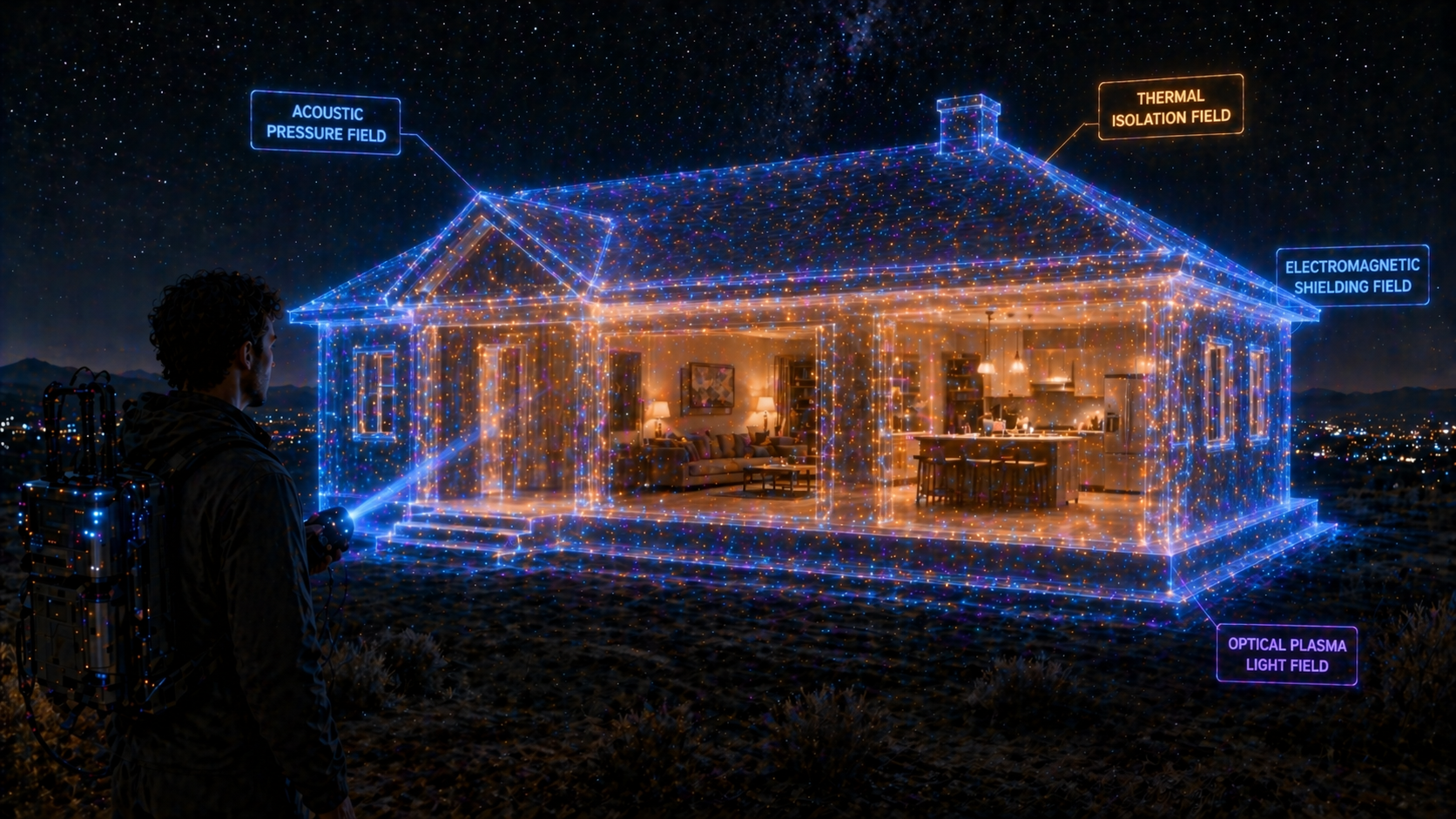
When the building is made of energy rather than matter, everything we assume about shelter, ownership, and place dissolves along with the walls.
By Futurist Thomas Frey
Part 3 of 3: The Projected House
The oldest human technology is the wall.
Before the wheel, before writing, before agriculture, human beings were building barriers against the world — piling stones, stretching skins, weaving branches, mixing mud and straw into something that would hold back the wind and the rain and the things that moved in the dark. Every architectural tradition in human history, on every continent, in every climate, starts from the same premise: shelter is a physical object. It is made of matter. It sits in a place. It stays where you put it.
That premise is about to become optional.
In the first column of this series, I traced a twenty-year-old thought experiment about creating floating points of light from intersecting invisible beams of energy — no bulb, no wire, no surface — and showed that the physics not only works but has been demonstrated in laboratories around the world. In the second column, I followed that physics into the future of display technology, where a million floating points of light become a three-dimensional video environment that fills a room and makes the rectangle of the screen obsolete.
In this column I want to follow the same physics to its most radical conclusion. Because the same principles that allow intersecting energy fields to create light at a point in space can, in principle, create other physical effects at a point in space. Thermal resistance. Acoustic damping. Electromagnetic shielding. Mechanical pressure sufficient to deflect physical objects.
Fields that behave like walls without being walls. Boundaries that exist in space without matter to define them. A house made entirely of energy that can be summoned, configured, and dismissed — and moved to a different location the next morning.
From Light to Structure: The Physics Bridge
The conceptual bridge from floating light to structural field requires understanding that light is only one of several things that intersecting energy fields can produce at their focal points.
Acoustic fields — the same focused ultrasound used in acoustic levitation displays — create real pressure gradients in space. A sufficiently intense acoustic field can exert enough force to trap and hold physical objects, as acoustic levitation research has demonstrated. A field intense enough to levitate a particle is a field that resists physical penetration. A planar acoustic field, maintained continuously, is in functional terms a pressure boundary — something that objects and bodies encounter as physical resistance even though there is no physical surface present.
Thermal fields are equally real. Focused electromagnetic energy creates heat at its focal point, but the inverse is also achievable — fields configured to create thermal isolation zones, boundaries across which heat transfer is impeded not by insulating material but by energy patterns that disrupt the thermal convection and conduction pathways. The physics of electromagnetic thermal management is well established in industrial contexts. Scaling it to architectural application is an engineering challenge, not a physics impossibility.
Electromagnetic shielding fields can block radio frequency propagation, block certain optical wavelengths, and deflect charged particles. A room enclosed in an electromagnetic field boundary is acoustically and electronically isolated from its surroundings in ways that a conventional room achieves through mass — heavy walls, dense insulation, conductive barriers — but that a field-based system achieves through pattern, not matter.
Put these together — acoustic pressure fields defining the structural boundaries, thermal isolation fields providing the insulation function, electromagnetic fields providing the shielding and privacy function, and optical plasma fields providing the lighting — and you have a building. A building with no physical substance whatsoever. A structure that is, from a functional standpoint, a house, while being, from a material standpoint, patterns of energy projected into space from emitters that could be the size of a backpack.
What You Could Walk Through — and What You Couldn’t
Here is where the projected house becomes genuinely strange to think about, and where the thought experiment demands precision rather than hand-waving.
A field-based wall would not be impenetrable to everything equally. Different physical phenomena would interact with it differently, and this selectivity is actually one of its most powerful features rather than a limitation.
A human being walking deliberately toward a field boundary would encounter increasing resistance — a pressure gradient that registers as something between a stiff wind and a firm surface, depending on field intensity. At low intensity, you could push through it with effort, the way you push through a strong headwind. At higher intensity, the field would be functionally impassable without the specific frequency override that the structure’s control system recognizes as authorized passage. The occupant of the house would have a code, a biometric signature, a wearable token — some signal that the field recognizes as permission to part and allow passage.
An insect, with its small mass and different electromagnetic profile, could be excluded entirely by a field tuned to deflect objects below a certain mass threshold — or by an optical component of the boundary that insects navigate by and that could be configured to disorient rather than admit. A bird would encounter the acoustic pressure gradient and, having no permission signal, veer away. A vehicle-sized object approaching at speed would meet a resistance force that scales with the approaching mass and velocity — a field intense enough to stop a human being could stop considerably more.
Rain would not fall inside the boundary. Sound from outside would be damped at the field perimeter. Heat would not transfer across it in either direction — the interior would maintain its temperature independent of the exterior environment, not because the walls are insulated but because the field disrupts the thermal exchange pathways.
And yet a person with the right signal authorization could walk through a wall as though it weren’t there. Not through some mechanical door that swings or slides, but through the wall itself — the boundary parting for authorized passage and closing seamlessly behind.
The ghost-walking-through-walls image from folklore turns out to be a reasonable description of daily life in a projected house. The ghost can walk through because the wall recognizes them as belonging inside. The wall is very real to everything that doesn’t have that recognition.
The Architecture of Impermanence
Now consider what this does to everything we currently understand about buildings, property, and place.
A conventional house takes months to build, costs hundreds of thousands of dollars, weighs hundreds of tons, and sits in its location permanently or until demolished. Its value is tied to its location. Its location determines its orientation, its solar exposure, its relationship to neighbors and infrastructure. The building and the place are inseparable — you cannot choose to keep the building and change the place, or keep the place and reconfigure the building.
A projected house is, in principle, fully relocatable overnight.
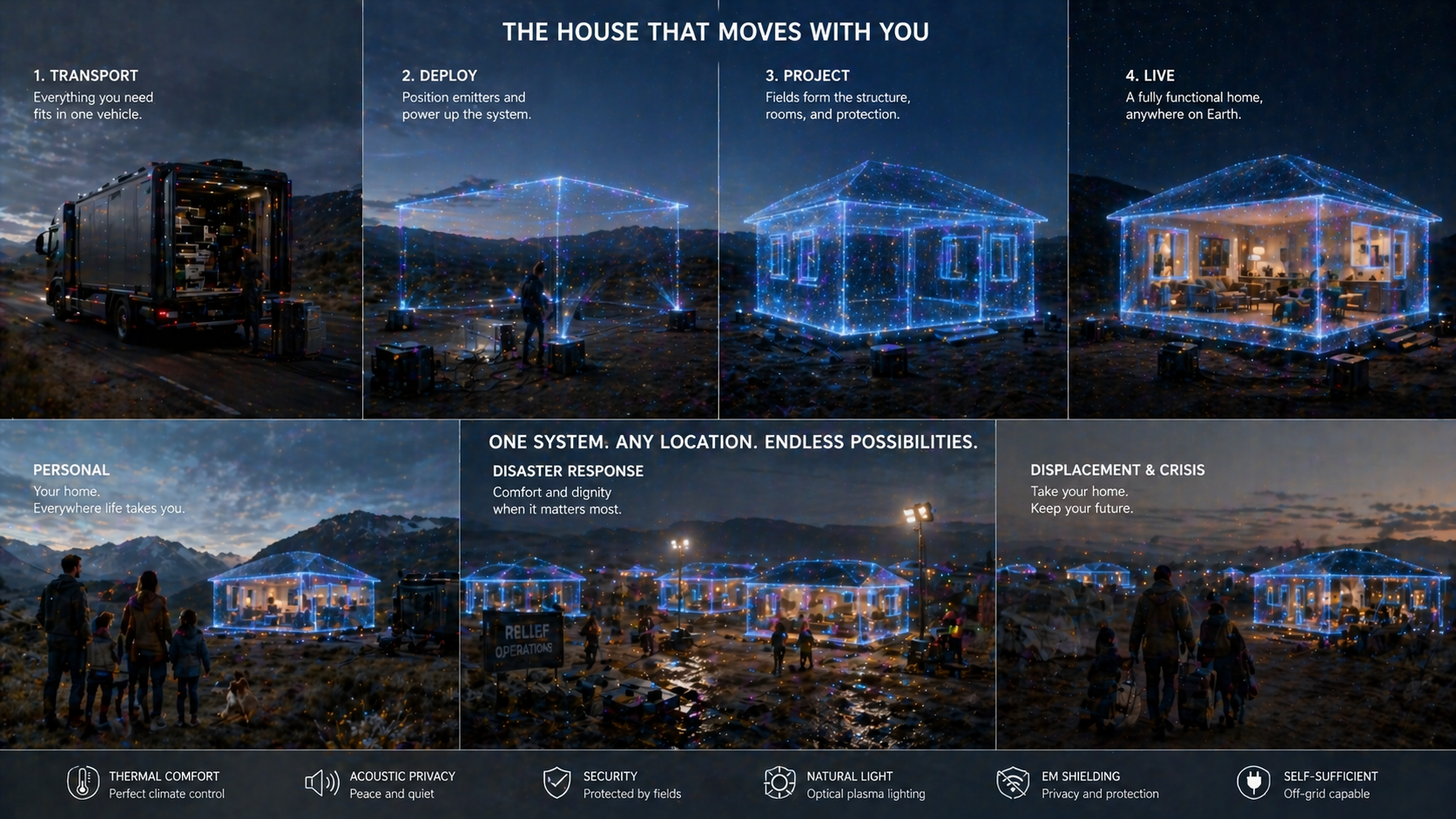
The emitter system that generates the field structure — a set of projector units that can be carried in a truck or even a large vehicle, deployed in a field or a parking lot or a mountaintop, and configured to generate the boundary fields in whatever shape the control system specifies — is the entire building. The land is a surface to rest the emitters on and to stand inside. The structure itself is the field.
Move the truck. Move the house.
This is not a camping tent or a mobile home. It is a structure with all the functional properties of a permanent building — thermal comfort, acoustic privacy, security, lighting, weather protection — that is simultaneously as mobile as a vehicle. The implications extend from the personal to the civilizational.
At the personal level: a family whose work requires relocation every few years no longer makes the sacrifice of leaving the home they’ve built. The home comes with them. The specific configuration of spaces, the familiar light quality, the acoustic character of the rooms — all of it is stored in the control system and reconstructed identically at the new location.
At the disaster response level: a projected house deployment system could establish fully functional temporary housing in hours rather than weeks. After a hurricane, after a wildfire, after an earthquake — field-based shelter systems could be deployed to affected areas, configured to house families in comfort, and redeployed when permanent construction is restored. The current choice between inadequate emergency shelter and expensive modular construction disappears.
At the geopolitical level: populations displaced by conflict, by climate, by economic collapse currently face the loss of not just their location but their shelter. A projected house system that is genuinely portable changes the calculus of displacement. The shelter is not the place. The shelter is the field generator. Take the generator; keep the house.
What You’d Actually Live In
I want to be concrete about the phenomenological reality of inhabiting a projected house, because abstract physics can make the experience seem alien when it would likely feel surprisingly normal.
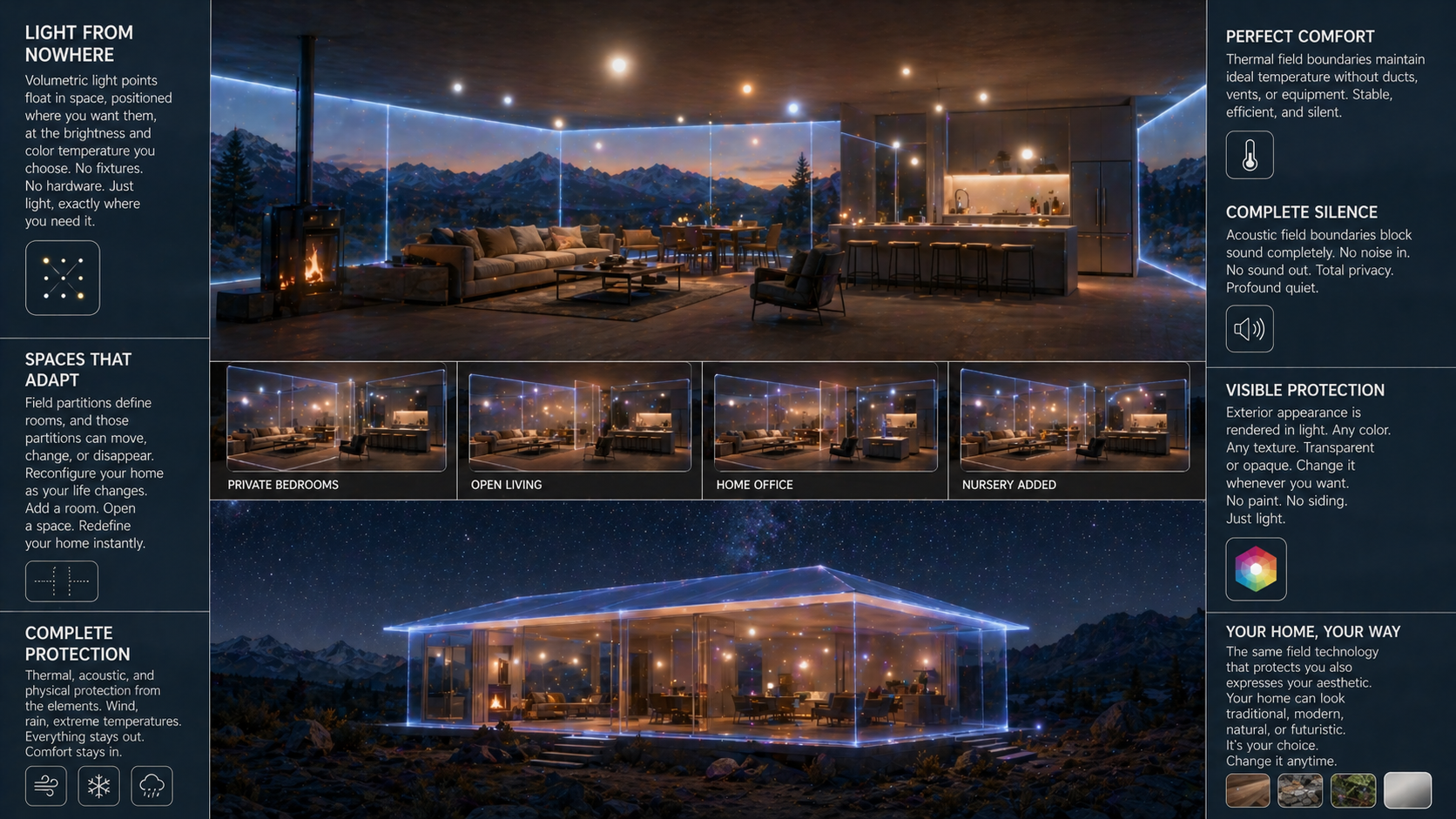
The interior would be lit by floating points of light — the volumetric lighting system described in the first column — positioned wherever the occupant chooses, at whatever intensity and color temperature suits the activity and the time of day. No fixtures on the walls because the walls themselves are fields. Light originating from empty space at the locations that make sense for the activity in the room.
The temperature would be stable regardless of external conditions, maintained by the thermal field boundary rather than by a heating or cooling system distributing conditioned air through ducts. The silence would be profound — acoustic field boundaries are more effective sound barriers than any physical wall, because they don’t transmit vibration the way solid materials do. External noise would not enter. Internal conversations would not exit.
The boundaries between rooms would be configurable. A field partition — a thinner, less physically resistant field boundary — could define a bedroom or a study or a bathroom, and that partition could be moved or dissolved by the occupant at will. The floor plan of the house would be reconfigurable without construction. A family with a new baby could add a nursery between breakfast and dinner. A couple whose children have left home could dissolve the walls between rooms and live in one large open space, restoring the subdivisions when guests arrive.
The exterior would appear solid in the sense that it would have a visual boundary — an optical component of the field would make the perimeter visible, configured to whatever aesthetic the occupant preferred. It could be transparent, offering a view of the landscape in all directions from inside while maintaining full privacy from outside. It could be opaque and white. It could be any color or texture the control system could render. The same surface that provides thermal and acoustic and physical protection could simultaneously display the equivalent of exterior cladding — rendered in light, changeable on demand, without paint or siding or any physical material.
The Fields Nobody Will Talk About
There is a conversation that will need to happen about projected house technology that the technology advocates will be slow to start.
If intersecting energy fields can define a private, secure, thermally comfortable, acoustically isolated space without physical construction, they can also define a space that is a prison. The same field that keeps rain out and intruders out can keep occupants in. A field boundary that requires an authorization signal to pass is a field boundary that can have that authorization revoked by whoever controls the system. The occupant’s ability to exit depends, in the field-based architecture, on the control system permitting exit.
This is not a hypothetical concern. It is the direct implication of the technology’s core capability. A building whose walls are configurable energy fields is a building whose walls can be reconfigured by whoever controls the energy systems. Questions of ownership, authorization, infrastructure dependency, and the rights of occupants become acute in ways that conventional construction — where the walls are physical and their existence does not depend on a continuous power supply and a functioning control system — does not raise.
The governance architecture for projected house technology will need to be as carefully designed as the field architecture. Occupants will need physical overrides. Control systems will need to be locally owned and locally operated rather than dependent on remote servers. The same conversation about infrastructure dependency that we’ve been having about smart home technology, about cloud storage, about software-as-a-service subscriptions — all of it applies here, at higher stakes because the service in question is the walls of your house.
A house that can be switched off by a landlord, a government, a creditor, or a hacker is a vulnerability that makes every previous housing insecurity look modest. Getting the governance right is not secondary to getting the physics right. It is equally important, and it needs to start before the technology is deployed rather than after.
The Timeline Nobody Can Honestly Name
The honest question at the end of this series is: how long?
The floating point of light — demonstrated in laboratory settings today, a commercial consumer product within years. The volumetric display — demonstrated in research settings, a commercial product within a decade for large-venue applications, probably fifteen years for consumer living-room scale.
The projected house — this is where intellectual honesty requires a longer view. The individual components are real and advancing. Acoustic levitation systems that can exert meaningful physical pressure on human-scale objects are not yet demonstrated. Thermal isolation fields at architectural scale are not yet demonstrated. The integration of multiple field systems into a coherent structural whole is not yet attempted.
What is demonstrated is the principle — that energy fields can produce physical effects at precisely defined locations in space without physical matter — and that principle is the same principle across all three columns in this series. The floating point of light proves that the physics permits it. The volumetric display demonstrates it at display scale. The projected house extrapolates it to architectural scale.
The extrapolation requires new engineering, new power systems, new control architectures, and new governance frameworks. It probably also requires a material science advance or two that I can’t predict from here. The timeline is decades rather than years.
But twenty years ago, the thought experiment that started this series — two invisible beams of energy crossing to produce a floating point of visible light — seemed about equally distant. It turned out the physics had already been proved in laboratories. The gap between the thought experiment and the reality was smaller than it looked from outside the field.
The gap between here and the projected house may be smaller than it looks from outside the field too.
The wall was the oldest human technology. The field that replaces it may be the most consequential.
Related Reading
Acoustic Radiation Force and the Physics of Field-Based Boundaries
Nature — The peer-reviewed physics of how focused acoustic fields create real mechanical force in space — the foundational science for the pressure-boundary component of field-based structural systems
Electromagnetic Shielding Without Physical Enclosures: The State of the Research
IEEE Spectrum — Current research on using configured electromagnetic fields to achieve shielding and isolation effects previously requiring physical enclosure — the energy-field approach to privacy, security, and thermal management at architectural scale
The Governance of Programmable Physical Space
Brookings Institution — A rigorous examination of the legal, ownership, and civil liberties questions raised when physical spaces are defined by software-controlled systems rather than physical construction — the governance framework that field-based architecture will urgently require