Farming is running out of land. The solution may not be better fields—but abandoning fields entirely and growing vertically, inside the earth.
By Futurist Thomas Frey
Agriculture has a geography problem.
The places where food grows best — flat, fertile, temperate, well-watered — are also the places where people want to live, build cities, and expand infrastructure. As the global population pushes toward ten billion, the competition between agriculture and development for the same arable land is intensifying in ways that traditional farming, no matter how optimized, cannot resolve. We are running out of the right kind of ground.
The idea I want to explore today reframes the question entirely. Instead of asking how to farm better on the land we have, it asks: what if we stopped thinking about land as the primary surface for agriculture altogether?
What if the growing surface was the wall of a cylinder, descending into the earth?
The Concept
The vision is deceptively simple in its architecture and radical in its implications.
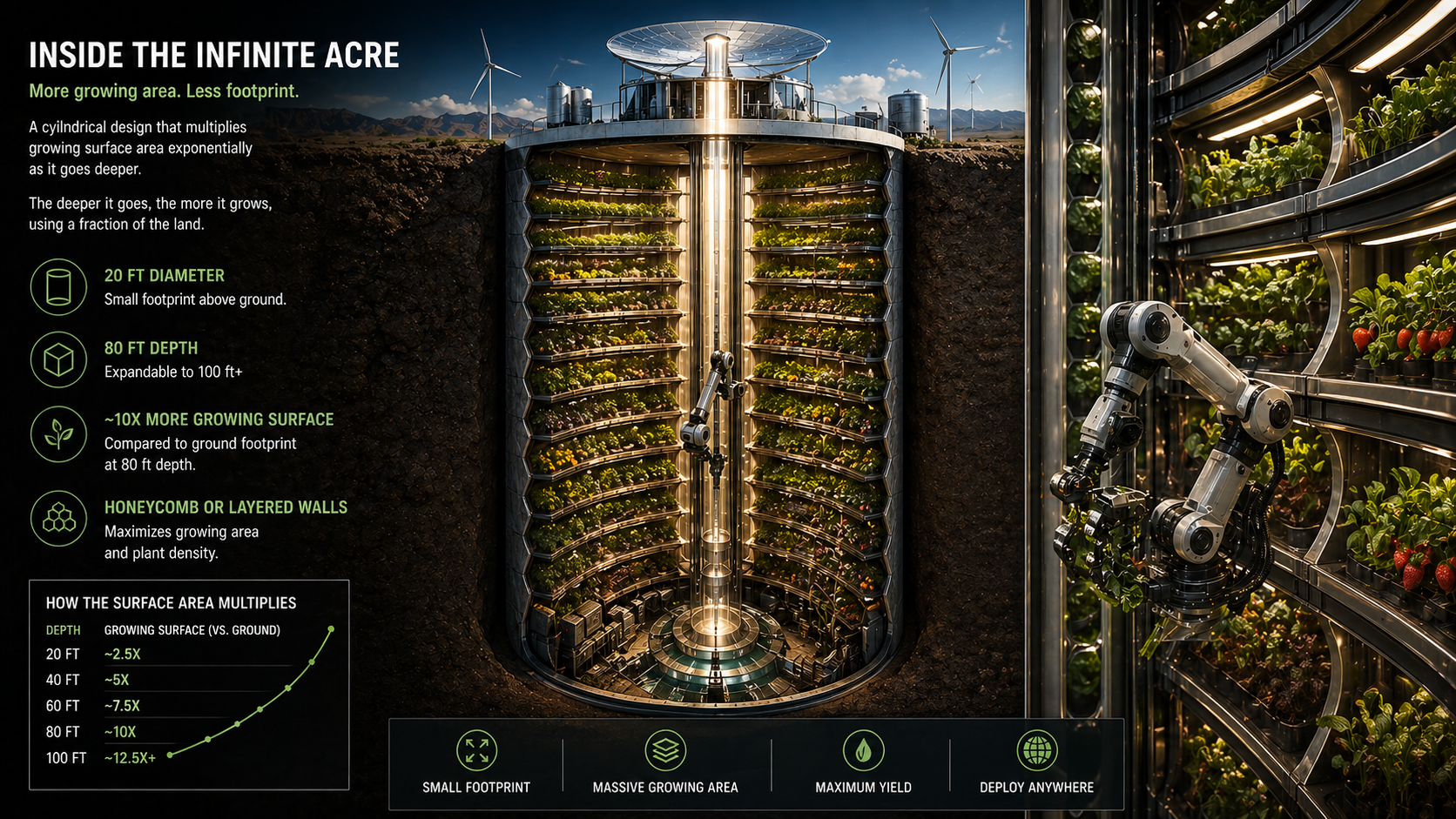
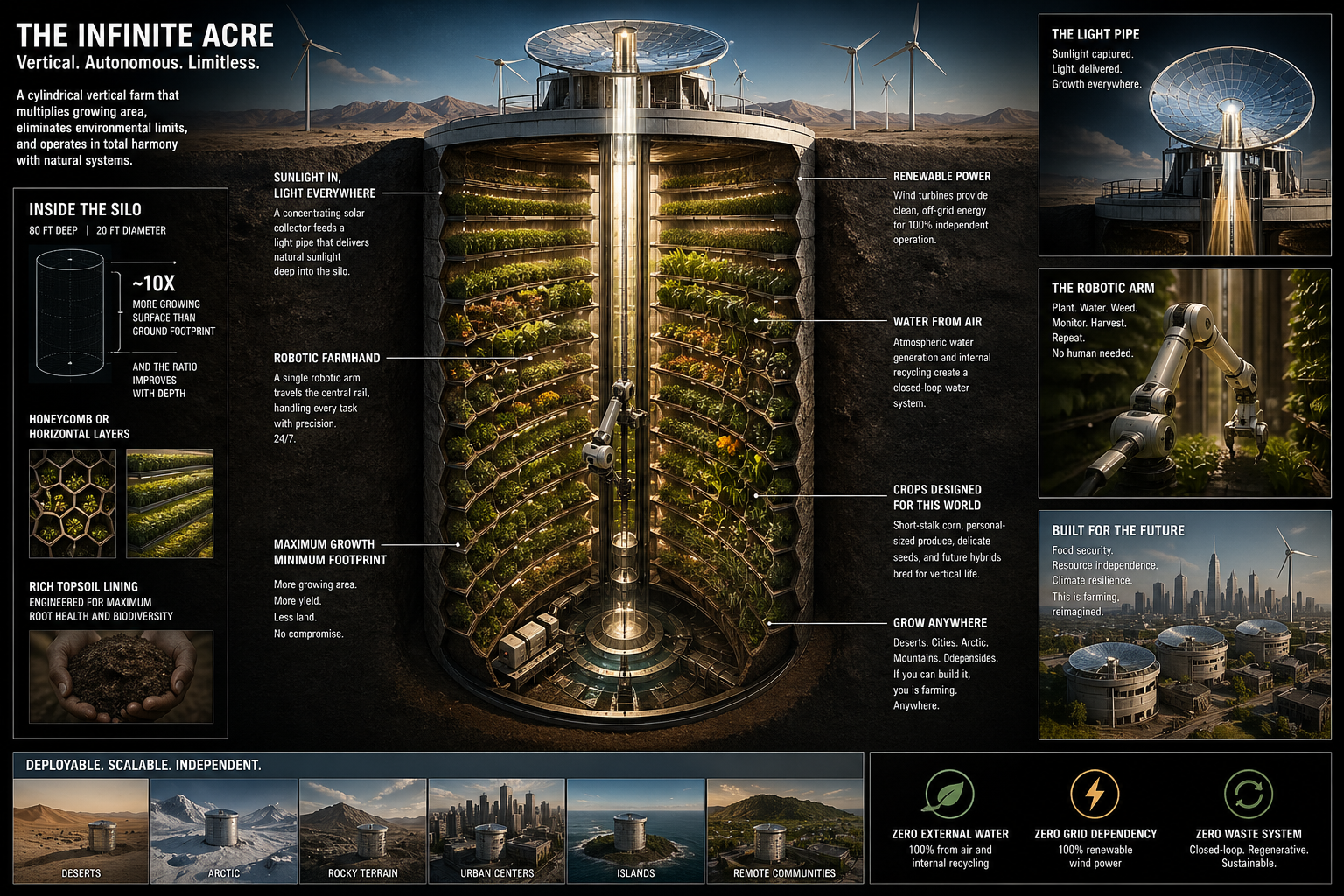
Imagine a cylindrical silo — some portions above ground, most of it below — with walls lined either in horizontal layers or honeycomb configurations, packed with rich topsoil. The cylinder descends perhaps 50 to 100 feet into the earth. Its interior surface area dwarfs the footprint of the opening at the surface. A structure with a 20-foot diameter and 80-foot depth has roughly ten times the growing surface of the ground it occupies — and that ratio improves with depth.
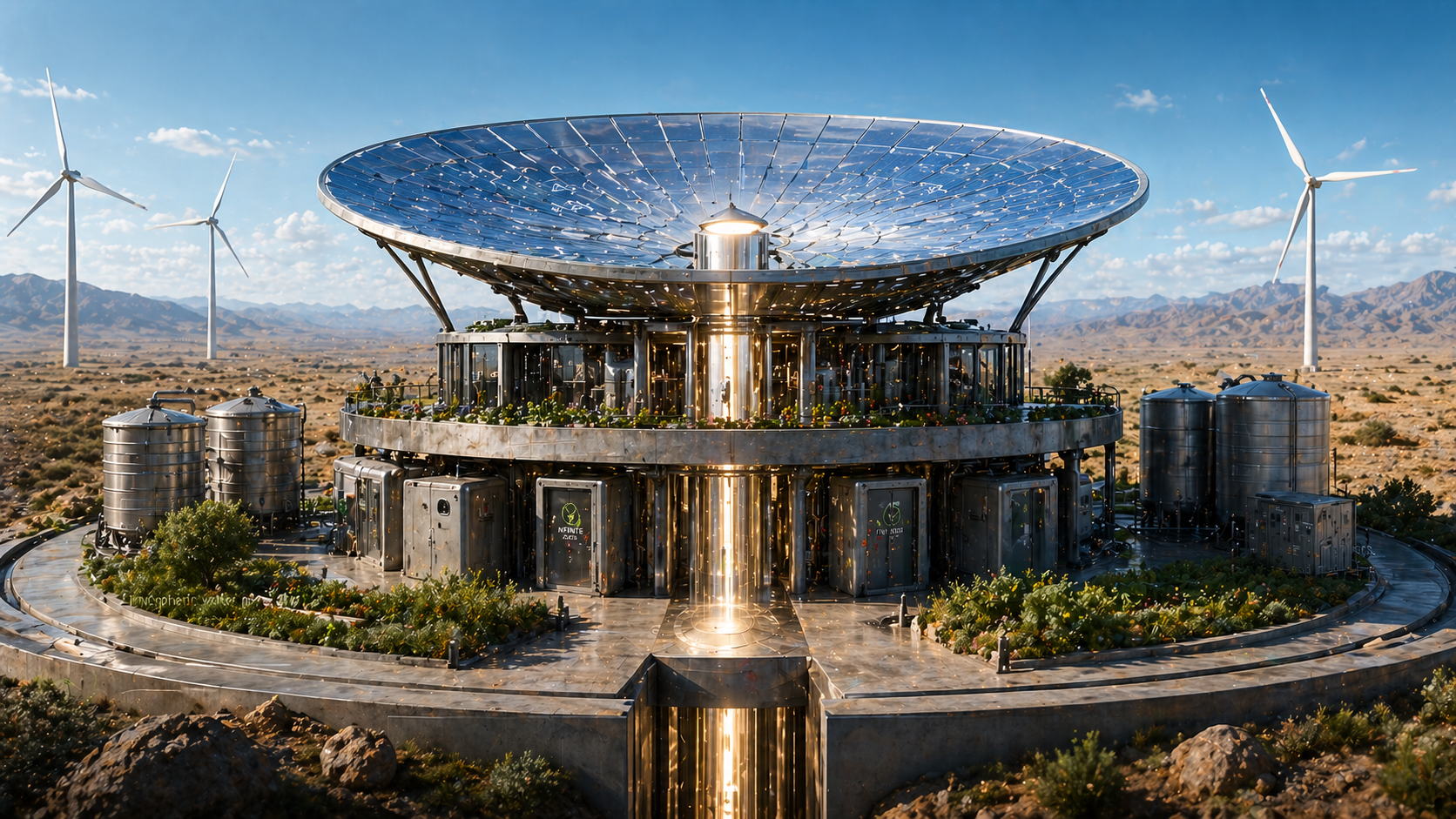
At the center of the cylinder runs a vertical shaft serving two simultaneous functions. First, it’s an optical channel — a light pipe that collects sunlight through a concentrating collector at the surface and distributes it down through the structure, providing natural illumination to growing surfaces that would otherwise never see the sun. Second, it’s the rail for a robotic arm that travels up and down the shaft performing every agricultural task: planting, irrigation, weeding, monitoring, harvesting, and post-harvest cleanup. One arm. One shaft. Fully automated, running around the clock, requiring no human presence inside the growing environment.
Power comes from external wind generators. Water comes from atmospheric moisture extraction — a condensation system that pulls humidity from the air and recycles evaporation from the growing surfaces themselves in a closed loop. The silo is, in principle, a self-contained agricultural ecosystem requiring no external water supply and no grid connection.
The crops it grows are purpose-designed for the environment: short-stalk corn bred for confined vertical spaces, personal-sized fruits and vegetables scaled for the wall surface and the robotic arm’s reach, fragile seed crops that benefit from the controlled, wind-free interior environment. Hybrid varieties that don’t exist yet, developed specifically for this growing context.
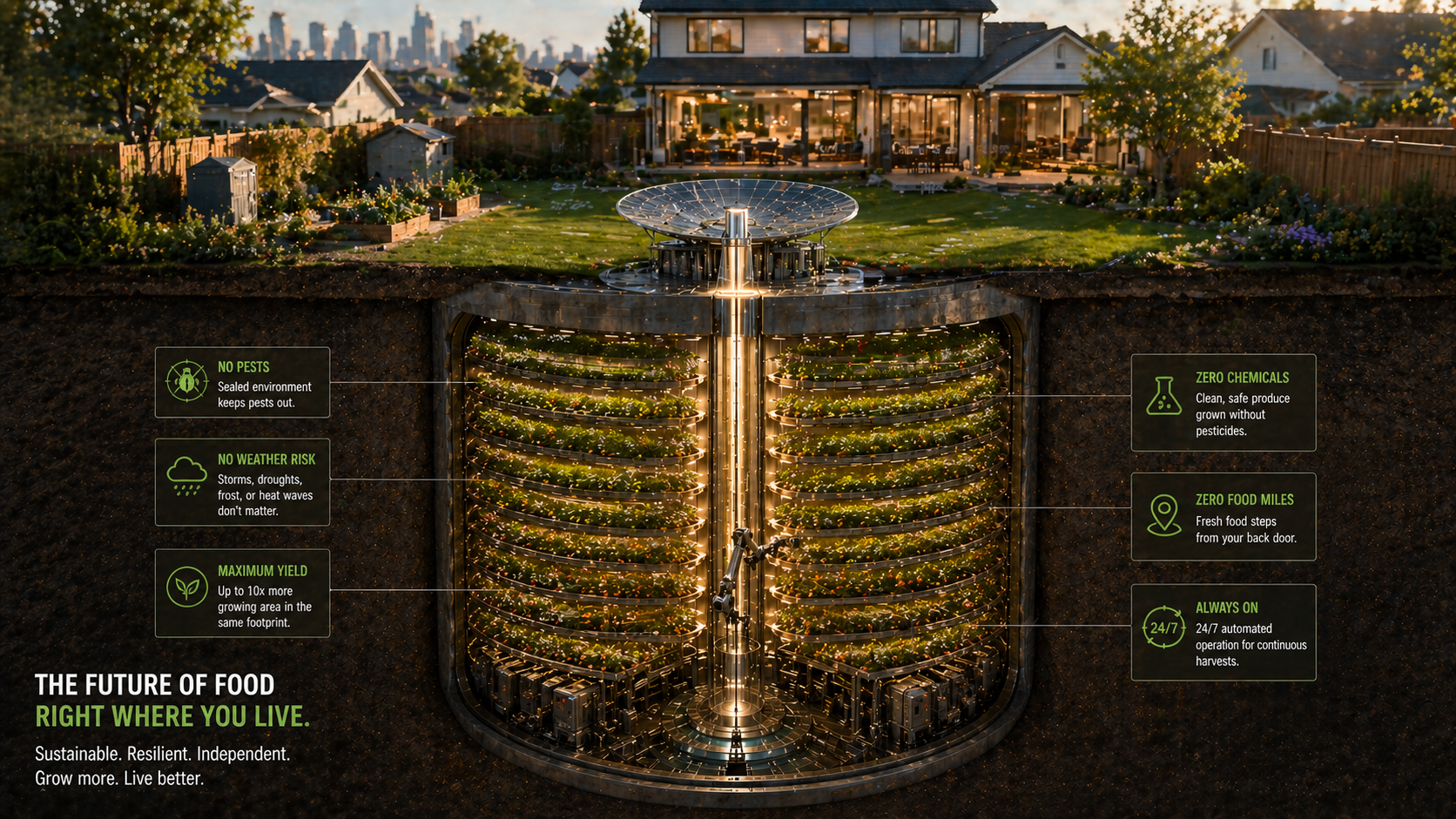
The result is a farming system that can be deployed in a desert, on rocky ground, in arctic conditions, in the middle of a city, or in any place where nothing currently grows. Not by adapting the farming to the environment — but by making the environment irrelevant.
Has Anyone Tried This?
The silo farming concept as fully described — cylindrical, underground, optically lit, robotically managed, atmospherically watered — does not yet exist as a deployed commercial system. It is a conceptual architecture waiting for its moment of assembly.
But every component of it has been developed, tested, and in many cases commercially deployed independently.
Vertical farming itself is a mature and rapidly expanding industry. Companies including Plenty, 80 Acres Farms, AeroFarms, and dozens of others are operating fully automated growing facilities at commercial scale, using robotic systems to handle everything from seeding to harvest without human intervention. Portland-based Canopii builds robotic greenhouses that can autonomously run the whole crop-growing process from seeding to harvest, producing up to 40,000 pounds of produce a year while requiring only one spigot of water. Plenty’s vertical farms use 1% of the land and 5% of the water required by traditional farming.
Underground growing environments are also established territory. Some common choices of structures to house vertical farming systems include buildings, shipping containers, underground tunnels, and abandoned mine shafts. Growing Underground in London operates a full commercial farm 33 meters beneath the streets of Clapham, in disused World War II air raid tunnels, producing herbs and microgreens year-round. The constant underground temperature eliminates heating and cooling costs, and the absence of pest pressure removes the need for pesticides entirely.
Atmospheric water generation — extracting moisture from air — is a working technology deployed in water-scarce environments worldwide, improving in efficiency each year as materials science advances. Solar light-piping systems that channel daylight into interior spaces through fiber optic or reflective tube systems are commercially available, though scaling them to the depths a deep silo would require remains an engineering challenge. The robotic arm performing multi-task agricultural operations on curved surfaces is the most novel component, but the underlying robotics — precision manipulation, computer vision for plant identification, autonomous rail navigation — are all mature technologies being combined in new ways across the existing vertical farming industry.
What hasn’t happened is someone assembling all of these components into the specific cylindrical silo architecture. That assembly is the innovation.
The Advantages That Matter Most
The headline advantage is surface area multiplication. This is the concept’s fundamental insight, and it’s geometrically real. Traditional farming is constrained by horizontal surface — you can only grow on the land you have. A cylindrical silo with lined walls converts a small footprint into a much larger growing surface, and that conversion scales with depth. A network of silos beneath a city or a desert creates agricultural capacity where none previously existed, without competing with any existing land use.
The second advantage is environmental independence. A self-contained silo with atmospheric water collection and wind power is not dependent on rainfall, soil quality, temperature range, or any of the variables that currently constrain where agriculture is possible. Deploying food production in the Sahara, the Gobi, the Arctic, or the middle of a megacity becomes an engineering question rather than an agricultural one. The implications for food security in climate-stressed, water-scarce, or densely populated regions are significant.
The third advantage is year-round production at constant yield. Underground environments maintain stable temperatures regardless of season. Controlled light and water delivery eliminates weather dependency. The silo farm produces the same output in January as in July, in drought as in flood. The volatility that currently makes food supply chains fragile and food prices unpredictable is structurally eliminated.
The fourth advantage is automation efficiency. A single robotic arm in a cylindrical geometry — moving up and down a central shaft with full access to every point on the surrounding wall — is a more elegant automation problem than the multi-robot, multi-track systems required in rectangular warehouse-style vertical farms. The geometry concentrates all agricultural tasks into a single axis of movement.
The Challenges Worth Naming Honestly
The light distribution problem is the most technically demanding. Getting meaningful photosynthetically active light to crops on the walls of a deep cylinder requires either a highly efficient optical channeling system or supplemental LED lighting. Current solar light pipe technology works well for shallow depths — skylights and daylighting systems operate in the 10 to 30 foot range. Getting concentrated sunlight to the bottom of an 80-foot shaft at sufficient intensity for plant growth is a materials and optics challenge that has not been fully solved at commercial scale. The economics of LED supplementation at depth would need to be carefully modeled to maintain the energy self-sufficiency advantage.
Root depth is a constraint for many high-value crops. Wall-mounted growing in a honeycomb configuration works well for shallow-rooted plants — leafy greens, herbs, strawberries, microgreens — which happen to be among the highest-value and fastest-cycling crops in the vertical farming industry. The short-stalk corn and personal-sized fruit varieties described in the concept require hybrid development that doesn’t yet exist but is technically achievable through plant breeding programs, including AI-assisted genomic design.
The robotic arm’s range and precision requirements are demanding. Performing the full spectrum of agricultural tasks — distinguishing ripe from unripe, applying the correct irrigation rate to each plant at each growth stage, extracting a ready crop without disturbing adjacent plants — across a curved three-dimensional surface, at varying depths, in changing light conditions, is a more complex manipulation problem than the linear-track systems in current commercial vertical farms. Achievable with current robotics capabilities, but requiring purpose-built systems rather than adapted existing ones.
The economics of silo construction, particularly the below-ground portion, require careful analysis relative to surface-based alternatives. Boring or excavating cylindrical shafts at scale is established technology — mining, tunneling, and utility boring industries have solved this problem in various forms — but the capital costs per silo need to be justified by the productivity and geographic flexibility advantages relative to surface alternatives.
What the Next Steps Look Like
The pathway from concept to deployed system runs through a sequence of progressively more complex demonstrations.
A shallow proof of concept — a 15 to 20 foot silo, above ground or partially buried, with wall-mounted growing surfaces, a prototype robotic arm, and manual lighting — would validate the core geometry and robotics challenge without requiring the full underground infrastructure or optical light distribution system. This is buildable with current technology and current capital.
The optical light distribution system warrants dedicated engineering development. High-efficiency concentrating collectors paired with reflective or fiber-optic light tubes that can deliver usable photosynthetic radiation to 50-foot depths would be a standalone valuable technology applicable to multiple industries beyond agriculture — and the engineering challenge is well-defined enough to be attacked directly.
Parallel crop development — breeding programs focused on short-stalk, wall-adapted varieties of high-value crops — can proceed independently of the silo hardware development. AI-assisted plant breeding is already accelerating variety development timelines dramatically.
The most compelling near-term deployment target is the application where the concept’s unique advantages are most clearly unmatchable: remote and extreme environments. A mining operation in a remote desert region, a scientific station in an arctic environment, a military forward operating base, an island community with no arable land — any of these represents a context where the silo farm’s geographic independence is not just advantageous but potentially the only viable food production option. Demonstrating the concept in one of these environments, where the comparison isn’t “silo versus conventional farming” but “silo versus expensive imported food,” changes the economic calculation entirely.
Farming as the Coolest Profession on Earth
There is a larger frame around all of this that deserves to be named directly.
The historical narrative of farming is one of diminishing status — a profession that talented young people leave rather than enter, that struggles to attract the next generation of practitioners, that is associated with physical hardship and economic precarity rather than innovation and mastery.
The silo farm, fully realized, inverts that narrative completely. The person managing a network of silo farms is not a field laborer. They are an operator of a sophisticated autonomous system integrating robotics, optical engineering, atmospheric chemistry, genomics, and precision agriculture. They are producing food in places where no food was possible before. They are solving one of the most important problems on Earth — how to feed ten billion people on a planet where the arable land isn’t expanding — using tools that require some of the deepest interdisciplinary expertise in the modern economy.
Vertical farming has matured into a multi-billion-dollar segment of controlled environment agriculture, with AI, robotics, and LED efficiency driving productivity and lowering costs. The silo farm concept extends that trajectory into its most ambitious and most geographically flexible form.
The future of agriculture isn’t in the field. It’s in the cylinder. And the people who figure out how to build and operate what’s in that cylinder will be doing some of the most consequential work on the planet.
Farming is about to become the coolest profession on earth. The silo is where it starts.
Related Reading
Growing Underground: The London Farm 33 Meters Below the Street
Growing Underground — The operational story of the world’s most established deep underground commercial farm, producing herbs and greens year-round in disused WWII tunnels beneath London — the closest existing proof of concept for underground agriculture at commercial scale
The Vertical Farming Economics Problem — and How It Gets Solved
TechCrunch — How the latest generation of robotic greenhouse companies is attacking the unit economics that have challenged earlier vertical farming ventures, and what the path to profitability actually requires
Food Security in Extreme Environments: The Case for Off-Grid Agriculture
World Economic Forum — An analysis of why geographically independent food production systems are becoming a strategic priority for food-insecure regions, remote communities, and climate-stressed agricultural zones — the strongest deployment case for silo farm technology