Fungi are remarkable lifeforms that challenge conventional ideas of intelligence. Despite lacking brains, these organisms exhibit signs of decision-making and communication. But just how complex are they, and what insights can they provide into other forms of awareness? A team of researchers from Japan’s Tohoku University and Nagaoka College sought to explore these questions through an intriguing experiment on the cord-forming fungus Phanerochaete velutina. Their study, published in Fungal Ecology, reveals that fungi can “recognize” different spatial environments and adjust their growth strategies accordingly.
While fungi are often recognized by their aboveground mushrooms, these are merely the surface manifestation of a vast underground network known as mycelium. These intricate webs stretch for miles beneath the soil, capable of transmitting environmental information throughout the network. Yet, the growth of mycelium doesn’t appear random—it seems to follow a deliberate, calculated pattern.
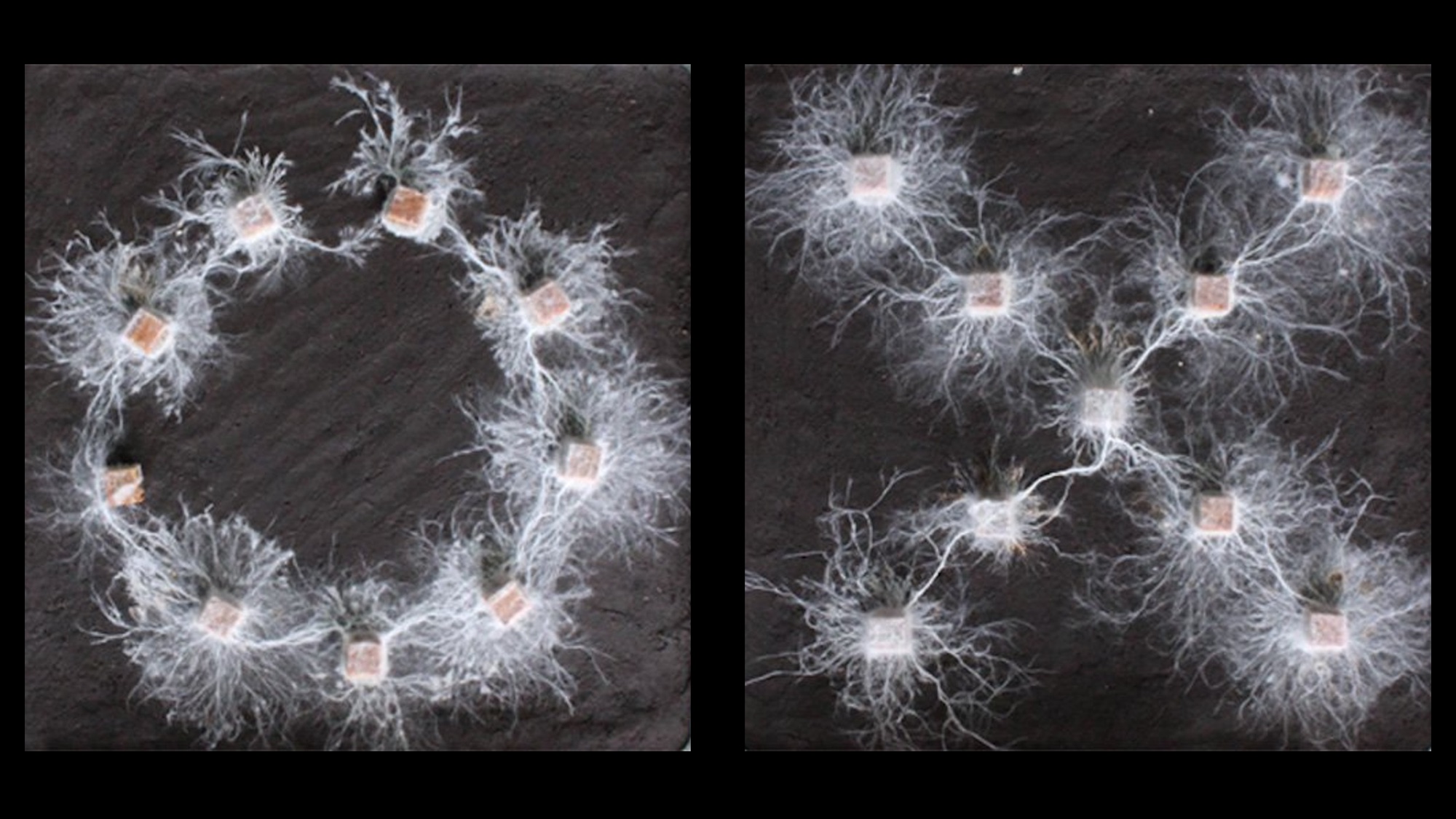
To test this, researchers set up two 24-cm-wide square environments filled with soil and soaked wood blocks in P. velutinaspores for 42 days. The wood blocks were then arranged either in a circular or cross-shaped pattern. Over the next 116 days, the team observed how the fungus expanded in each setup, looking for signs of decision-making.
Initially, the mycelium grew outward from each block, avoiding connections for the first 13 days. By around the 30-day mark, the fungal networks in both arrangements had formed dense webs connecting all the wood samples. However, by day 116, a striking transformation had occurred: the fungal networks reorganized into clearly defined, intentional pathways. In the circular setup, the mycelium grew uniformly outward but avoided the interior of the ring. In contrast, the cross-shaped setup saw fungi extending from the four outermost blocks as if using them as “outposts” for resource foraging.
The researchers theorize that in the circular environment, the fungus determined there was no need to waste energy on areas it already occupied. Meanwhile, in the cross setup, the outer blocks served as strategic hubs for further growth. These findings suggest that P. velutina can communicate through its mycelial network, making decisions based on its environment, despite having no central nervous system.
“You’d be surprised at just how much fungi are capable of. They have memories, they learn, and they can make decisions,” said Yu Fukasawa, a study co-author at Tohoku University. “The differences in how they solve problems compared to humans is mind-blowing.”
While much remains to be uncovered about these often-overlooked organisms, ongoing research may not only deepen our understanding of fungi but could also provide insights into the evolutionary history of consciousness. This growing body of knowledge might even pave the way for the development of advanced bio-based computing systems in the future.
By Impact Lab