
By Futurist Thomas Frey
How a robot-first lunar economy could unfold — and why what happens 240,000 miles away will reshape life on Earth
The Moment Everything Changed
On April 1, 2026, NASA is scheduled to launch Artemis II — four astronauts on a ten-day journey around the Moon, the first humans to travel beyond Earth’s orbit since Apollo 17 in 1972. They won’t land. They’ll fly the Orion spacecraft within 8,889 kilometers of the lunar surface, loop around it, and come home. But that modest circumnavigation is not the real story.
The real story is what’s already happening in boardrooms, government offices, and engineering labs around the world as people prepare for what comes after. Artemis IV, targeting 2028, will put humans on the lunar surface for the first time in half a century. Artemis V, also planned for 2028, is when NASA expects to begin building its Moon base. Annual lunar landings follow after that. And in the shadow of all that activity, an economic question that once belonged to science fiction is becoming a business plan: what, exactly, is the Moon worth — and to whom?
The answer is turning out to be extraordinary. And the path to getting there will look nothing like the Apollo era.
Why the Moon — and Why Now
The Moon’s economic case rests on three things it has in abundance: water ice, helium-3, and proximity to Earth. Each of those is more strategically important than it sounds.
The lunar south pole is believed to hold significant deposits of water ice locked in permanently shadowed craters that haven’t seen sunlight in billions of years. Water on the Moon is not primarily valuable as drinking water — it’s valuable as rocket fuel. When you split water into hydrogen and oxygen through electrolysis, you get the two components of the most powerful chemical propellant we know how to produce. A Moon with water is, in effect, a fueling station 240,000 miles from Earth — and a staging base for every mission going deeper into the solar system. Anyone who controls the lunar fuel supply controls the logistics of cislunar space. That is why NASA Administrator Jared Isaacman recently said, of the race with China to the south pole, “I’ll be damned if China gets there first.” This isn’t science. It’s infrastructure strategy.
Helium-3 is the more exotic prize — and the one that is already attracting serious commercial contracts right now, years before anyone has landed a mining robot. Because the Moon has no atmosphere and no magnetic field, the solar wind has been implanting helium-3 directly into the lunar regolith for billions of years. Earth has almost none of it — our entire annual supply, produced as a byproduct of nuclear stockpiles, amounts to roughly 8,000 to 10,000 liters. The Moon may hold hundreds of thousands of tons. At current prices of approximately $20 million per kilogram, that is a staggering reserve. And demand is climbing fast: quantum computers require helium-3 to cool their hardware to near absolute zero, and as quantum data centers scale — one facility potentially consuming more helium-3 than exists on Earth — lunar supply becomes not a luxury but a necessity. Seattle-based Interlune has already signed contracts to deliver lunar helium-3 by 2029, with Finnish cryogenics company Bluefors agreeing to purchase up to 1,000 liters annually in a deal worth an estimated $300 million. The U.S. Department of Energy made the first-ever government purchase of an extraterrestrial resource in mid-2025 — three liters of lunar helium-3, designed to seed supply chains and signal strategic commitment.
And then there is proximity. The Moon is three days away at current technology. Mars is months away. The Moon is close enough to manage remotely, close enough to supply regularly, close enough to evacuate from in an emergency. As a first off-Earth economic frontier, nothing else comes close.
Robots First — Always
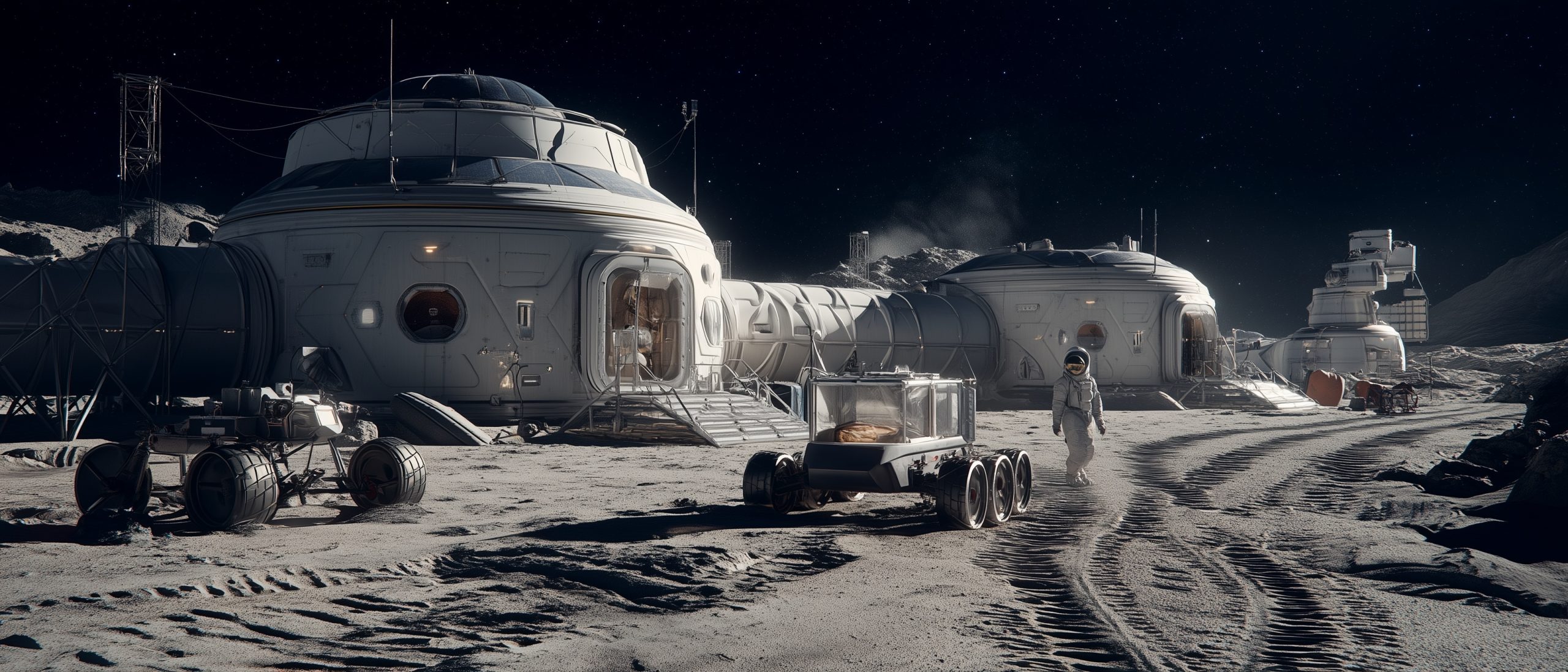
The most important thing to understand about the lunar economy is that humans will not build it. Robots will. This isn’t idealism — it’s logistics and economics.
Keeping a human being alive on the Moon costs an enormous amount of money and creates constraints that make no sense for industrial operations. Every kilogram of food, water, and air shipped from Earth consumes resources that could otherwise carry equipment. The lunar day lasts two Earth weeks, followed by two weeks of night where temperatures swing 300 degrees Celsius — conditions that are merely inconvenient for a robot and potentially lethal for a human. The communication delay between Earth and Moon runs about 2.6 seconds round-trip — long enough to make real-time teleoperation clumsy but short enough for autonomous robots with AI decision-making to operate effectively with ground supervision. The lunar surface is covered in a fine, abrasive dust — regolith — that gets into every mechanism, degrades every seal, and is the enemy of human spacesuits. Robots can tolerate it far better than people.
The robot-first lunar economy will unfold in layers. The first layer is surveying and prospecting — autonomous rovers mapping the distribution of water ice, helium-3 concentrations, rare earth element deposits, and stable terrain for construction. This work is already happening. Firefly Aerospace’s Blue Ghost lander touched down on the Moon in March 2025, followed by Intuitive Machines’ Nova-C just days later. Australia plans to land a mining rover in 2026 as part of NASA’s Commercial Lunar Payload Services program, specifically designed to extract oxygen from regolith and test In-Situ Resource Utilization — the practice of using what you find on the Moon rather than shipping everything from Earth.
The second layer is extraction and processing. Interlune’s full-scale excavator prototype, built with industrial equipment manufacturer Vermeer, can process up to 100 metric tons of lunar regolith per hour. The process involves thermal heating — concentrated solar energy or compact nuclear reactors baking the regolith above 800 degrees Celsius to release trapped gases including helium-3 — followed by separation and storage. Water ice extraction uses different methods: drilling, heating, and electrolysis to split it into hydrogen and oxygen. NASA’s PRIME-1 experiment successfully tested its TRIDENT drill on the lunar surface in 2025, validating the extraction approach. The third layer — construction — comes later: robots using lunar regolith as a building material to 3D print habitats, roads, and landing pads, reducing the need to ship structural materials from Earth at all.
The Data Center in the Sky
One of the most surprising economic ideas gaining serious traction is placing AI data centers on the Moon or in lunar orbit — and when you understand the physics, it stops being surprising.
The two primary constraints on data center growth on Earth are power and cooling. AI compute is extraordinarily energy-intensive, and heat dissipation at scale requires enormous infrastructure — water cooling systems, massive HVAC, dedicated power substations. In space, you have virtually unlimited solar power and the vacuum itself as a heat sink. SpaceX has already filed with the FCC to launch up to one million orbital data center satellites, as covered in my earlier column on Terafab. Elon Musk has explicitly described a future where AI data centers on the Moon are launched into orbit using electromagnetic mass drivers powered by solar energy — bypassing chemical propulsion entirely. The physics are real. The timeline is longer than the proponents suggest. But the direction is clear: as AI compute demand continues to compound, the ceiling of what Earth can physically support will be reached. The Moon is the next floor.
What makes this specifically lunar rather than simply orbital is the combination of abundant solar power, proximity to helium-3 for quantum cooling, the Moon’s low gravity making launch costs significantly lower than from Earth (escape velocity is just 2.38 km/s versus 11.2 km/s on Earth), and eventually the ability to manufacture data center components using lunar materials rather than shipping them from Earth. It is a long arc. But the arc is bending in a specific direction.
The Pioneers
Who will build the lunar economy? The answer, already visible in current contract and mission activity, is a layered coalition of nations, agencies, and private companies — and the coalition is more competitive than cooperative.
The United States leads in infrastructure and legal framework. NASA’s Artemis program, backed by $20 billion allocated for a lunar base, provides the governmental anchor. The Artemis Accords — signed by over 40 nations — establish norms for resource extraction, safety zones, and transparency. More importantly, the 2015 U.S. Commercial Space Launch Competitiveness Act gave American citizens the right to own resources they extract from space, providing the legal foundation for a private lunar economy that no treaty had previously allowed.
The commercial pioneers are moving fast. Interlune — founded by former Blue Origin CEO Rob Meyerson — is the most advanced helium-3 mining venture, with excavator prototypes, signed purchase agreements, and a 2027 mission to validate lunar helium-3 concentrations before a 2029 pilot plant deployment. Blue Origin, through Project Oasis, is mapping lunar resources from orbit at ultra-high resolution. Astrobotic is developing landing systems. ispace is building rovers. Intuitive Machines already has operational lunar missions. SpaceX provides the launch infrastructure that makes all of it economically plausible — Starship’s reusability fundamentally changes the cost calculus of getting to the Moon from ruinously expensive to merely expensive, and eventually to routine.
China is pursuing a parallel track entirely — not just competing but explicitly building an alternative to the U.S.-led system. China aims for human lunar landings by 2030 and an International Lunar Research Station by 2035, developed in partnership with Russia, Pakistan, and others who have not signed the Artemis Accords. Half of the 450 lunar missions projected for 2033 are expected to be commercial, with $151 billion in projected revenue. China accounted for 90 percent of global humanoid robot shipments last year — the same manufacturing dominance it achieved in EVs — and intends to apply that approach to space hardware. This is not a scientific competition. It’s a race to control the logistics infrastructure of cislunar space before the legal norms are fully set.
The Hardest Problems
The lunar economy faces obstacles that don’t yield to enthusiasm or investment alone. They’re engineering and governance problems of genuine difficulty.
Lunar dust is the most underappreciated problem. Regolith particles are sharp, fine, electrostatically charged, and pervasive. Unlike Earth dust, which has been worn smooth by wind and water, lunar regolith is jagged at the microscopic level. It gets into everything — optical sensors, mechanical joints, solar panels. Apollo astronauts found it coating their suits after just hours on the surface. For an autonomous robot expected to operate for months or years, dust management may be as important as locomotion or AI decision-making. No one has fully solved it yet.
Power during the lunar night is the second existential constraint. Solar panels work beautifully during the two-week lunar day, but the two-week lunar night is an operational void for solar-powered systems. Compact nuclear reactors — NASA has been developing fission surface power systems for exactly this reason — provide the answer, but deploying and operating nuclear power systems on the Moon adds regulatory, safety, and technical complexity that has no precedent. The nation or company that gets reliable all-cycle power working on the Moon first gains an enormous positional advantage over everyone who doesn’t.
Legal governance is the third problem, and arguably the most urgent. The 1967 Outer Space Treaty prohibits national sovereignty over the Moon but says nothing definitive about resource extraction. The result is a patchwork of national laws, the non-binding Artemis Accords, and competing claims that could create real conflict as commercial operations scale. As SpaceNews observed: the entity that leads in operationalizing ISRU will control the lunar logistics chain — and that’s a geopolitical prize too valuable to leave to informal norms.
What This Means for Life on Earth
Every major expansion of the human economic frontier has cascaded back onto Earth in ways the pioneers didn’t fully anticipate. The industrial revolution transformed not just manufacturing but cities, families, politics, and philosophy. The internet didn’t just change communication — it restructured commerce, media, education, and social organization. A functioning lunar economy will do the same, and the effects will be visible long before the first lunar factory ships its first product.
The most immediate effect is on energy. If helium-3 mining reaches commercial scale — and the combination of quantum computing demand and long-term fusion energy development makes this likely over a 20 to 30-year horizon — it fundamentally changes the energy equation. Deuterium-helium-3 fusion produces almost no radioactive waste and generates energy as charged particles rather than neutrons, enabling direct electricity conversion at efficiencies conventional fission cannot match. A kilogram of helium-3 yields as much energy as burning approximately 15 million kilograms of coal. The geopolitics of energy, which have defined global conflict for a century, become a very different calculation when the fuel comes from a satellite that no single nation owns.
The second effect is on manufacturing and materials. Technologies developed for In-Situ Resource Utilization — extracting oxygen from regolith, 3D-printing structures from lunar dust, managing extreme temperature cycles with minimal maintenance — will transfer back to Earth applications in mining, construction in extreme environments, and disaster response. The same robot that learns to operate in the unforgiving conditions of the lunar surface is being trained, in effect, for the most demanding industrial deployments on Earth as well. The Robot Olympics discussed in my previous column are not unrelated to this — the humanoid robots learning to work in environments they weren’t designed for are the same platforms that will eventually staff the early lunar outposts.
The third effect — the most profound and the hardest to model — is psychological. Humanity has spent its entire existence as a single-planet species. Every war, every resource conflict, every civilizational rise and fall has happened on one rock, with one atmosphere, within one gravitational well. The moment a permanent human economic presence exists on another world — even a modest, robot-heavy, resource-extraction presence — the cognitive frame of what we are changes. Not immediately. Not for everyone. But the premise of scarcity that underlies so much of human conflict — that there is only so much land, so much resource, so much room — begins, slowly, to feel less absolute.
The Artemis II crew launching this April will fly around the Moon and come home. They won’t mine anything, build anything, or stay longer than ten days. But they will look back at Earth from 240,000 miles away — the same view the Apollo crews described as the most perspective-shifting moment of their lives — and when they return, the world they describe will be a world with a future on more than one world. That shift in perspective is not separable from the economic one. The Moon is not just open for business. It is open for the kind of thinking that every great economic frontier eventually produces: the realization that the limits we assumed were permanent were only temporary, and that the next chapter is bigger than the one we’re finishing.
Resources, Reactors and Rivalries Will Decide the New Moon Race
SpaceNews — The geopolitical and commercial stakes of lunar resource control, including helium-3 and water ice
Helium-3 Mining on the Moon: A New Frontier for Science and Geopolitics
Interesting Engineering — The science, business case, and current contract activity around lunar helium-3
NASA Strengthens Artemis: Adds Mission, Refines Overall Architecture
NASA — The updated Artemis mission sequence, timeline, and long-term lunar base plans through 2028 and beyond