
Polar Shifts, Tectonic Forces, Ocean Currents — The Planet’s Future Is Already Written in Its Physics
By Futurist Thomas Frey
The Planet Has Its Own Agenda
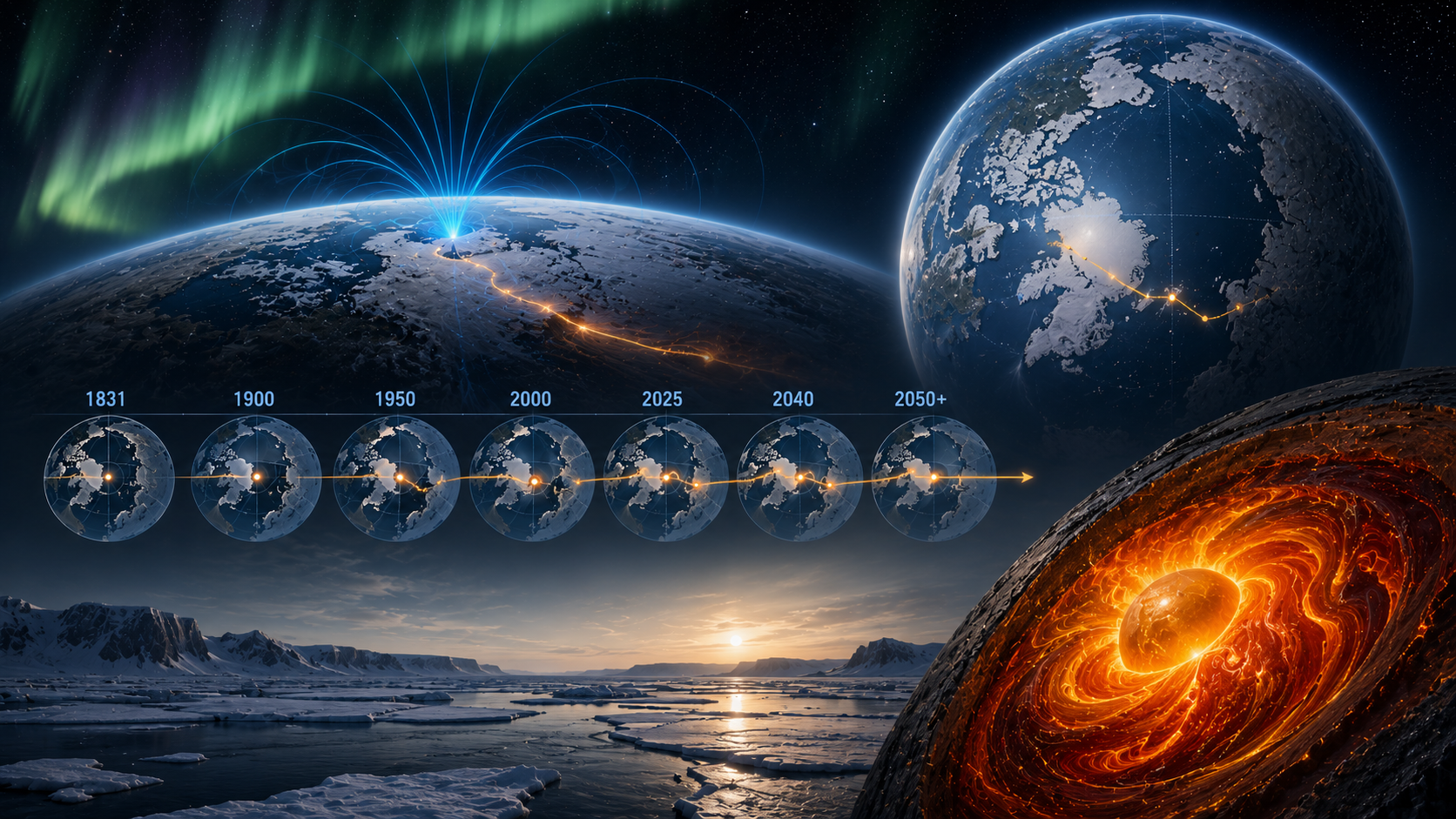
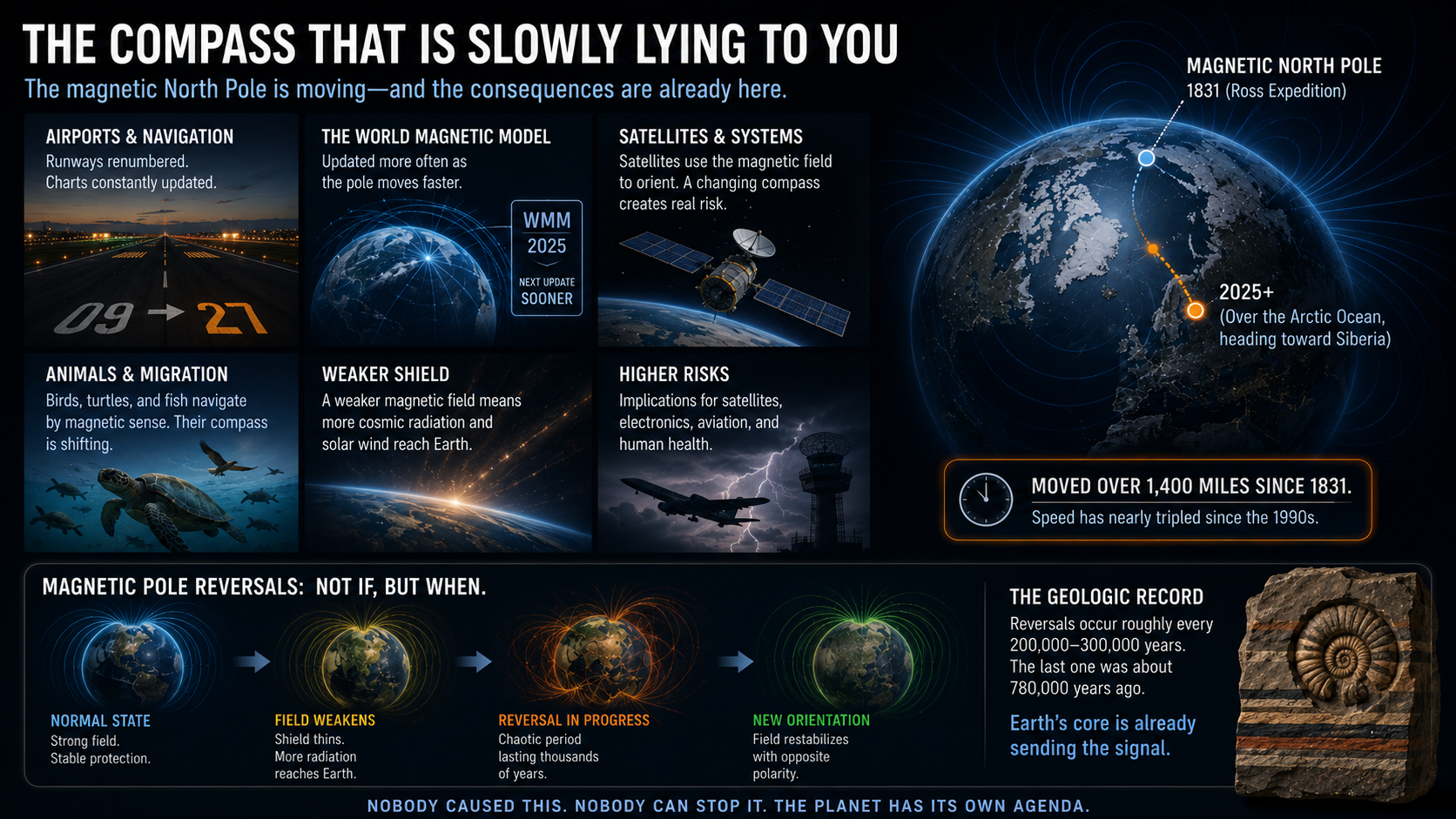
Sometime in the next few decades — possibly sooner, possibly later, but with a geological certainty that no committee vote or policy decision will alter — the magnetic North Pole will continue its accelerating journey across the Arctic. It has already moved more than 1,400 miles since systematic tracking began in 1831, when explorer James Clark Ross planted a flag in the Canadian Arctic and declared he had found it. Today that flag would be underwater, hundreds of miles behind the pole’s current position somewhere over the Arctic Ocean, racing toward Siberia at a pace that has nearly tripled since the 1990s.
Nobody caused this. Nobody can stop it. No election will reverse it, no technology will pause it, no economic cycle will slow it. The movement of the magnetic pole is driven by fluid dynamics in Earth’s outer core — churning rivers of molten iron thousands of kilometers below our feet, operating on timescales and by physics that have nothing to do with human civilization. It was in motion before our species existed. It will be in motion long after whatever we build on the surface has been erased.
This is the second signal we need to learn to read in this series about a future already in motion: the planet itself. Earth is not a stable stage on which human events are performed. It is a dynamic, layered system of forces with its own trajectories, its own timelines, and its own complete indifference to our plans. The futurist who ignores Earth’s signals in favor of exclusively human ones is reading only half the score.
The Compass That Is Slowly Lying to You
The practical consequences of magnetic pole migration are already arriving and will compound significantly over the coming decades. Every airport runway in the world is numbered according to its magnetic compass bearing — when the pole moves enough, runways have to be renumbered and navigation charts updated. This has already happened repeatedly at airports from Florida to Canada. The FAA and its international counterparts update the World Magnetic Model — the mathematical framework underlying GPS, aviation navigation, and military positioning systems — on an accelerating schedule because the pole is moving faster than previous models predicted.
Satellites in low Earth orbit rely on the magnetic field for orientation. Animals that navigate by magnetic sense — birds, sea turtles, salmon returning to their natal streams — are operating with a compass that is subtly, continuously shifting. The disruption to migration patterns is real and measurable, though its full ecological consequences are still being mapped.
More significantly, the magnetic field’s strength varies during these periods of polar wandering. A weaker field means reduced shielding from cosmic radiation and solar wind — with implications for everything from satellite electronics to human cancer rates at high altitudes. During a full magnetic pole reversal, which the geological record shows happens roughly every 200,000 to 300,000 years and for which we are arguably overdue, the field weakens dramatically for thousands of years before restabilizing in the opposite orientation. The last reversal was approximately 780,000 years ago. The mathematics of geological history suggest another is not a question of if, but when — and the when is a signal already present in the behavior of Earth’s core, readable by those with instruments to detect it.
The Orbital Clock Nobody Can Override
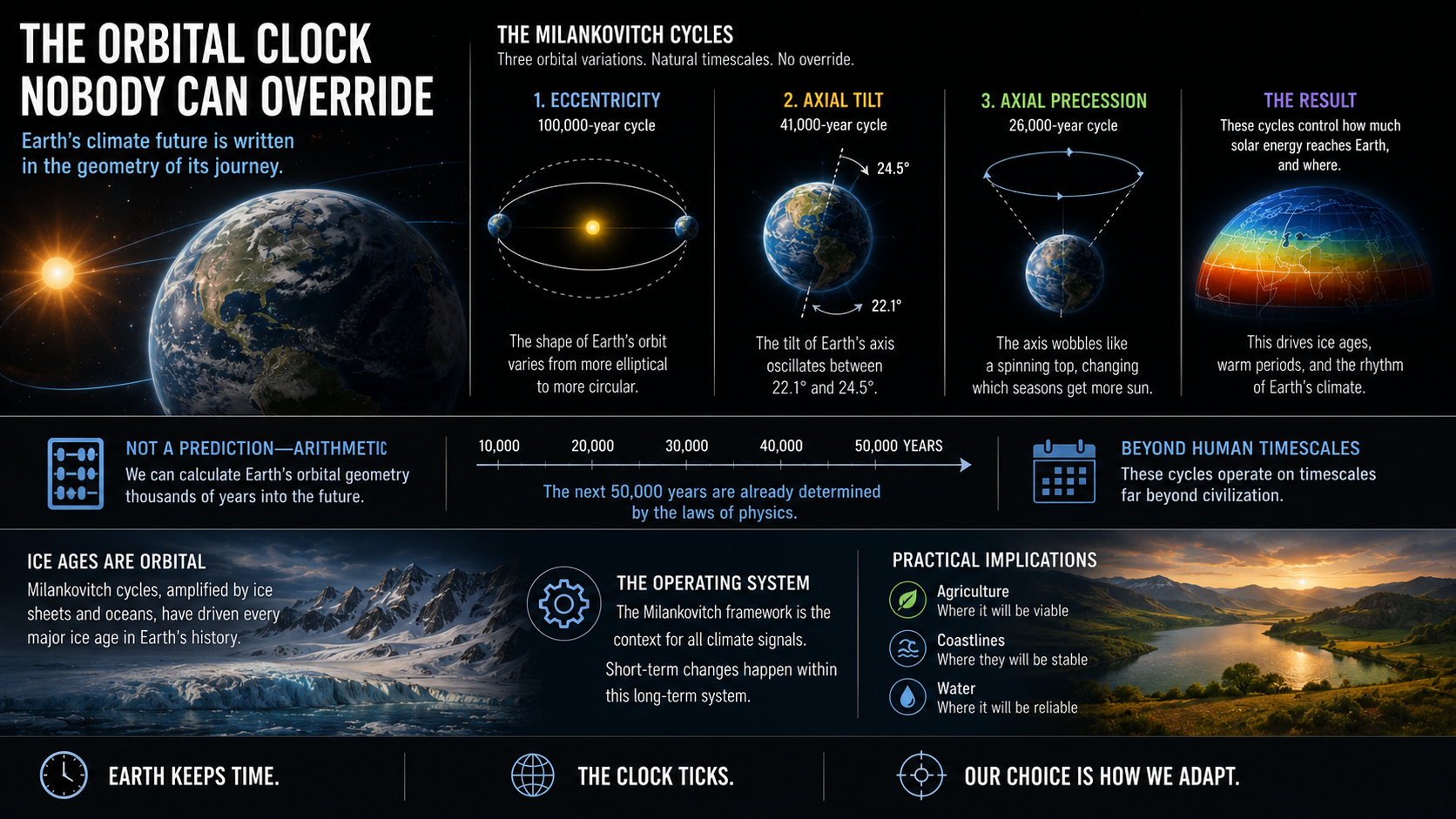
Pull back further in scale and the signal becomes even more fundamental. Earth’s climate future — on timescales of tens of thousands of years — is determined not primarily by what happens on Earth’s surface but by the geometry of its journey through space. Milankovitch cycles, named for the Serbian mathematician Milutin Milanković who calculated them in the early twentieth century, describe three overlapping orbital variations: the eccentricity of Earth’s elliptical orbit around the sun, which cycles over roughly 100,000 years; the tilt of Earth’s axis, which oscillates between 22.1 and 24.5 degrees over approximately 41,000 years; and the wobble of that axis, which precesses like a spinning top over roughly 26,000 years.
These cycles, interacting with each other and with the reflectivity of ice sheets and the carbon absorption capacity of oceans, have driven every ice age in Earth’s history. They are calculable centuries in advance. The trajectory of Earth’s orbital geometry over the next 50,000 years is not a prediction — it is arithmetic. We know, with genuine precision, how much solar radiation will reach different latitudes at different seasons thousands of years from now. The broad climate envelope of Earth’s deep future is already written in the physics of orbital mechanics.
What this means practically is that when we talk about long-term human habitability — where agriculture will be viable, where coastlines will be stable, where water will be reliable — the Milankovitch framework is not optional background knowledge. It is the operating system within which all shorter-term climate signals must be interpreted.
The Conveyor Belt Slowing Down
On a timescale more immediately consequential, one of Earth’s most critical heat distribution systems is already changing in ways whose downstream effects are still propagating through the climate system.
The Atlantic Meridional Overturning Circulation — the vast system of ocean currents that carries warm surface water from the tropics northward into the North Atlantic, releasing heat that keeps Western Europe dramatically warmer than its latitude would otherwise permit, and then sinking as cold, dense, salty water to return southward along the ocean floor — has slowed significantly since the mid-twentieth century and is at its weakest point in over a millennium. The mechanism is well understood: freshwater from melting Greenland ice sheets is diluting the salinity of North Atlantic waters, reducing their density, and weakening the sinking that drives the entire circulation.
The consequences of continued slowing are not speculative. They are already propagating through the system. Sea level rise on the U.S. East Coast is accelerating faster than the global average because the AMOC acts as a pump that suppresses sea levels in the western North Atlantic — as it weakens, that suppression weakens with it. Shifts in the jet stream are altering precipitation patterns across Europe and North America in ways that are already affecting agriculture and drought frequency. The full consequences of changes set in motion decades ago are still arriving. The changes being set in motion today will arrive for our children and grandchildren.
Yellowstone Is Not Waiting for Permission
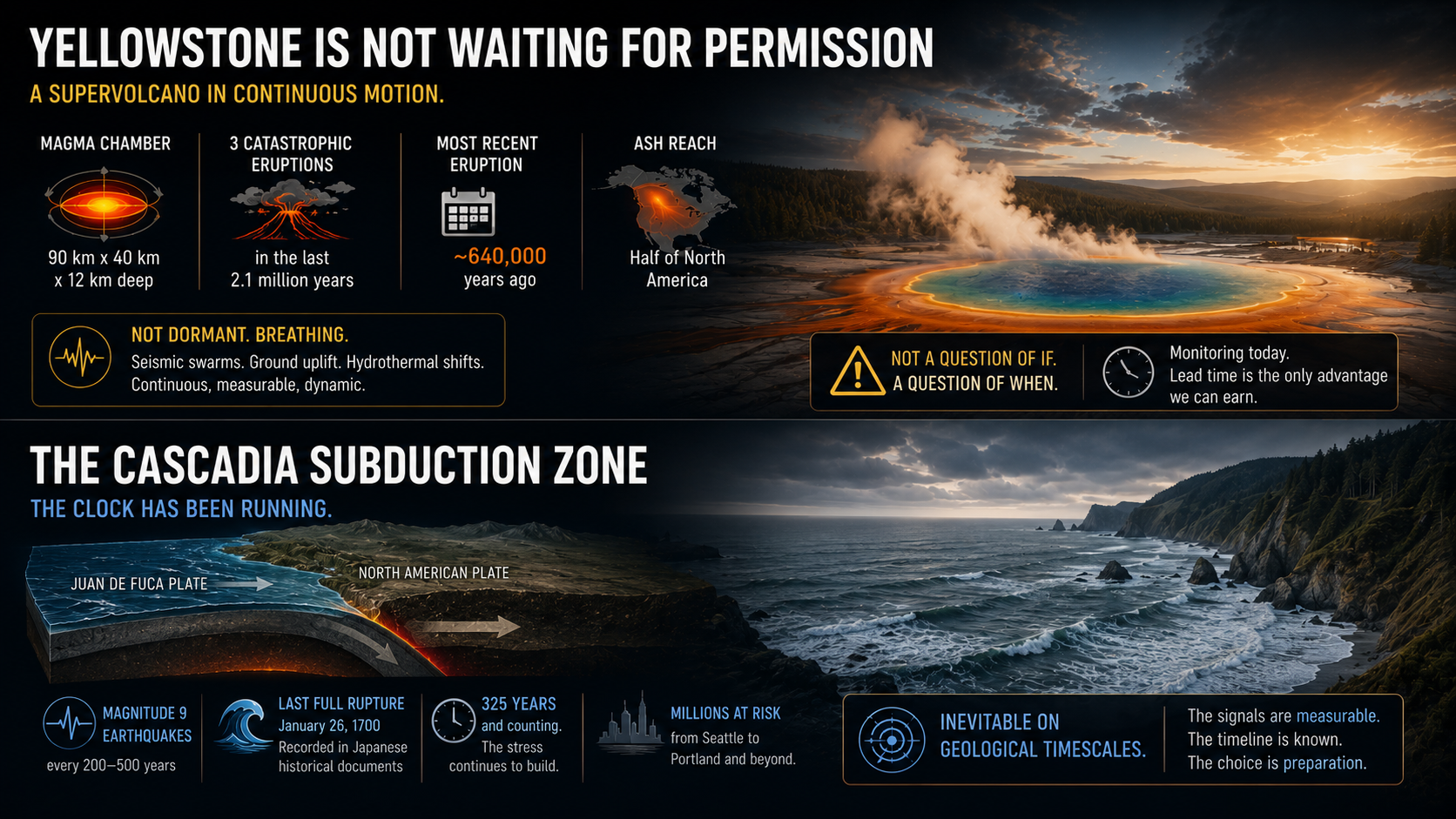
Beneath the tourist-friendly geysers and hot springs of Yellowstone National Park sits one of the most powerful volcanic systems on the planet — a magma chamber roughly 90 kilometers long, 40 kilometers wide, and 12 kilometers deep, sitting atop a hotspot that has produced three cataclysmic eruptions in the last 2.1 million years. The most recent, approximately 640,000 years ago, deposited ash across half the North American continent.
A full Yellowstone eruption is not imminent by scientific consensus. But it is inevitable on geological timescales, and the monitoring network of seismometers and GPS sensors around the caldera is measuring a system in continuous, dynamic motion — ground uplift and subsidence, earthquake swarms, hydrothermal fluctuations. The system is not dormant. It is breathing. The question is not whether Yellowstone will erupt again. It is whether human civilization will have the foresight and the institutional capacity to read the signals of its buildup with enough lead time to matter.
The same is true of the Cascadia subduction zone off the Pacific Northwest coast, where the Juan de Fuca tectonic plate is sliding beneath the North American plate and accumulating stress that geological evidence suggests releases in magnitude 9 earthquakes approximately every 200 to 500 years. The last full rupture was January 26, 1700 — a date known with unusual precision because the tsunami it generated was recorded in Japanese historical documents. The clock has been running for 325 years.
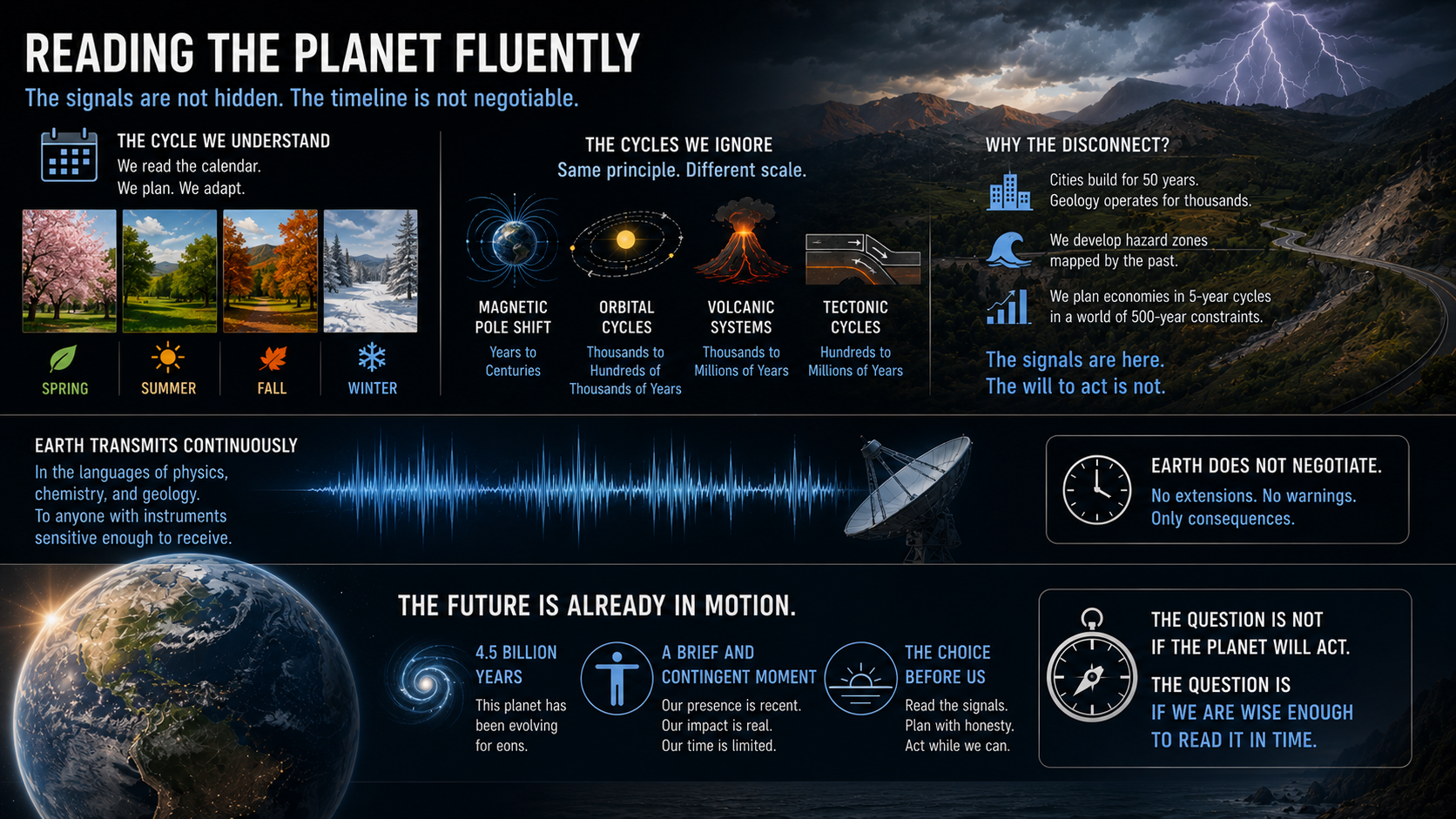
Reading the Planet Fluently
The seasonal cycle is the most accessible model for everything this column is arguing. Nobody predicts summer. Nobody is surprised by winter. We read the calendar of a system already in operation, plan our agriculture and our wardrobes and our energy infrastructure around its rhythms, and consider ourselves competent stewards of a future we understand. The geological and geophysical signals described above are no different in kind — only in the timescale required to read them fluently.
The tough question is this: why do our cities build infrastructure with fifty-year design lives in floodplains already mapped for sea level rise? Why do we permit dense development on coastlines identified in geological records as tsunami inundation zones? Why do our economic planning cycles extend five years into a future whose physical constraints are calculable over five hundred? The signals are not hidden. The instruments to read them exist. What is missing is the institutional will to let the planet’s timeline interact with our planning timeline in an honest and consequential way.
Earth does not negotiate. It does not extend deadlines. It does not issue warnings in languages designed for human comprehension. It transmits continuously, in the languages of physics and chemistry and geology, to anyone with instruments sensitive enough to receive them.
The future of this planet is already in motion. It has been for 4.5 billion years. Our presence here is a recent and contingent development in a story whose larger arcs were written long before we arrived — and will continue long after, with or without us.
The question is whether we are wise enough to read them while there is still time to act.
Related Articles
NOAA National Centers for Environmental Information — The World Magnetic Model and the Accelerating Shift of Magnetic North https://www.ncei.noaa.gov/products/world-magnetic-model
NASA Earth Observatory — Milankovitch Cycles and Their Role in Earth’s Climate History https://earthobservatory.nasa.gov/features/Milankovitch
Nature Climate Change — Observed Fingerprint of a Weakening Atlantic Ocean Overturning Circulation https://www.nature.com/articles/s41558-018-0107-x