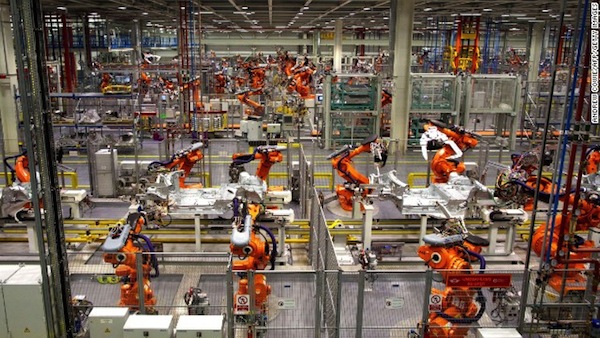
This is your future: Ray Kurzweil

By the early 2020s, we will have the means to program our biology away from disease and aging, by the early 2020’s. Health and medicine have been a hit or miss up until recently. We would discover interventions such as drugs that had benefits, but also many side effects. Until recently, we did not have the means to actually design interventions on computers.


Continue reading… “This is your future: Ray Kurzweil”

Hour of Code initiative hopes to spark students’ interest in computer programming

Could you love coding in an hour?

The goal of this year’s Computer Science Education Week (CSEW) initiative “Hour of Code” to encourage students to try coding for an hour. CSEW has been going on since 2009, but this year nonprofit Code.org took over and put the focus on getting kids interested in computer science. President Obama, Ashton Kutcher, and Mark Zuckerberg are among the nonprofits’ recruits that are advocating to kids to spend one hour this week learning code, in hopes of spurring interest in a future increasingly interconnected with computer literacy.


Continue reading… “Hour of Code initiative hopes to spark students’ interest in computer programming”

Technology’s Threat to the Future of Sports – Part 1

Futurist Thomas Frey: Recently I returned from a trip to Seoul, Korea where I was asked to speak at the Global Sports Marketing Forum on the “future of sports.” This event was part of a series being planned to draw attention to the 2018 Winter Olympics in Pyeongchang, Korea.


Continue reading… “Technology’s Threat to the Future of Sports – Part 1”

Facebook’s most talked about topics for 2013

[vimeo]http://vimeo.com/81305866[/vimeo]

Facebook’s 2013 Year in Review looks back at the stories, trends, and events that were shared most across the social network this last year. The year in review details the most talked about topics globally and for individual countries. It also shows the life events people felt most compelled to share.


Continue reading… “Facebook’s most talked about topics for 2013”

Why do doctors choose a $2,000 eye drug when an effective $50 alternative is available?

There are two eye drugs that have been declared equivalently miraculous. Tested side by side in six major trials, both prevent blindness in a common old-age affliction. Biologically, they are cousins. They’re even made by the same company.


Continue reading… “Why do doctors choose a $2,000 eye drug when an effective $50 alternative is available?”

Are teens really rejecting television?

Teens still watch 20 hours of TV a week.

Favorite technologies and online behavior of teenagers has a way of predicting the entire country’s favorite technologies and online behavior. From Facebook, to mobile-phone addiction and Snapchat, the habits we dismissed yesterday as silly and childish have a way of going national.


Continue reading… “Are teens really rejecting television?”

China to combat smog with artificial rain

Will cloud seeding work to wash the smog out of the air?

China has a severe air pollution problem. Smog has done everything from grounding planes at major airports to closing schools across the country. China’s smog is so dense that it’s even crept over to Japan and across other parts of Asia. China is working on putting measures into place to combat pollution, but they still need a more immediate solution for clearing up the heavy smog. According to the China Meteorological Administration, he country is putting its hopes on artificial rain.


Continue reading… “China to combat smog with artificial rain”

The number-one state with the highest public-college tuition is…

Where do students have it worst?

Student debt is a national problem that affects all 50 states (51, if you count D.C.). The amount and frequency with which undergraduates borrow varies vastly from state to state, some of which are far better at providing an affordable education than others.


Continue reading… “The number-one state with the highest public-college tuition is…”

Millennials are cheap – a graph that explains the teenage budget

Piper Jaffray got this when he last surveyed teenagers to learn how they spend money.

Nobody ever said it was easy being a teenager but, this make it look fun. Clothes (including shoes), electronics, movies, music, video games, concerts, accessories, food: That is the life. And together, it makes up about 70 percent of the teen budget.


Continue reading… “Millennials are cheap – a graph that explains the teenage budget”

Who’s hiring and who isn’t hiring

Who has been hiring and hasn’t?

After the start of the worst six months for the U.S. labor market since the Great Depression five years ago, we learned last week that 203,000 new jobs were created in November and the unemployment rate dropped to 7%. Discussion in the immediate aftermath of the news centered on whether the report marked more of the ho-hum same or a sign that, after three years of puttering along, the economy might finally be preparing for a return to something approaching prosperity.


Continue reading… “Who’s hiring and who isn’t hiring”

Discover the Hidden Patterns of Tomorrow with Futurist Thomas Frey
Unlock Your Potential, Ignite Your Success.

By delving into the futuring techniques of Futurist Thomas Frey, you’ll embark on an enlightening journey.

Learn More about this exciting program.