Google Director Of Engineering: This is how fast the world will change in ten years

Michael Simmons

It wasn’t supposed to be like this.

Futurists from the 20th century predicted that labor saving devices would make leisure abundant. According to the great economist John Maynard Keynes, the big challenge would be that…

“For the first time since his creation man will be faced with his real, his permanent problem — how to use his freedom from pressing economic cares, how to occupy the leisure, which science and compound interest will have won for him, to live wisely and agreeably and well.”

— John Maynard Keynes (1930)

Fast forward almost a century later.

Things didn’t quite go as expected. This quote from a modern researcher captures the current ethos:

“Rather than being bored to death, our actual challenge is to avoid anxiety attacks, psychotic breakdowns, heart attacks, and strokes resulting from being accelerated to death.”

— Geoffrey West

Rather than inhabiting a world of time wealth, we’re inhabiting a world of time poverty. Rather than feeling the luxury of time freedom, we’re feeling the burden of constant hurry.

What happened?

How did things turn out the exact opposite of what we were expecting?

More importantly, will the pace of life keep accelerating? And if it does, what are the implications (ie — can most people even cope)? What should we be doing now as knowledge workers to prepare for this future?

So, I spent over 100 hours reading the top 10 books related to these questions across the disciplines of sociology, technology, physics, evolution, business, and systems theory.

Continue reading… “Google Director Of Engineering: This is how fast the world will change in ten years”

South Korea’s fertility rate falls to lowest in the world

The nation’s capital Seoul logs the lowest birth rate of 0.64

South Korea’s fertility rate fell to the lowest in the world last year, data showed on Wednesday, February 24, as uncertainty over the coronavirus discouraged couples from marrying and having children.

The number of expected babies per South Korean woman fell to 0.84 in 2020, dropping further from the country’s previous record low of 0.92 a year earlier, the official annual reading from the Statistics Korea showed.

That is the lowest among over 180 member countries of the World Bank, and far below 1.73 in the United States and 1.42 in Japan.

Continue reading… “South Korea’s fertility rate falls to lowest in the world”

MyHeritage’s deepfake tool animates ancient photos and it’s as weird as it sounds

By Mehreen Kasana

The genealogy service is using artificial intelligence-powered tools as a marketing campaign to drum up new subscribers.

Nostalgia sells and marketers know it. People like to fantasize about a past they think was better than it likely was — and wonder what it might have been like for their relatives who lived through it. To capitalize on this, a genealogy-tracking service called MyHeritage has launched an AI-powered tool it calls Deep Nostalgia which animates old photos of users’ family members, whether deceased or otherwise. 

Several users of the service have taken to Twitter to share animated images of their great grandparents, reanimated, and exhibiting various facial expressions. The style of each video is almost the same: the subject moves their eyes around and then tilts their head a little, as if trying to recall something in answer to a question, before returning their gaze to the viewer. But then, it’s early days for the service, and odds are it’ll get a lot more flexible eventually.

Continue reading… “MyHeritage’s deepfake tool animates ancient photos and it’s as weird as it sounds”

This Gigantic 165-Inch MicroLED TV Folds Into Nothing When the Game Is Over

By BRYAN HOOD

It’s as fun to watch it unfold as it is to actually watch your program on it. 

C Seed is no stranger to extravagant TVs, but its latest set takes things up a notch. And a giant one at that.

The Austrian company’s just-announced M1 is a folding 4K MicroLED TV set that rises out of the floor like a robot when you’re ready to watch the big game or binge your favorite show. While that alone makes it noteworthy, so does its size, as the set measures a massive 165-inches diagonally.

You may take as much enjoyment out of watching the M1 turn on as you do watching an episode of The Sopranoson it. When you’re ready to sit down and take in a show or a movie, a hidden compartment in the floor opens, an obelisk-like column rises from it and then, once upright, the folded-up screen fans out before locking itself into place in the set’s base. Basically, it’s a Transformer that turns into a TV and doesn’t take up any room when you’re doing something else.

Continue reading… “This Gigantic 165-Inch MicroLED TV Folds Into Nothing When the Game Is Over”

Lack of symmetry in qubits can’t fix errors in quantum computing, might explain matter/antimatter

A new paper seeking to cure a time restriction in quantum annealing computers instead opened up a class of new physics problems that can now be studied with quantum annealers without requiring they be too slow. Credit: Los Alamos National Laboratory

by Charles Poling , Los Alamos National Laboratory

A team of quantum theorists seeking to cure a basic problem with quantum annealing computers—they have to run at a relatively slow pace to operate properly—found something intriguing instead. While probing how quantum annealers perform when operated faster than desired, the team unexpectedly discovered a new effect that may account for the imbalanced distribution of matter and antimatter in the universe and a novel approach to separating isotopes.

“Although our discovery did not the cure the annealing time restriction, it brought a class of new physics problems that can now be studied with quantum annealers without requiring they be too slow,” said Nikolai Sinitsyn, a theoretical physicist at Los Alamos National Laboratory. Sinitsyn is author of the paper published Feb. 19 in Physical Review Letters, with coauthors Bin Yan and Wojciech Zurek, both also of Los Alamos, and Vladimir Chernyak of Wayne State University.

Significantly, this finding hints at how at least two famous scientific problems may be resolved in the future. The first one is the apparent asymmetry between matter and antimatter in the universe.

“We believe that small modifications to recent experiments with quantum annealing of interacting qubits made of ultracold atoms across phase transitions will be sufficient to demonstrate our effect,” Sinitsyn said.

Continue reading… “Lack of symmetry in qubits can’t fix errors in quantum computing, might explain matter/antimatter”

Portable Starlink ‘Mini’ gets a nod of acknowledgement from Elon Musk

By Simon Alvarez

SpaceX’s satellite internet service, Starlink, may be released in a more portable form in the future, as per recent Twitter comments from SpaceX CEO Elon Musk. During a recent conversation on the social media platform, Musk acknowledged that the idea of a Starlink “Mini” that’s designed around portability would be a good idea. 

The idea of a Starlink “Mini” was suggested by spaceflight photographer John Kraus, who suggested that a small sub-1-foot dish, self-contained router, and rechargeable battery would be a viable product. The photographer’s suggestions are valid, as portable satellite internet access would most likely be a game-changer for those who are frequently mobile, such as travelers and photographers. 

SpaceX’s current Starlink kit is not that portable at all, thanks to its dish’s large size and the system’s geographical limitations. However, some Starlink users have noted that they were able to successfully use the satellite internet system in areas outside their service address. A Model 3 owner, for example, successfully used Starlink after driving into a national park. This experience, however, is not shared by all of the satellite internet’s users today. 

Continue reading… “Portable Starlink ‘Mini’ gets a nod of acknowledgement from Elon Musk”

Meet The Billionaire Founder Of South Korea’s Amazon That’s About To Go Public

Bom Kim, founder and chief executive officer

By Ralph Jennings

Coupang is preparing for a U.S. listing that could value the South Korean e-commerce giant at more than $50 billion. It’s another milestone for Coupang’s 42-year-old billionaire founder Bom Kim, who has been leading the company since 2010.

Dubbed the Amazon of South Korea, Coupang’s IPO would be the largest U.S. listing by a foreign company since Alibaba’s blockbuster debut in 2014.

Coupang has grown by cutting prices and speeding up deliveries. It offers same-day and next-day delivery of groceries and general merchandise. It delivers prepared foods through the name Coupang Eats and offers video streaming under the label Coupang Play.

Continue reading… “Meet The Billionaire Founder Of South Korea’s Amazon That’s About To Go Public”

Dwarf planet closest to Earth is geologically alive

On the way to its lowest and final orbit, NASA’s Dawn spacecraft captured this dramatic image of Ceres’s limb.IMAGE BY NASA/JPL-CALTECH/UCLA/MPS/DLR/IDA

The tiny, frigid world Ceres amazes with evidence of recent ice volcanoes fed by the remnants of an ancient underground sea.

Tucked into the asteroid belt between Mars and Jupiter, the dwarf planet Ceres is a small world that holds big surprises. A slew of new research from NASA’s Dawn spacecraft advances the case that—in its own cold, salty way—Ceres is a geologically active body, with ice volcanoes and surviving pockets of an ancient ocean.

About a year’s worth of data collected by Dawn from late 2017 through late 2018—during its final orbits before running out of fuel—show that the dwarf planet probably has briny liquid seeping out on its surface, as well as mounds and hills that formed when ice melted and refroze after an asteroid impact about 20 million years ago. 

The idea that liquid water could persist on Ceres—a world that’s less than a third of the moon’s width—would have once seemed outlandish. But now that humankind has seen it up close, we know that frigid, tiny Ceres is geologically alive. 

Continue reading… “Dwarf planet closest to Earth is geologically alive”

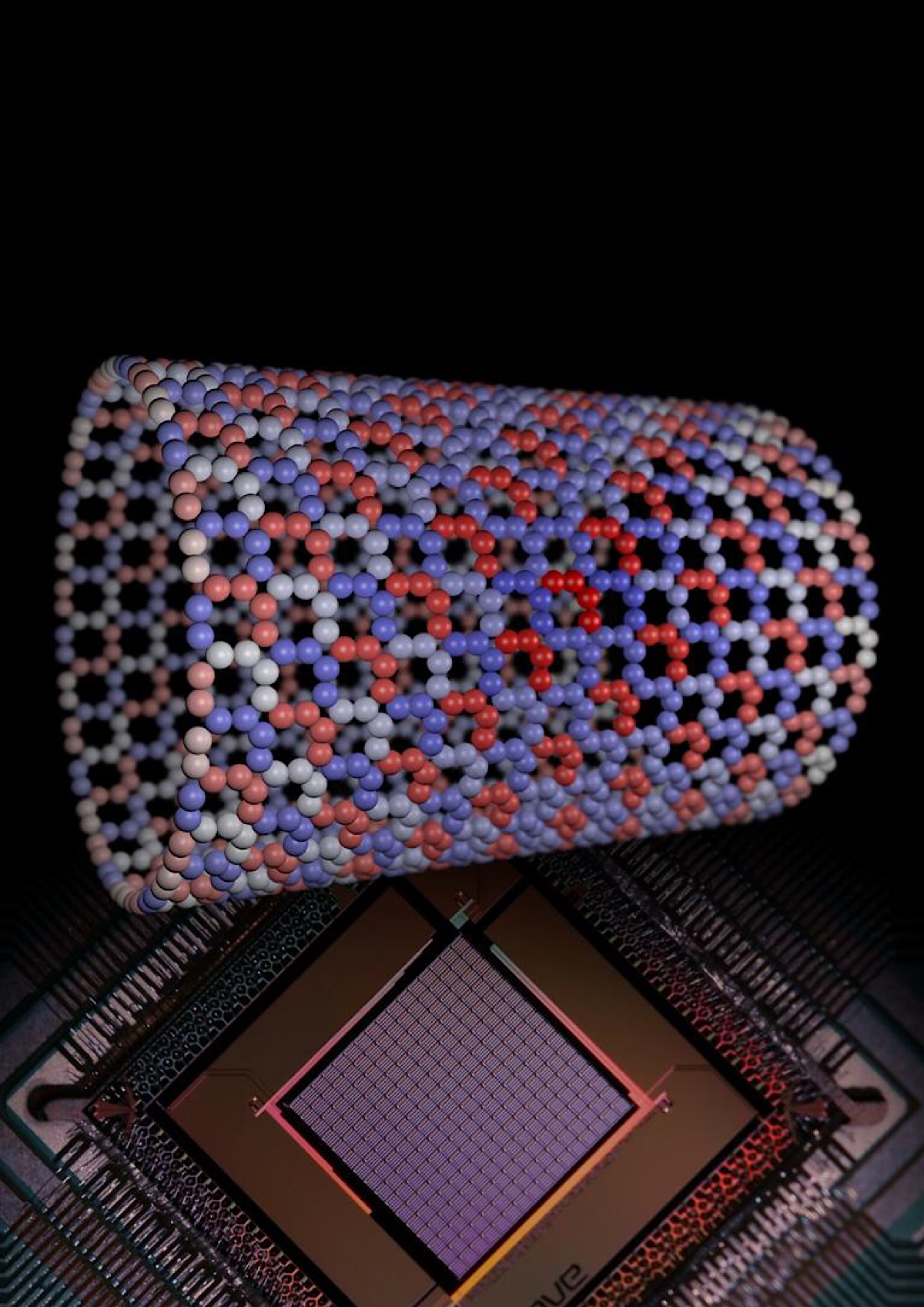
A quantum computer just solved a decades-old problem three million times faster than a classical computer

To simulate exotic magnetism, King and his team programmed the D-Wave 2,000-qubit system to model a quantum magnetic system.

By Daphne Leprince-Ringuet 

Using a method called quantum annealing, D-Wave’s researchers demonstrated that a quantum computational advantage could be achieved over classical means.

Scientists from quantum computing company D-Wave have demonstrated that, using a method called quantum annealing, they could simulate some materials up to three million times faster than it would take with corresponding classical methods.  

Together with researchers from Google, the scientists set out to measure the speed of simulation in one of D-Wave’s quantum annealing processors, and found that performance increased with both simulation size and problem difficulty, to reach a million-fold speedup over what could be achieved with a classical CPU.  

Continue reading… “A quantum computer just solved a decades-old problem three million times faster than a classical computer”

USPS unveils next-generation mail truck with electric drivetrain option

Defense contractor Oshkosh is the winner of a years-long contest

By Sean O’Kane 

The United States Postal Service (USPS) has revealed its new mail truck after a years-long competition. The new truck will be built by Wisconsin-based defense contractor Oshkosh and can be fitted with both gasoline and electric drivetrains. But it won’t hit the road until 2023.

Oshkosh winning the contract is a potentially major blow to commercial electric vehicle startup Workhorse, which was one of the three remaining bidders. The company’s stock price plummeted following the announcement, and trading was halted multiple times.

The USPS has been looking to replace its existing mail trucks for years now, and it started taking solicitations for new designs back in 2015. The need for new trucks is urgent. The ones currently on the road are not only woefully out of date — they don’t even have air conditioning — but they’re a major fire risk.

The switchover was supposed to start happening in 2018, but the program experienced multiple setbacks. The USPS repeatedly extended deadlines in the early going at the request of the bidding manufacturers, and then when they finally delivered the first prototypes, many of them were faulty, according to an Inspector-General report released last August. The program was hit with further delays once the COVID-19 pandemic hit.

Continue reading… “USPS unveils next-generation mail truck with electric drivetrain option”

Netflix launches ‘Downloads for You,’ a new feature that automatically downloads content you’ll like


Sarah Perez

Netflix today is launching a new feature that aims to bring more offline content to users who opt-in automatic downloads. With “Downloads for You” enabled, the Netflix app will download recommended TV shows and movies to your mobile device based on your tastes, as determined by your Netflix watch history.

After turning on the feature for the first time, you’ll be able to select the amount of storage space you want to dedicate to saving these recommended downloads on your device: either 1GB, 3GB or 5GB. The downloads will then take place when you’re connected to a Wi-Fi network, and will contain a mix of recommendations that Netflix believes you’ll like. Typically, the app will download the first few episodes of a TV show — enough to get you started.

You can also cast the downloaded content to a nearby TV, where it will stream directly from your phone.

After you’ve watched the episodes or movies, you can delete them from the device to free up more storage space for the next time you’re connected to Wi-Fi.

Continue reading… “Netflix launches ‘Downloads for You,’ a new feature that automatically downloads content you’ll like”
Discover the Hidden Patterns of Tomorrow with Futurist Thomas Frey
Unlock Your Potential, Ignite Your Success.

By delving into the futuring techniques of Futurist Thomas Frey, you’ll embark on an enlightening journey.

Learn More about this exciting program.