The Gas Station in Space: Orbit Fab’s Ambitious Plan to Extend the Life of Satellites

Orbit Fab, an American company founded in 2018, is hoping to revolutionize the satellite industry by producing in-orbit “gas stations” that can refuel satellites, making them more sustainable and profitable. Satellites currently rely on limited fuel supplies to stay in position, but with the ability to refuel in orbit, they could be used for longer periods of time, reducing the cost of manufacturing and launching them.

Orbit Fab’s plan involves sending large tanks containing several tonnes of fuel into orbit and using smaller vessels to shuttle fuel between the tanks and satellites. Although the risks associated with operating such a system are high, the company has conducted numerous tests and is confident it will be safe.

Continue reading… “The Gas Station in Space: Orbit Fab’s Ambitious Plan to Extend the Life of Satellites”

Clear Skies Ahead: The Solar-Powered Airship Solution to Air Travel’s Carbon Footprint

Researchers are investigating technical alternatives to conventional aircraft, such as solar-powered airships equipped with super-efficient solar cells and lightweight batteries. Professor Christoph Pflaum and Professor Agnes Jocher, along with student Tim Riffelmacher from the Friedrich-Alexander-Universität Erlangen-Nürnberg (FAU) and the Technical University of Munich (TUM), have published a paper in the International Journal of Sustainable Energy outlining the route a solar airship would take to fly from London to New York in the most time-efficient and eco-friendly manner.

Continue reading… “Clear Skies Ahead: The Solar-Powered Airship Solution to Air Travel’s Carbon Footprint”

The Future of Car Design: How AI is Changing the Game

What if automakers could design their next popular vehicle in minutes for a fraction of the cost? That’s what General Motors and the MIT Sloan School of Management explored in a recent study, using a neural network to analyze data collected from GM clinics to determine what makes an attractive vehicle. By inputting images and scores given by attendees, the AI software trained itself to output an aesthetic rating for a given image. The program was able to predict with remarkable accuracy how consumers would rate vehicles, achieving a 74% agreement rate.

Next, the program used this information to design new vehicles that would score high aesthetically, based on parameters such as “make it Chevy-like.” Interestingly, some of the designs generated by the AI were strikingly similar to vehicles sold by automakers in 2020, despite the fact that they were not in the automaker’s lineup in 2014.

Continue reading… “The Future of Car Design: How AI is Changing the Game”

Unleash Your Creativity with This AI-Powered Video Transformation App

The use of AI-generated images has become increasingly accessible, with tools like DALL-E allowing users to easily create visuals from a basic prompt. While AI video generation is still in its early stages, a new app from AI startup Runway offers a glimpse into the technology’s potential.

The recently launched Runway ML iOS app enables users to transform existing videos from their photo gallery or captured on the app into entirely new videos using prompts, images, or presets. The app’s video-to-video technology, Gen-1, has been available for desktop use since February, and the app version streamlines the process, making it more accessible to users.

Although the results from Runway’s technology can sometimes appear warped or disfigured, it is important to keep in mind that unexpected outputs are common with generative AI, especially in the early stages of AI video generation.

Runway ML iOS app is free to download from the Apple App Store and already ranks 19th in the Photo & Video category. However, in-app purchases are available to access different subscription plans, which provide users with varying credit limits and features. The Free plan includes a limit of 125 credits and grants users three video projects with 720p video exports. The Standard plan costs $143.99 annually and provides 625 credits, unlimited video projects, watermark removals, 1080p exports, and additional features. The Pro plan, which costs $334.99, provides users with 2,250 credits per month, unlimited video projects, ProRes exports, 500GB of assets, and premium perks. The app also teases Runway’s Gen-2 text-to-video technology, which is “coming soon.”

By The ImpactLab

Bridging the Gap: Human Neurons Transforming the AI Landscape

A groundbreaking innovation by Cortical Labs features human neurons grown on a silicon chip, creating a hybrid AI that’s already capable of playing computer games. Late in 2022, Cortical Labs made headlines with an article in the scientific journal Neuron, where it revealed that the startup had successfully taught neurons in a petri dish to play the classic game Pong. This breakthrough marked the emergence of a new organic-digital intelligence known as the Biological Intelligence Operating System (biOS), or the DishBrain. As it stands, DishBrain can play Pong – but in the future, it could revolutionize computing.

To develop the biOS, researchers first nurture neurons in a nutrient-rich solution. These neurons are then grown on a silicon chip equipped with pins that transmit electrical impulses to the neural structure and receive impulses back – functioning similarly to a brain. In essence, biOS is a hybrid of silicon and organic tissue, establishing a connection between an organic neural network and the digital realm.

Continue reading… “Bridging the Gap: Human Neurons Transforming the AI Landscape”

Reinventing the Banking Industry: How Financial Institutions Must Evolve to Survive the Digital Revolution

The future of banking is happening faster than we imagined!

By Futurist Thomas Frey: As the global banking system experiences increasing turbulence, a growing number of influential individuals have begun asking crucial questions about 2040 and the future of the banking industry.

What will the landscape of banking look like in 2040? Will physical branches still be relevant? What will be the primary functions and services of banks? And, is there a future where banks may no longer be necessary?

Continue reading… “Reinventing the Banking Industry: How Financial Institutions Must Evolve to Survive the Digital Revolution”

Meta’s new AI project turns doodles into animated figures

Meta’s intention in making Animated Drawings an open-source project is to enable other developers to innovate and provide users with more diverse and immersive experiences

Meta, the parent company of Facebook, has announced a new AI project that can turn simple doodles into animated figures. The project, called “Doodle to Life,” uses machine learning algorithms to analyze hand-drawn sketches and transform them into animated 3D characters.

The technology behind Doodle to Life is based on Meta’s existing machine learning models for understanding and processing natural language. By adapting these models to interpret doodles, the company hopes to create a new form of expression that is accessible to anyone.

“Everyone can draw a doodle, but not everyone can animate a character,” said Ficus Kirkpatrick, Head of AI at Meta. “With Doodle to Life, we’re making it easy for anyone to bring their ideas to life in a fun and creative way.”

Continue reading… “Meta’s new AI project turns doodles into animated figures”

Scientists create new biocompatible bio-ink to 3D print artificial organs

The new temperature method is based on a “poly(organophosphazene)-based temperature-sensitive hydrogel.”

A team of scientists has developed a new biocompatible bio-ink that can be used to 3D print artificial organs, such as livers and pancreases, that can be transplanted into humans. The researchers, led by Dr. Ali Khademhosseini, a professor of bioengineering at the University of California, Los Angeles, created the new ink by combining alginate, gelatin, and a glycoprotein called recombinant human collagen.

According to Khademhosseini, the new bio-ink has several advantages over previous formulations. “The new ink is biocompatible and can support cell growth and differentiation, which is essential for creating functioning tissues,” he explained. “Additionally, it has the necessary mechanical properties to be 3D printed into complex structures.”

To test the new bio-ink, the team 3D printed a liver-like structure and then seeded it with liver cells. After a week, the cells had grown and formed a functioning tissue that could perform some of the functions of a real liver.

Continue reading… “Scientists create new biocompatible bio-ink to 3D print artificial organs”

Microsoft Joins the Chip-munks, Will Make its Own AI Chips

One of the primary reasons for Microsoft’s foray into chip-making is to ​​reduce costs, which Athena could possibly slash by a third in comparison to Nvidia

Microsoft has announced its plan to develop its own AI chips, which will be used to power its Azure cloud platform and other products. This move will bring Microsoft into the growing club of tech companies that have started building their own custom chips to handle AI workloads.

According to Microsoft’s Chief Technology Officer, Kevin Scott, the company has already started to make progress in developing its own AI chips. He said, “We are going to build some of the world’s most advanced AI supercomputers, AI chips and infrastructure.”

Scott also mentioned that Microsoft is collaborating with researchers from several universities to develop these AI chips. He stated, “We’re working with a number of different academic institutions to do advanced research around these new types of chips.”

Continue reading… “Microsoft Joins the Chip-munks, Will Make its Own AI Chips”

Hyundai Building Wearable Robot for Patient Rehabilitation

The ‘X-ble MEX’ is a wearable medical robot Hyundai Robotics Lab developed to help with lower muscle reconstruction and joint mobility recovery.

Hyundai Motor Group has announced that it is developing a wearable robot for patient rehabilitation. The wearable robot, which is currently in the prototype stage, is designed to help patients who have suffered from strokes or other neurological disorders regain their mobility.

According to the company, the wearable robot consists of a waist belt and leg straps that can be worn by the patient. The robot is equipped with sensors that can detect the patient’s movements and provide feedback to help them improve their walking and balance.

“We are excited to be developing this innovative wearable robot technology, which has the potential to revolutionize the way patients recover from neurological disorders,” said Chung Eui-sun, executive vice chairman of Hyundai Motor Group. “Our goal is to help patients regain their mobility and independence, and improve their quality of life.”

Continue reading… “Hyundai Building Wearable Robot for Patient Rehabilitation”

Mitsubishi Motors to Launch World’s First Real-time Cinematic Vehicle Configurator

● Industry-first use of the latest cloud streaming video game technology allows customers to configure their ideal 2023 Outlander Plug-In Hybrid and see it in motion 
● Upon completion, customers receive personalized interactive microsite featuring images and videos of their vehicle 
● ZeroLight‘s cloud-based, plug-and-play visualization platform complements Mitsubishi Motors’ ClickShop digital showroom experience

Mitsubishi Motors has announced the launch of the world’s first real-time cinematic vehicle configurator, which will enable customers to configure and visualise their vehicles in a more immersive and interactive way. The configurator is set to be launched in the UK in May 2023, and will be available on the company’s website.

According to Mitsubishi Motors UK’s managing director, Rob Lindley, “We are excited to be launching this cutting-edge technology, which will provide our customers with a more engaging and interactive way to configure and visualise their vehicles. This is a game-changing technology that we believe will revolutionize the way people buy cars.”

Continue reading… “Mitsubishi Motors to Launch World’s First Real-time Cinematic Vehicle Configurator”

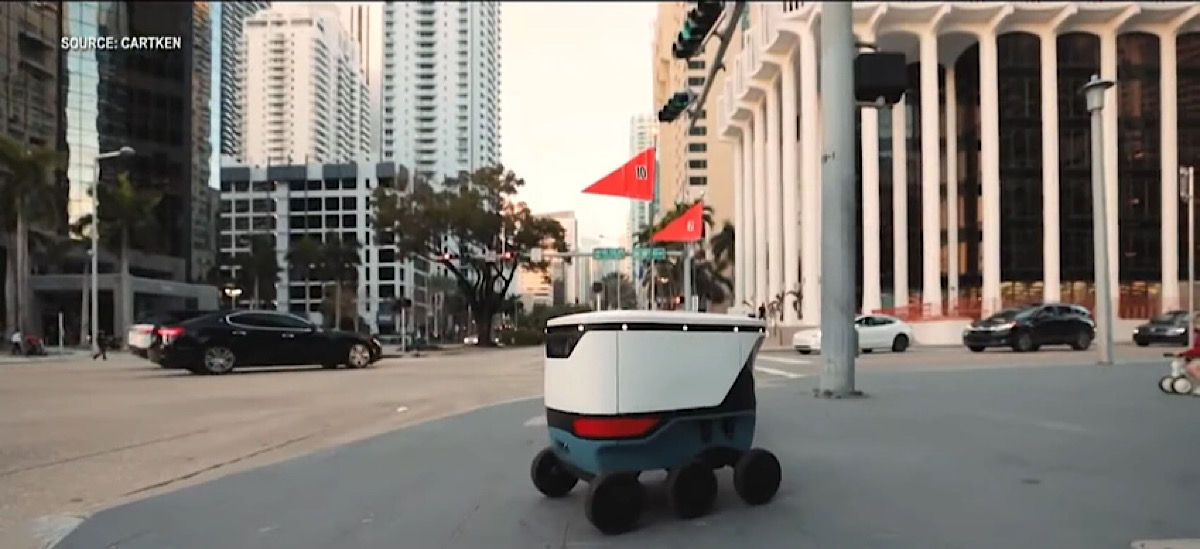
Uber Expands Robot Delivery Service to Virginia

The news follows the successful pilot of the service in Miami, Florida

Uber has expanded its robotic delivery service to Virginia, providing contactless delivery to customers through its autonomous delivery robots. This marks the fourth state in which Uber has launched its robotic delivery service, following its debut in California in 2019.

According to Luke Fischer, Head of Uber’s Autonomous Delivery business unit, “Our delivery robots are perfect for customers who are looking for an affordable and convenient way to receive their orders. With this expansion, we are excited to bring our service to more people in Virginia, and provide them with a safer, more efficient and cost-effective delivery option.”

The delivery robots are equipped with cameras and sensors that allow them to navigate sidewalks and traffic safely, and they can travel up to three miles per hour. Customers can track the delivery in real-time through the Uber app and receive a notification once the delivery has been made.

Continue reading… “Uber Expands Robot Delivery Service to Virginia”
Discover the Hidden Patterns of Tomorrow with Futurist Thomas Frey
Unlock Your Potential, Ignite Your Success.

By delving into the futuring techniques of Futurist Thomas Frey, you’ll embark on an enlightening journey.

Learn More about this exciting program.