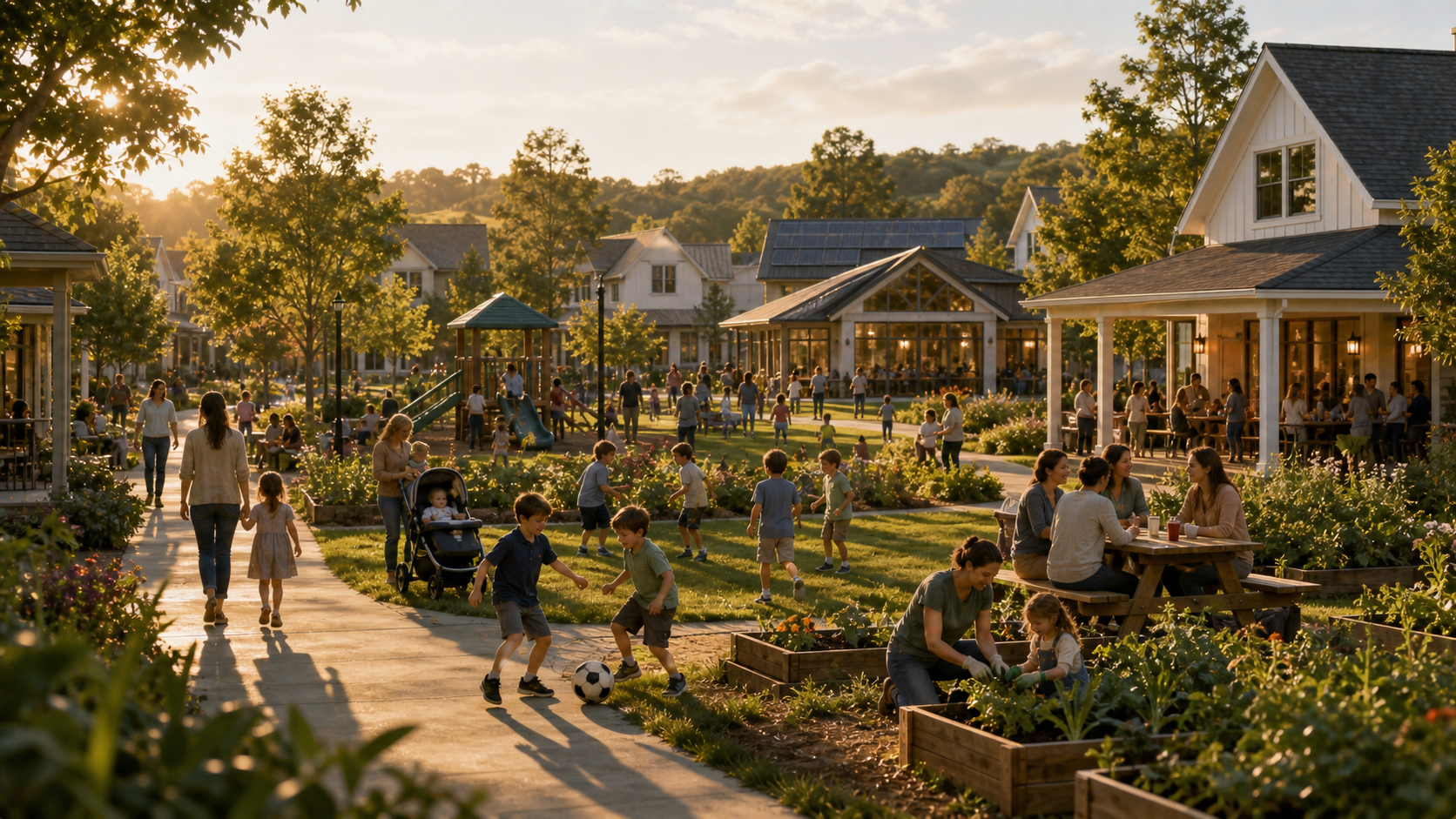
What happens when the vow becomes the neighborhood — and the neighborhood becomes the proof of concept
By Futurist Thomas Frey
Part 6 of 6: The Colony
Every transformative idea in human history has had a moment when it stopped being a philosophy and became a place.
The Puritan settlers didn’t write treatises about the ideal community and wait for governments to implement them. They built the community, in a specific geography, with specific people, under specific rules they had chosen together. The kibbutz movement didn’t lobby the Israeli government for agricultural reform before demonstrating what communal farming could produce. It built farms, on actual land, and let the results make the argument. The Shakers, the Oneida community, the Hutterite colonies, the cooperative villages of Scandinavia — whatever their specific ideology, they shared a recognition that ideas about how to live together only become real when someone actually lives together that way.
The Vitalist Colony is that moment for this series.
Not a policy proposal. Not a cultural advocacy campaign. Not an institutional framework waiting for governments to adopt it. A place — a designed, intentional, physically real community where the Vitalist vocation is the organizing principle of daily life, where the infrastructure described in the preceding five columns is built and operational, and where the results are visible and measurable and available to anyone who wants to evaluate them.
The Colony is the proof of concept. And proof of concepts, in the history of social transformation, have a track record that no amount of policy argument can match.
Continue reading… “The Vitalists Part 6 – The Vitalist Colony”