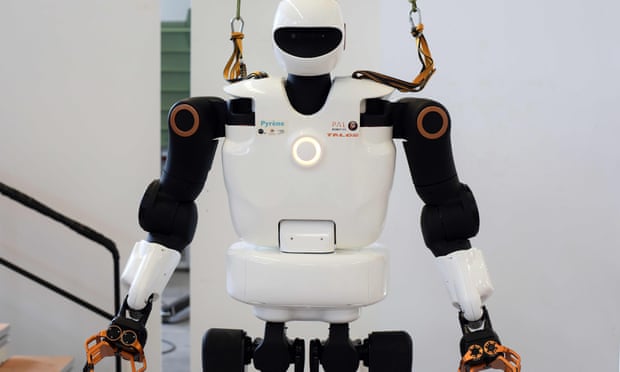
The Global Robotics Integration Program: One Billion Robots Joining Human Society by 2040

By Futurist Thomas Frey

By 2035, Japan will have more citizens over 65 than under 18. Germany’s workforce will have shrunk by 15 million people. China will face a demographic cliff with too few young workers supporting too many retirees. Across the developed world, the same crisis looms: not enough humans to care for the elderly, staff hospitals, deliver goods, or teach the next generation.

The Global Robotics Integration Program is humanity’s response—a $3 trillion megaproject to deploy one billion humanoid and autonomous robots across healthcare, logistics, and education sectors by 2040, all connected through an international “Robot Internet” that enables coordination, learning, and continuous improvement.

This isn’t replacing humans. It’s augmenting human civilization with machine partners designed to work alongside us, handle tasks humans can’t or won’t do, and prevent societal collapse as demographics invert. By 2040, human-robot co-societies won’t be science fiction—they’ll be how civilization functions.

Continue reading… “The Global Robotics Integration Program: One Billion Robots Joining Human Society by 2040”

The Evolution of Robots: When the Lines Between Human and Machine Disappear Completely

By Futurist Thomas Frey

We’re approaching a threshold that will fundamentally change what it means to be human. Not because robots are becoming more human-like—though they are—but because humans are becoming more machine-like, and the distinction between the two is evaporating faster than anyone predicted.

When I first wrote about the blurring lines between people and machines, humanoid robots were clumsy prototypes and brain-computer interfaces were experimental medical devices. That was then. Now we’re watching those lines dissolve in real-time, and the implications are staggering.

Continue reading… “The Evolution of Robots: When the Lines Between Human and Machine Disappear Completely”

Air. Water. Anywhere: Students Build a 3D-Printed Drone That Flies, Swims—and Breaks the Rules of Physics

In a Danish lab filled with student prototypes and secondhand electronics, something extraordinary has taken flight—and dived straight into the pool.

A team of applied industrial electronics students at Aalborg University has pulled off a jaw-dropping feat: a fully 3D-printed hybrid drone that takes off, plunges underwater, swims like a mechanical fish, and then explodes back into the air—no pause, no manual switch, just seamless transition between two fundamentally different worlds.

Forget what you know about drones. This isn’t a toy with wings. It’s a shape-shifting robot that obeys no single environment and no conventional engineering playbook.

Continue reading… “Air. Water. Anywhere: Students Build a 3D-Printed Drone That Flies, Swims—and Breaks the Rules of Physics”

Robots Are Learning to Taste: How 3D Laser Scanners Are Teaching Machines to Harvest Like Humans

The future of farming isn’t about bigger tractors—it’s about smarter sensors. And now, robots are getting their first real taste of fruit.

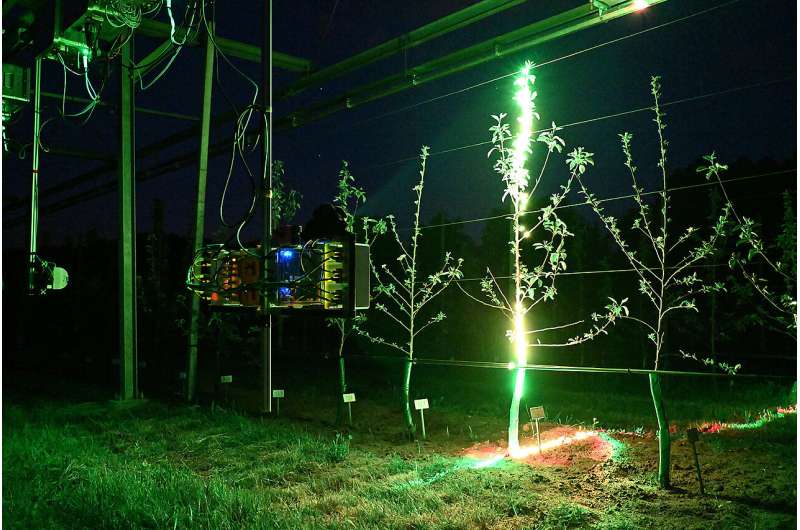
In a field outside Potsdam, Germany, something unusual is happening. A robotic system, armed with a 3D laser scanner developed by Professor Andreas Nüchter’s team at Julius-Maximilians-Universität Würzburg, is circling rows of apple trees—not to observe, but to understand. This isn’t your typical machine vision. It’s multispectral precision scanning designed to read water content, analyze ripeness, and make nuanced decisions that were once the exclusive domain of skilled human pickers.

And that’s exactly the point.

Continue reading… “Robots Are Learning to Taste: How 3D Laser Scanners Are Teaching Machines to Harvest Like Humans”

Robot completes 2-hour brain surgery in just 2.5 minutes

Robo surgeon 7gc6

Brain surgery is precision business, and one slip can spell doom for affected patients. Even in one of the most skilled jobs in the world, human error can still be a factor.

Researchers from the University of Utah are looking to provide less opportunity for those errors to occur. A robot that the team is developing is able to reduce the time it takes to complete a complicated procedure by 50 times.

Continue reading… “Robot completes 2-hour brain surgery in just 2.5 minutes”

Tarzan the swinging robot could be the future of farming

tarzan-sloth-robot-1

Some farmers already use drones to monitor their crops, but a team of researchers from Georgia Tech have created a far more interesting alternative. Instead of designing yet another drone, they created a robot inspired by Kristen Bell’s favorite animal: the sloth. However, they named it “Tarzan” after the most recognizable character who moves by swinging from vine to vine.

Their machine was designed to move like the fictional jungle dweller. Tarzan will be able to swing over crops using its 3D-printed claws and parallel guy-wires stretched over fields. It will then take measurements and pictures of each plant with its built-in camera while suspended.
Continue reading… “Tarzan the swinging robot could be the future of farming”

Our fear of artificial intelligence – Is it for all the wrong reasons?

Fear of AI 11

People in Britain are more scared of the artificial intelligence embedded in household devices and self-driving cars than in systems used for predictive policing or diagnosing diseases. That’s according to a survey commissioned by the Royal Society, which is billed as the first in-depth look at how the public perceives the risks and benefits associated with machine learning, a key AI technique.

Continue reading… “Our fear of artificial intelligence – Is it for all the wrong reasons?”

This bricklaying bot could be the architect of the future

If you want curves like this, you’ll need a robot. Designed by architects Archi-Union, the undulating exterior of the Chi She Gallery in Shanghai was made using an adapted car-manufacturing robot. “We used digital tools to transform geometry data to digital-fabrication data,” says Li Han, chief architectural designer at Archi-Union, who spent five years making the cyborg helper.

Continue reading… “This bricklaying bot could be the architect of the future”

MIT’s Color-changing Robot ‘skin’ Was Inspired by the Golden Tortoise Beetle

Researchers at the Massachusetts Institute of Technology have created a 3D-printed robot “skin” capable of changing color according to the physical stimuli that it receives. The work was inspired by the so-called “goldbug,” a golden tortoise beetle, which changes color in the wild.

“I was googling online about two and a half years ago, looking for creatures that change their color, and found out about this beetle,” project leader, Subramanian Sundaram, an MIT graduate student in electrical engineering and computer science, told Digital Trends. “The golden tortoise beetle is incredibly interesting. One of the things it does is that, when it’s disturbed or scared, it drains out the fluid in its shell which is normally golden in color, but becomes a reddish-brown. I was interested by the idea that this beetle was able to respond to mechanical disturbances by changing the color and transparency of its outer shell. I thought we might be able to replicate that.”

Continue reading… “MIT’s Color-changing Robot ‘skin’ Was Inspired by the Golden Tortoise Beetle”

Scientists just made electronic skin that’s better than human skin

Scientists at the University of Glasgow have invented a robot skin that surpasses human flesh.

Professor Ravinder Dahiya and his team created a silicone and graphine skin which provides haptic feedback to the user. The thin layer of graphine acts as a sensor, making the electronic skin (e-skin) very sensitive to touch. It’s also flexible and cheap to manufacture.

Continue reading… “Scientists just made electronic skin that’s better than human skin”

Why we must teach morality to robots

Every week comes a new warning that robots are taking over our jobs. People have become troubled by the question of how robots will learn ethics, if they do take over our work and our planet.

As early on as the 1960s Isaac Asimov came up with the ‘Three Laws of Robotics’ outlining moral rules they should abide by. More recently there has been official guidance from the British Standards Institute advising designers how to create ethical robots, which is meant to avoid them taking over the world.

Continue reading… “Why we must teach morality to robots”

Starship Technologies develops self-driving robot that can deliver groceries for $1.50

starship

Starship is a new company that is promising to disrupt local delivery with the launch of a self-driving robot that can deliver groceries to customers’ doors in under 30 minutes for less than $1.50 (£1). The Starship robot has been developed by Skype co-founders Ahti Heinla and Janus Friis. It drives on pavements at an average speed of 4mph, and uses proprietary mapping and navigation technology to avoid crashing into obstacles.

Discover the Hidden Patterns of Tomorrow with Futurist Thomas Frey
Unlock Your Potential, Ignite Your Success.

By delving into the futuring techniques of Futurist Thomas Frey, you’ll embark on an enlightening journey.

Learn More about this exciting program.