Amazon’s Project Kuiper plans to launch prototype satellites in early 2023

Project Kuiper is a satellite system that aims to provide fast, affordable broadband, making Amazon another competitor against SpaceX’s Starlink service.

By Stephanie Condon

Amazon is getting closer to launching Project Kuiper, a satellite system that aims to provide fast, affordable broadband to customers globally. But before it can actually deploy its large-scale satellite constellation, Amazon has to test different elements of the satellite network in space. 

To that end, Amazon announced Wednesday that it’s working with the company United Launch Alliance (ULA) to send two prototype satellites into space. The satellites Kuipersat-1 and Kuipersat-2 will be completed later this year and will hitch a ride on the first flight of ULA’s new Vulcan Centaur rocket in early 2023.

Amazon initially planned to send its two prototypes into space on ABL Space Systems’ new RS1 rocket, which has been beset by delays

The prototype mission will help Amazon learn how the different pieces of its satellite network work together, supplementing its on-the-ground testing with real-world data from space. “We’ll use findings from the mission to help finalize design, deployment, and operational plans for our commercial satellite system,” Amazon said in its release. 

Launching the prototypes on Vulcan Centaur gives Amazon the added benefit of using the same launch vehicle that will deliver some of the first production Kuiper satellites. ULA is slated to provide 47 launches for Amazon’s Kuiper satellite constellation. 

“Using the same launch vehicle for our prototype mission gives us a chance to practice payload integration, processing, and mission management procedures ahead of those full-scale commercial launches,” Project Kuiper VP Rajeev Badyal said in a statement. 

Continue reading… “Amazon’s Project Kuiper plans to launch prototype satellites in early 2023”

Airspeeder completes ‘world’s first electric flying car race’ during inaugural EXA eVTOL event

By Scooter Doll

Nascent eVTOL racing league Airspeeder has successfully completed what it is calling the “world’s first electric flying car race” during its inaugural EXA Series event. Two EXA team pilots went head to head in South Australia using remotely operated eVTOLs, kicking off a development league that will eventually feed into global Grand Prix series. Check out the video recap of this historical event kicking off electric flight racing.

Airspeeder is an electric vertical take-off and landing (eVTOL) racing league headquartered in London that was first announced in November 2021. The league exists as an entity of Alauda Aeronautics – an electric aviation company based in Adelaide, Australia, where the league’s technical HQ is located, alongside its testing grounds. Alauda designs, engineers, and builds the league’s eVTOL racing aircraft called “Speeders.”

Airspeeder successfully completed its first remote-piloted eVTOL drag race in 2021 as one of its first big steps toward building a competitive league that will consist of multiple teams competing around the globe. These remote-piloted races will comprise Airspeeder’s flagship EXA Series to begin, and will eventually evolve into a series of Grand Prix taking place in the air above different countries.

The pilots themselves have forgone over 270 test flights and hours of simulator races in preparation for this initial flying car race, kicking off the league’s inaugural EXA circuit race. Following the arial event across a 1 km digital sky-track, Airspeeder has crowned the winner of the “world’s first electric flying car race” – Zephatali Walsh.

Continue reading… “Airspeeder completes ‘world’s first electric flying car race’ during inaugural EXA eVTOL event”

World’s first space tourist set to fly around the Moon with SpaceX

A SpaceX Starship. Photo: SpaceX

By Miriam Kramer

Businessman Dennis Tito, the first-ever space tourist, has scored another trip to space — and this time he’s going around the Moon with SpaceX.

Why it matters: SpaceX’s ultimate goal is to make life multi-planetary by bringing about a future where humans are living on Mars and possibly deeper into the solar system.

  • These types of private missions allow the company to test the technology they see as key to creating that future.

What’s happening: SpaceX announced today that Tito, 82, and his wife Akiko Tito will circle the Moon with 10 other, yet-to-be-named crewmembers on the third crewed flight of the company’s Starship, designed for deep space exploration. 

Continue reading… “World’s first space tourist set to fly around the Moon with SpaceX”

Israeli Robots To Dry-Clean Solar Panels In India

By Ariel Grossman

Israeli robots will clean solar panels in India under a new agreement.

Airtouch Solar will supply its autonomous and water-less cleaning robot to Avaada Group, India’s leading renewable energy supplier, for the next 25 years.

The robots use microfiber wipes and wind-blowing technology to remove dirt and soil from solar panels. The company’s software can also predict problems in advance and reduce failure rate.

According to the company, the robots will be able to save 80,000 to 100,000 kiloliters of water per megawatt of energy produced annually, in addition to revenue gains and faster cleaning.

Currently, 95 per cent of the solar panel market is operating without a robotic cleaning solution. The solar panel robotic cleaning industry is estimated to be worth $11 billion by the year 2025. 

Continue reading…Israeli Robots To Dry-Clean Solar Panels In India

Elon Musk’s ‘X’ app will be a WeChat-like super app

By Athik Saleh

Elon Musk has a flair for the dramatic. The man spent months trying to get out of buying Twitter, only to do an about-turn and express his desire to acquire it. There are many theories behind why he changed his mind. One of them is ‘X, the everything app.’ Let’s have a look at what this all-encompassing app could be. 

Why does this story matter?

  • Musk wants to buy Twitter for the same price as he offered the first time. And he wants to do it this month itself.
  • While the world tries to understand his decision, the eccentric billionaire with a love for the letter X (X.com, SpaceX, Model X, X Holdings…) is probably thinking about an app that can change the way the free world functions.

What is the ‘X’ app?

A ‘super app’ capable of doing everything that a user can imagine. An app that can function as a one-stop shop for every digital need of a consumer. Does this vivid description ring a bell? Does it sound like we’re talking about ‘WeChat‘? This is what Musk meant by the ‘X’ app – an app that is more than just an app. 

Continue reading… “Elon Musk’s ‘X’ app will be a WeChat-like super app”

Google Announces Text-to-Video AI Generator that Creates HD Video

 By MATT GROWCOOT

Coming hot off the heels of Meta’s text-to-video generator, Google has announced its own artificially intelligent (AI) movie generator. 

Goggle’s Imagen Video is still in its development phase, but the company says it will be capable of producing 1280×768 videos at 24 frames per second from a written prompt. 

According to Google’s research paper, Imagen Video will have stylistic abilities, such as generating videos based on the work of famous artists like Vincent van Gough. It will also generate 3D rotating objects while preserving their structure and rendering text in various animation styles. 

Google hopes that its AI-video model can “significantly decrease the difficulty of high-quality content generation.” Imagen Video builds on Google’s Imagen, a text-to-image program similar to OpenAI’s DALL-E. 

Continue reading… “Google Announces Text-to-Video AI Generator that Creates HD Video”

Elon Musk Says His A.I. Robot Will Pave The Way to ‘A Future of Abundance’

At Tesla’s A.I. Day, Musk claimed that his robots will be able to handle a wide variety of tasks.

BY BEN SHERRY

Elon Musk gave the world a first look at Optimus, the company’s A.I.-powered “humanoid” robot, at Tesla’s second-annual A.I. Day event last week. Unlike a Tesla car, the robot was slow–very slow.

Emerging from behind a video screen, the robot, this prototype model referred to as “Bumble C,” stiltedly made its way across the stage, waved to the audience, and did a short “raise-the-roof” motion with its arms before shuffling back offstage. Unlike the proposed version shown off at the 2021 A.I. Day event, which Musk admitted was just a man in a costume, the prototype was clearly a work-in-progress, with exposed wires and blinking hardware. But Musk hinted that Tesla’s team had barely scratched the surface of the robot’s potential.

“The robot can do a lot more than what we just showed you, we just didn’t want it to fall on its face,” said Musk, who added that the demonstration was the first time that Bumble C had walked without being tethered to anything, such as a crane or external power source.

Continue reading… “Elon Musk Says His A.I. Robot Will Pave The Way to ‘A Future of Abundance’”

3D Nanoprinted Electrodes Hold Potential for Personalized Treatment of Neurological Disorders

3D Nanoprinted Electrodes Holds Potential for Personalized Treatment of Neurological Disorders

By Margaret Davis

Researchers from Carnegie Mellon University pioneered the CMU Array, a new type of microelectrode array (MEA) for brain-computer interface platforms that holds the potential for how doctors treat neurological disorders.

Phys.org reported that the MEA is 3D-printed at a fully customizable nanoscale, which means that patients suffering from epilepsy or limb function loss could someday have a personalized treatment plan. The researchers applied the newest microfabrication technique and Aerosol Jet 3D printing to produce the MEA and solve design barriers of other brain-computer interfaces (BCI) arrays.

Continue reading… “3D Nanoprinted Electrodes Hold Potential for Personalized Treatment of Neurological Disorders”

New RNA Tool Can Illuminate Brain Circuits and Edit Specific Cells

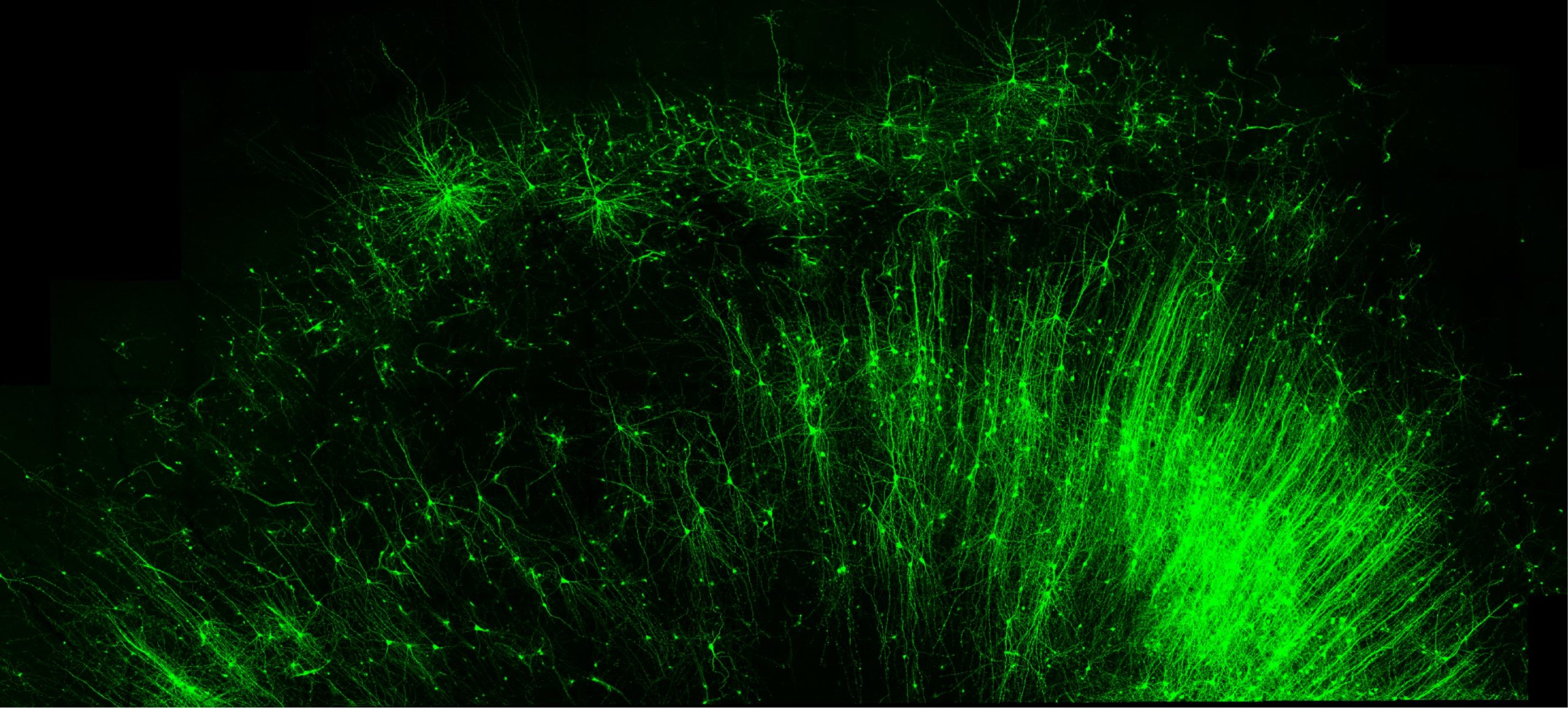
Tagging and illuminating only the inhibitory “brake” cells (green) in human brain tissue is just one of many things the new tool from Duke University, CellREADR, can do.

Editing technology is precise and broadly applicable to all tissues and species.

Scientists at Duke University have developed an RNA-based editing tool that targets individual cells, rather than genes. It is capable of precisely targeting any type of cell and selectively adding any protein of interest.

Researchers said the tool could enable modifying very specific cells and cell functions to manage disease.

Using an RNA-based probe, a team led by neurobiologist Z. Josh Huang, Ph.D. and postdoctoral researcher Yongjun Qian, Ph.D. demonstrated they can introduce into cells fluorescent tags to label specific types of brain tissue; a light-sensitive on/off switch to silence or activate neurons of their choosing; and even a self-destruct enzyme to precisely expunge some cells but not others. The work will be published today (October 5, 2022) in the journal Nature.

Their selective cell monitoring and control system relies on the ADAR enzyme, which is found in every animal’s cells. While these are early days for CellREADR (Cell access through RNA sensing by Endogenous ADAR), the possible applications appear to be endless, Huang said, as is its potential to work across the animal kingdom.

Continue reading… “New RNA Tool Can Illuminate Brain Circuits and Edit Specific Cells”

Halo Car Plans to Have Humans Control Vehicles on Public Streets Remotely

Las Vegas-based startup company, Halo Car, has announced that it will remove human safety operators from behind the wheel later this year, as reported by TechCrunch.

By April Fowell

This means that their vehicles will use humans to control vehicles via public streets and deliver them to its car-sharing service customers remotely. Therefore, their operations will consist of fully remote deliveries and will mark the launch of commercial operations officially. It will also kick off their campaign to scale their fleet of electric vehicles and expand beyond Las Vegas. 

Continue reading… “Halo Car Plans to Have Humans Control Vehicles on Public Streets Remotely”

Google AI Allows You to ‘Fly’ Into a Landscape Photograph

 By MATT GROWCOOT

Google has created a program where the viewer can “fly into” a still photo using artificially intelligent (AI) 3D models. 

In a new paper entitled InfiniteNature-Zero, the researchers take a landscape photo and then use AI to “fly” into it like a bird, with clever software generating a fake landscape thanks to machine learning. 

When facing the daunting task, researchers had to fill in information that a still photo doesn’t provide, such as hidden areas in a photo. For example, a spot that is hidden behind trees needs to be generated. This can be done by “inpainting,” the AI will simulate what it thinks would be there by the process of machine learning with huge datasets. 

Similarly, to get the flying effect, the AI has to generate what is outside of the photograph’s borders. This is called “outpainting” and is much like the content-aware tool in Photoshop where the AI will generate a wider image based upon the original photo and aided by its deep learning from massive datasets. 

As anyone who has ever zoomed into a photo will know, the image quality falls apart as its breaks down into blurry pixels. To stop this from happening, Google uses superresolution, a process where AI synthesizes a noisy, pixellated image into a crisp one. 

Continue reading… “Google AI Allows You to ‘Fly’ Into a Landscape Photograph”

Space Force’s digital push focuses on ‘Spaceverse’

Goal is to create virtual, immersive environments that train Guardians and rapidly develop systems

By Courtney Albon

WASHINGTON — Last fall, the U.S. Space Force gave defense companies an unprecedented look at its initial plan to make missile warning satellites more resilient against potential threats from China.

The business fair was unique in a few ways. It offered industry a deeper understanding of the challenges the service expects to face over the next few decades as adversaries advance space and missile technology and test on-orbit weapons. It also paired that analysis with a roadmap of the capabilities the Space Force thinks it needs to protect against these growing threats — work the service doesn’t typically reveal until much later in the acquisition process.

Perhaps the most significant feature of that October 2021 meeting was that the models it shared with industry to show its analysis of the space environment and the counter-space threats were all digital.

Speaking at the Air and Space Force Conference in National Harbor, Md., last month, Chief of Space Operations Gen. Jay Raymond said the meeting and those models were a first step toward creating what the service calls a “digital thread,” which is essentially a virtual record of a product that continues throughout its lifecycle.

The idea, he said, is for programs to have that thread from the beginning, making it easier to define capability gaps, build a system, test it, inject into a simulated training environment and operate it over time.

“If we do this right, we can take everything from force design to requirements . . . to acquiring the capabilities and testing the capabilities and training our Guardians on those systems — all using the same digital thread,” Raymond said Sept. 20. “That’s nirvana. We’re not close to that. But we’ve taken a good step. We’ve done the digital design, we’re figuring out what that digital requirements process is, and I think it’s going to pay significant dividends for us as we move forward.”

While the thread is central to the Space Force’s vision to be the world’s first fully digital military branch, it’s only one piece. Last May, the service released a vision document that laid out its priorities in this area, which include developing a “digitally fluent” workforce, connecting its field commands in a virtual environment and ensuring that decision-making is informed by data.

Lisa Costa, the Space Force’s Chief Technology and Innovation Officer, told C4ISRNET in an interview that as the service’s leader on implementing this digital vision, her team is focused on three critical areas: creating virtual, immersive environments to train Guardians and develop systems; working with industry to procure digital infrastructure; and identifying future problem sets and capabilities to inform technology and research investments.

Continue reading… “Space Force’s digital push focuses on ‘Spaceverse’”
Discover the Hidden Patterns of Tomorrow with Futurist Thomas Frey
Unlock Your Potential, Ignite Your Success.

By delving into the futuring techniques of Futurist Thomas Frey, you’ll embark on an enlightening journey.

Learn More about this exciting program.