Astrobotic announces plans for lunar power service

Astrobotic’s LunaGrid would use vertical solar arrays and rovers to deliver power to customers at the south pole of the moon.

By Jeff Foust

PARIS — Astrobotic unveiled plans Sept. 19 to develop a commercial power service for the moon that the company argues is essential for creating long-term infrastructure on the lunar surface.

At the International Astronautical Congress here, Astrobotic announced its LunaGrid project, which will combine solar arrays the company is developing with tethered rovers that will deliver uninterrupted power to customers on the lunar surface.

Such a power system, said John Thornton, chief executive of Astrobotic, is essential for systems that can survive for extended periods on the moon. “What we need is long-term infrastructure that can be there and last multiple years,” he said in an interview. “We see this as the grid for the surface of the moon, principally at the poles.”

The power would be generated by Vertical Solar Array Technology (VSAT) arrays, solar arrays that are deployed vertically and are optimized for operations at the lunar poles, where the sun is always low on the horizon. Astrobotic won a $6.2 million award from NASA Aug. 23 to develop and test prototypes of that solar array, one of three the agency made for similar technologies.

Continue reading… “Astrobotic announces plans for lunar power service”

This environmentally friendly quantum sensor runs on sunlight

Light shines through a diamond sensor that is the heart of a sunlight-powered quantum device that measures magnetic fields.

By James R. Riordon

TRADING POWER-HUNGRY LASERS FOR SUNLIGHT IS A FIRST STEP TOWARD SUSTAINABLE QUANTUM TECH.

Quantum tech is going green.

A new take on highly sensitive magnetic field sensors ditches the power-hungry lasers that previous devices have relied on to make their measurements and replaces them with sunlight. Lasers can gobble 100 watts or so of power — like keeping a bright lightbulb burning. The innovation potentially untethers quantum sensors from that energy need. The result is an environmentally friendly prototype on the forefront of technology, researchers report in an upcoming issue of Physical Review X Energy.

Continue reading… “This environmentally friendly quantum sensor runs on sunlight”

Study: Medical debt threatens people’s health, housing

Soaring medical debt is setting U.S. adults up for higher risks of eviction, food insecurity and bad health outcomes regardless of insurance or income, a new study found.

By Sabrina Moreno

Why it matters: Uninsured or middle-to-low-income patients are more likely to get stuck with medical debt while the rich are largely spared. But even private insurance offers little protection against unaffordable bills, according to the study published in JAMA Open Network on Friday.

  • “Private insurance is a defective product. You pay for it and then when you get sick, there’s co-payments, there’s deductibles, there’s out-of-network fees, there’s things that aren’t covered at all,” said Steffie Woolhandler, a physician and public health professor at Hunter College who co-authored the study. 

The big picture: More than 100 million Americans live with medical debt, per an investigation by Kaiser Health News and NPR.

  • Mounting costs coupled with stagnant wages can force people into delaying necessary care, taking on multiple jobs, sacrificing essentials like groceries and depleting savings to the point of financial ruin.

Yes, but: People in states that expanded Medicaid reported an average of $3,000 less in medical debt than those in states who hadn’t, signaling a link between comprehensive coverage and lower bills.

Continue reading… “Study: Medical debt threatens people’s health, housing”

A Star Wars-like hoverbike is set to launch in the US next year

It can fly for 40 minutes and go up to 100 km per hour (Picture: Masatoshi Okauchi/REX)

By Anugraha Sundaravelu

Flying motorbikes are not something that exist in science fiction anymore.

On Thursday, a hoverbike built by Japanese manufacturers made its debut at the Detroit Auto Show.

Drawing inevitable comparisons to the speeder bikes of ‘Star Wars’, the futuristic bikes are scheduled to launch in the United States next year.

The XTURISMO hoverbike is made by Japanese startup AERWINS Technologies and can fly for 40 minutes, reaching speeds of up to 100 km per hour.

‘I feel like I’m literally 15 years old and I just got out of “Star Wars” and jumped on their bike,’ said Thad Szott, co-chair of the auto show after taking a test drive – or, perhaps, a test hover.

‘I mean, it’s awesome! Of course, you have a little apprehension, but I was just so amped. I literally had goosebumps and feel like a little kid,’

Continue reading… “A Star Wars-like hoverbike is set to launch in the US next year”

Air Canada-Backed Startup Launches New Electric Airplanes! Here’s the New Heart Aerospace ES-30

Air Canada is ordering 30 units of the new zero-emission aircraft.

By Griffin Davis

The Air Canada-backed startup, Heart Aerospace, launched a new electric airplane. The giant airline company announced that it had already ordered 30 units of the new zero-emission aircraft. 

Now, it seems like they are getting the attention of major airlines across the globe. This can be seen in the latest investment made by Air Canada in Heart Aerospace.

Air Canada-Backed Startup Launches New Electric Airplanes!

According to Electrek’s latest report, Heart Aerospace unveiled the new ES-30, the successor of the recent ES-19 model.

Continue reading… “Air Canada-Backed Startup Launches New Electric Airplanes! Here’s the New Heart Aerospace ES-30”

First 3D printed multi-storey home in North America completes

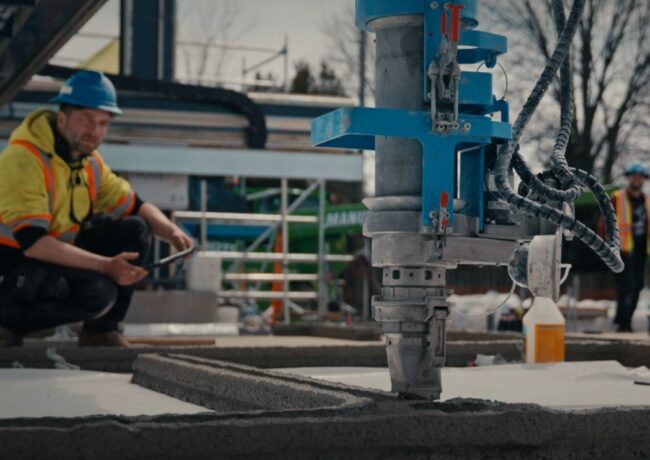
After 80 hours of printing concrete, Ontario-based Nidus3D has finished a two-storey 3D printed home in a test of how technology could speed up construction and ease a shortage in trade skills.

The home, Nidus3D’s second, is a 2,300 sq ft space with a studio on the ground floor and residence above.

Using a COBOD BOD2 printer, the company cut construction time by more than half from its first 3D printed home, which took 200 hours to build.

Another innovation, it said, was 3D printing a horizontal beam on site and lifting into place by a crane.

Although there are other 3D printed homes in the US and Canada, these have either been one-storey houses or included a second non-3D printed storey.

In Europe, a company called Kamp C built the continent’s first two-storey 3D printed house in July 2020. Created entirely on site, the building in Westerlo, Belgium also used a BOD2 printer.

Continue reading… “First 3D printed multi-storey home in North America completes”

Space Diamonds From Dwarf Planets May Be Future Of Mining & Manufacturing

Tiny folded diamonds that fell to Earth from an ancient dwarf star may sound like something from an intergalactic feature film, but researchers from Australia and the United Kingdom have proven the existence of the rare gems after examining a stony meteorite.

BY TYLER DURDEN

Scientists from Australia and the UK have established the existence of lonsdaleite, a rare hexagonal diamond, no bigger than a human hair, that researchers note is layered into a distinctive folded pattern, unlike the earth-formed diamonds that have a cubic structure.

The existence of Lonsdaleite—named after the pioneering British crystallographer Dame Kathleen Lonsdale—has previously been the subject of debate because its very existence could not be proven.

The lead scientist on the research team Prof. Andy Tomkins, from Monash University’s School of Earth, Atmosphere, and Environment, said the mysteries of the rare diamond were what drove him continue researching ureilite meteorites in his lab.

Tomkins said it was a case of curiosity-driven science.

“This is exactly the sort of curiosity-piquing observation that sends scientists diving down rabbit holes for months on end,” he said.

Continue reading… “Space Diamonds From Dwarf Planets May Be Future Of Mining & Manufacturing”

Vast Space To Build an Artificial-Gravity Space Station in Orbit

By Tiffany Winfrey

Jed McCaleb, a cryptocurrency entrepreneur and founder of Vast Space, wants to build an artificial-gravity space station in low Earth orbit.

According to McCaleb (via Space News), there will be a lot of humans living all around the solar system in the future.

Since other businesses are assisting in lowering launch costs, McCaleb believes that building substantial buildings for people to live and work in space will be the next crucial step.

Continue reading… “Vast Space To Build an Artificial-Gravity Space Station in Orbit”

New Buzz Lightyear Toy Includes Conversational AI and Voice Recognition

By ERIC HAL SCHWARTZ

Robot toymaker Robosen has debuted a new Buzz Lightyear toy based on the recent Disney and Pixar film built with conversational AI and voice recognition to interact with children. The robot incorporates natural language understanding to detect when it is addressed and respond like the character from the film, though the AI makes it seem more like the Toy Story action figure that comes to life when no humans are around. The $650 robot is available for pre-order and will arrive next spring (when its price will rise to $800).

Continue reading… “New Buzz Lightyear Toy Includes Conversational AI and Voice Recognition”

Steering the Future of Autonomous Vehicles

Keith J. Bucklew, Freight Planning Practice Leader, HDR

AUTONOMOUS VEHICLES COULD RESHAPE THE TRUCKING INDUSTRY, PRESENTING A SOLUTION TO IMPROVE SAFETY AND CAN BE A FREIGHT MOBILITY MULTIPLIER TO SUPPORT SUPPLY CHAIN EFFICIENCY AND RELIABILITY. BUT A PATCHWORK OF STATE LAWS CREATES A HINDRANCE TO IMPLEMENTING EMERGING TECHNOLOGY.

Currently the United States has no federal guidelines for how autonomous trucking vehicles should operate. In the absence of uniform standards, the trucking industry should unite to encourage states to act jointly to create consistent regulations for the implementation of new technology.

In sports, a football team knows, regardless of where they play, that the field dimensions and game rules are the same, but that is not true for the trucking industry. It’s as if Soldier Field in Chicago was twice as long as the field at SoFi Stadium in Los Angeles. That discrepancy would invite chaos.

With the absence of consistency, the freight technology playing field can be an operational quagmire. The trucking industry should speak as one voice to advocate for both federal and state uniform regulations.

Continue reading… “Steering the Future of Autonomous Vehicles”

Into the metaverse: How conversational AI will build its experiential foundation


By Raj Koneru

The much-hyped metaverse concept — once thought of as a futuristic, hypothetical online destination — is quickly becoming a new kind of internet. As more users interact with one another in these virtual environments, brands will realize new opportunities for engaging their target audiences. Companies such as Meta (formerly Facebook) are rapidly making plans to expand into the metaverse, altering and advancing how people will work, socialize, shop and even bank in the future. 

While some completely disagree with the positive potential of this digital world, it cannot be refuted that the metaverse is a topic that many have heard of and will become increasingly ubiquitous. Gaming may be its most obvious initial use case, as consumers and gamers alike are steadily continuing to merge their physical and digital lives. This is something that’s been happening since the arrival of the iPhone, a device that has become an extension of our brains and bodies. As technology progresses and advances, it’s only natural that more parts of our lives will be embedded into the digital world. 

With more people opting to “live” inside the metaverse, there will be routine tasks that require more advanced and intuitive communication. Be it mailing a letter, purchasing land or buying a burger, there must be a proper way to scale communications through artificial intelligence. Technologies like CAIP (conversational AI platforms) will allow brands to design more appealing and engaging user experiences in this burgeoning virtual environment.

Continue reading… “Into the metaverse: How conversational AI will build its experiential foundation”

The Future of Healthcare in the Home May Come With Robots

Modern tech has revolutionized the healthcare industry. When patients can’t be treated at the hospital, new technologies enable patients to receive quality care from the comfort of their homes.

By Sam Bowman 

But while the benefits of telehealth were once limited to virtual checkups and prescription deliveries, modern healthtech is advanced enough to completely replace several services offered by primary care providers, hospitals, and specialists.

Thanks to modern robotics — and the artificial intelligence that supports its functionality — care is more convenient, accurate, and affordable than ever. Let’s explore some of the new technology that brings doctors to patients’ homes, and how providers and patients alike can benefit from robots in the future of healthcare.

Continue reading… “The Future of Healthcare in the Home May Come With Robots”
Discover the Hidden Patterns of Tomorrow with Futurist Thomas Frey
Unlock Your Potential, Ignite Your Success.

By delving into the futuring techniques of Futurist Thomas Frey, you’ll embark on an enlightening journey.

Learn More about this exciting program.