Boom Supersonic’s XB-1 Breaks Sound Barrier, Capturing Shock Waves and Achieving Sonic Boom-Free Flight

In a groundbreaking achievement, Boom Supersonic’s XB-1 aircraft has captured the attention of the aviation world by breaking the sound barrier during a supersonic flight, with shock waves from the event photographed in stunning detail. The historic flight, which took place in January, marked XB-1 as the first privately developed civil supersonic aircraft to break the sound barrier in the United States.

Just weeks later, on February 10th, the aircraft achieved another supersonic milestone, this time in collaboration with NASA. The second flight was used to capture detailed ground-based images of the shock waves generated by the XB-1 as it soared at supersonic speeds. For this specialized imaging, a team from NASA utilized Schlieren photography, a technique that reveals changes in air density around the aircraft—a phenomenon that is typically invisible to the naked eye.

Continue reading… “Boom Supersonic’s XB-1 Breaks Sound Barrier, Capturing Shock Waves and Achieving Sonic Boom-Free Flight”

GE’s Catalyst Engine Certification Marks a Game-Changer for the Turboprop Market

GE’s Catalyst turboprop engine has reached a critical milestone with its recent Federal Aviation Regulation (FAR) Part 33 certification, ensuring its airworthiness and bringing it a step closer to operational deployment. This achievement is not only a technical success but also a testament to the significant innovations behind the engine, including the extensive use of 3D printing in its design. Nearly a third of the Catalyst’s internal components have been created using 3D printing technology, replacing 855 traditionally manufactured parts with just 12 3D-printed ones. The result is a lighter, more efficient engine that promises substantial cost savings in maintenance and fuel consumption.

The Catalyst turboprop engine features optimized components, including the high-temperature turbine and compressor, which have been designed for improved performance. Notably, the engine consumes 18% less fuel than comparable engines, which represents a significant financial advantage for operators. With turboprop fuel costs ranging from $250 to $600 per hour, this reduction in fuel consumption can have a considerable impact on overall operational costs.

Continue reading… “GE’s Catalyst Engine Certification Marks a Game-Changer for the Turboprop Market”

BrainLLM: A Breakthrough in Decoding Thoughts into Text Using Brain Activity

Recent developments in large language models (LLMs), like those powering AI chatbots such as ChatGPT, have revolutionized text generation by predicting word sequences. However, integrating these models with brain recordings has remained a significant challenge. The key question is whether we can directly generate natural language from brain activity, bypassing the limitations of predefined word sets. A groundbreaking study has made strides toward this vision by introducing BrainLLM, a system that merges brain recordings with LLMs to generate coherent natural language.

In this study, researchers developed BrainLLM, a system designed to directly translate brain activity into natural language by integrating brain recordings with an LLM. The study relied on non-invasive functional magnetic resonance imaging (fMRI) data collected from participants while they processed spoken or written language stimuli. To train the model, the researchers used three public datasets containing fMRI recordings of individuals exposed to various linguistic stimuli.

Continue reading… “BrainLLM: A Breakthrough in Decoding Thoughts into Text Using Brain Activity”

Revolutionary Burner Design Tackles Methane Emissions with Advanced Technology

A cutting-edge burner has been developed to improve methane combustion efficiency, featuring a unique nozzle design that directs methane flow in three distinct directions, alongside an impeller that guides gas toward the flame. This innovative configuration ensures optimal oxygen-methane mixing and enables complete combustion before external factors like crosswinds can disrupt the process. The burner’s design was made possible through a combination of machine learning, computational fluid dynamics, and additive manufacturing techniques.

Extensive testing at Southwest Research Institute’s (SwRI) indoor facility confirmed the burner’s effectiveness in simulating controlled crosswind conditions. “Even a slight crosswind drastically reduced the efficiency of most burners. We discovered that the structure and movement of the fins inside the burner played a critical role in maintaining optimal performance,” explained SwRI Principal Engineer Alex Schluneker.

Continue reading… “Revolutionary Burner Design Tackles Methane Emissions with Advanced Technology”

Maserati Sets New Autonomous Speed Record at Kennedy Space Center

Maserati has just achieved a groundbreaking milestone in autonomous driving, setting a new speed record at the iconic Kennedy Space Center in Florida. The stunning MC20 supercar reached an impressive 197.7 mph with no driver behind the wheel, marking a major leap forward for autonomous technology.

This remarkable feat is the result of a collaboration between the Indy Autonomous Challenge (IAC) and Politecnico di Milano, Italy’s largest scientific and technological university. The partnership is pushing the boundaries of hardware, computing power, and artificial intelligence to explore the future of autonomous vehicles.

Continue reading… “Maserati Sets New Autonomous Speed Record at Kennedy Space Center”

Stem Cell Therapy Restores Vision in Patients with Corneal Damage

A groundbreaking stem cell therapy known as CALEC has demonstrated a remarkable 92% success rate in regenerating corneas and restoring vision for patients with previously untreatable eye injuries. Although still in the experimental stage, the procedure shows significant promise, particularly for those suffering from severe corneal damage.

In an expanded clinical trial, the CALEC therapy was tested on 14 patients with blinding corneal injuries. The results, published on March 4, 2025, in Nature Communications, revealed that the treatment was not only feasible and safe but also showed a high proportion of complete or partial success. The patients were followed for 18 months, and the trial’s outcomes were hailed as a major advancement in regenerative medicine for eye injuries.

Continue reading… “Stem Cell Therapy Restores Vision in Patients with Corneal Damage”

Revolutionizing Taste: The Digital Device Bringing Flavor to Virtual Reality

As I scroll through cooking videos online, I come across a Cajun blackened shrimp recipe that looks absolutely mouthwatering. The presenter describes it so vividly: juicy, plump, smoky, with a burst of spices. Although I haven’t tasted the dish, I can almost imagine its rich flavor. But what if we could recreate that exact experience from the digital world directly in our mouths? Thanks to a new breakthrough, we’re one step closer to making that a reality.

A device smaller than a postage stamp is capable of mimicking primary tastes like salty, sweet, sour, bitter, and savory (or umami), opening the door to experiencing food digitally. This reusable gadget mixes chemicals that represent these fundamental tastes and then delivers them to the tongue in gel form. Developed by researchers at Ohio State University, the system features a gum-like strip connected to a liquid reservoir. It works by releasing taste components in a gel, which then interacts with the user’s taste buds. The device is wireless and includes a sensor that helps regulate the precise chemical blend.

Continue reading… “Revolutionizing Taste: The Digital Device Bringing Flavor to Virtual Reality”

Breakthrough in Space Manufacturing: First Metal Component Printed on the International Space Station

A major milestone in space manufacturing has been achieved with the return of the first-ever metal component produced on the International Space Station (ISS). The component, created using a metal 3D printing system developed by Airbus and its partners, marks a significant step forward in additive manufacturing technology for space exploration. This system has been operational in the ISS’s Columbus module since January 2024, thanks to ESA astronaut Andreas Mogensen, who installed it as part of his Huginn mission.

The first successful print, a curved structure shaped like an “S”, was completed in June 2024. Following this initial test, a fully functional component was produced later that summer, with another sample printed in December. The sample now returned to Earth is being analyzed at the European Space Research and Technology Center (ESTEC) in the Materials and Electrical Components Laboratory. The primary objective of this investigation is to compare how the metal 3D printing process in microgravity differs from production on Earth. Another sample will also be sent to the Technical University of Denmark (DTU) for further analysis.

Continue reading… “Breakthrough in Space Manufacturing: First Metal Component Printed on the International Space Station”

Japan Takes Major Step Toward Tackling Space Debris with Groundbreaking ADRAS-J Mission

The growing issue of space debris—comprising spent rockets, defunct satellites, and other fragments—poses an increasing threat to active missions in Earth’s orbit. If left unchecked, this orbital clutter could lead to catastrophic collisions, damaging current satellites and jeopardizing the future of space exploration.

In response to this looming crisis, a team in Japan is making significant strides to clean up the space junk. Astroscale, a company dedicated to removing space debris, launched its ADRAS-J mission to test innovative technology designed to capture and remove debris. ADRAS-J stands for Active Debris Removal by Astroscale-Japan.

Continue reading… “Japan Takes Major Step Toward Tackling Space Debris with Groundbreaking ADRAS-J Mission”

Princeton and University of Washington Develop Ultra-Efficient Light-Based Camera for AI Vision

Researchers from Princeton University and the University of Washington have made a remarkable leap in camera technology by developing an ultra-compact camera—about the size of a grain of salt—that captures incredibly detailed, full-color images. Building on this breakthrough, the team has now developed a new type of camera designed for computer vision, a key area of artificial intelligence (AI) that enables computers to recognize and interpret images and videos.

This new prototype camera takes a radically different approach to computer vision. Unlike traditional devices that rely on electricity, this camera uses light to perform object identification and analysis, offering extraordinary speed and energy efficiency. The camera can identify objects at the speed of light, making it far faster and more efficient than conventional computer vision systems.

Continue reading… “Princeton and University of Washington Develop Ultra-Efficient Light-Based Camera for AI Vision”

MIT Develops Thread-Based Fabric Computers for Whole-Body Monitoring

Wearable technology has become a staple in modern life, but most devices are limited to smartwatches, rings, and eyewear. Now, researchers have developed a revolutionary thread-based computer that can be stitched directly into clothing, paving the way for a new era of body monitoring. This breakthrough could have significant applications in healthcare, sports, and beyond.

While devices like smartwatches are able to track heart rate, body temperature, and movement, they are often confined to monitoring specific points on the body. Meanwhile, humans generate vast amounts of data, such as heat, sound, and electrical signals, that these devices fail to capture. Recognizing this gap, a team of engineers from MIT has created a fabric-based computer capable of monitoring the body in a far more comprehensive way.

Continue reading… “MIT Develops Thread-Based Fabric Computers for Whole-Body Monitoring”

SLAC Physicists Break Records with World’s Most Powerful Electron Beams

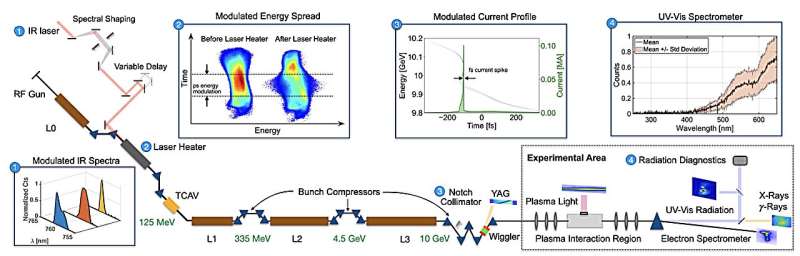
A team of physicists at the SLAC National Accelerator Laboratory in Menlo Park, California, has successfully generated the highest-current, highest-peak-power electron beams ever recorded. Their groundbreaking research, published in Physical Review Letters, marks a significant step forward in the development of high-powered electron beams, a field with potential applications ranging from fundamental science to industrial uses.

For years, scientists have pushed the boundaries of high-powered laser light, exploring its ability to split atoms and recreate conditions found on other planets. However, the SLAC team’s focus was on advancing the power of electron beams, aiming to give them similar capabilities as high-powered lasers.

Continue reading… “SLAC Physicists Break Records with World’s Most Powerful Electron Beams”
Discover the Hidden Patterns of Tomorrow with Futurist Thomas Frey
Unlock Your Potential, Ignite Your Success.

By delving into the futuring techniques of Futurist Thomas Frey, you’ll embark on an enlightening journey.

Learn More about this exciting program.