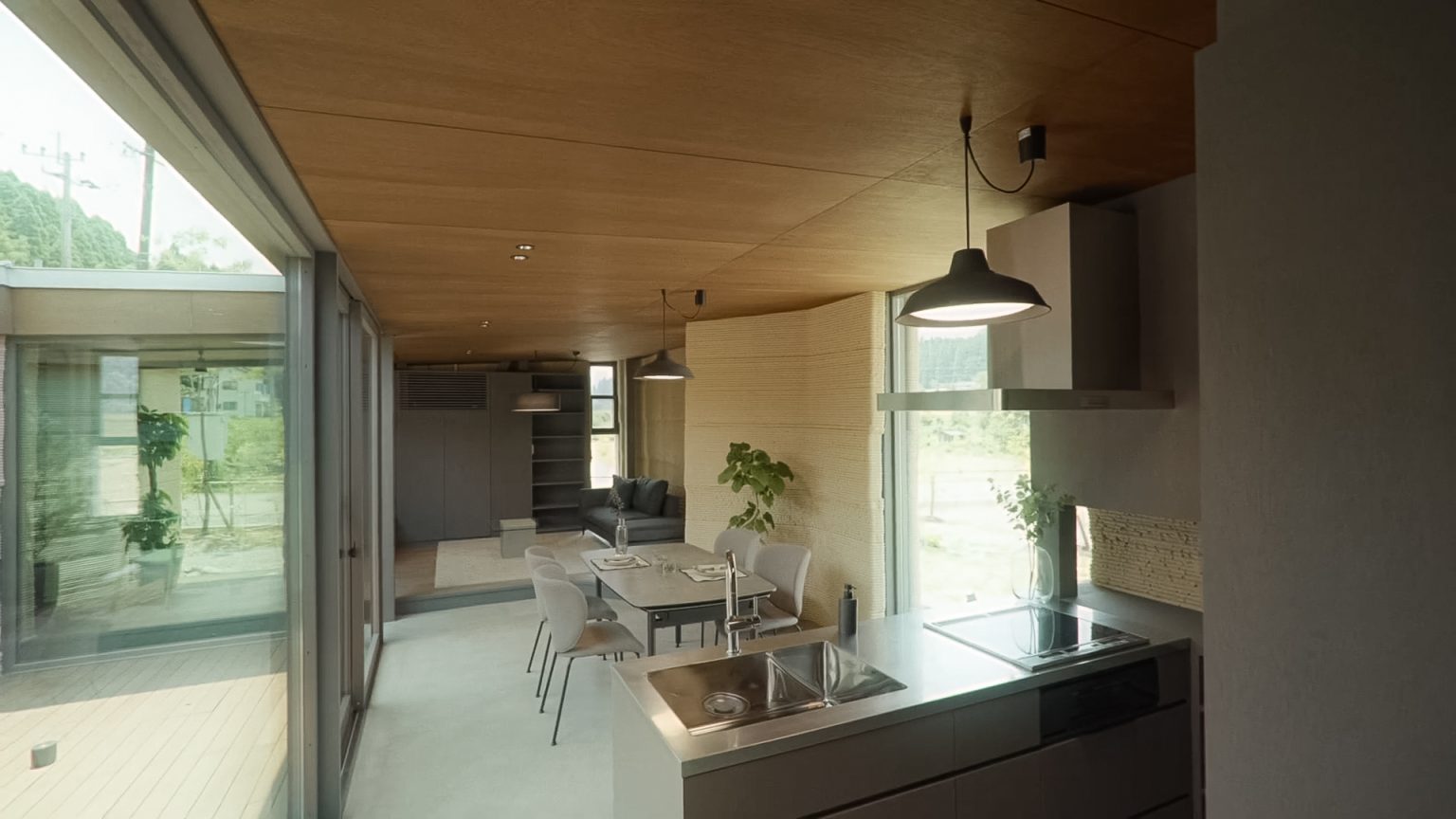
Concrete has dominated architecture for more than a century, shaping everything from suburban homes to megacities. But in Japan, a quiet revolution is underway—one that replaces cement with earth, sensors, and code. The result? A home that is both ancient in material and futuristic in execution.
The project, called Lib Earth House B, is the latest milestone from Japanese firm Lib Work in collaboration with Italian 3D printing pioneer WASP. Using the massive Crane WASP 3D printer, which was first unveiled in 2018 with the prototype “Gaia,” the team built an entire 100-square-meter residence without a single bag of cement. Instead, they relied on earth-based materials, locally sourced and layered into form with additive manufacturing.
This is more than an architectural experiment. It’s a provocation. If houses can be printed directly from the ground beneath our feet, what happens to centuries-old supply chains built on quarries, kilns, and global shipping? If walls themselves can become intelligent, laced with sensors monitoring temperature and humidity in real time, what does that mean for the future of building design?
Inside, the Lib Earth House offers all the comforts of a modern dwelling—kitchen, bedroom, bathroom, living space—yet its bones come from a process that feels closer to pottery than to pouring concrete. Thick, sculpted walls provide not only structural strength but also natural insulation. Embedded sensors feed continuous data on condensation and thermal stability, turning the house itself into a long-term research platform.
But technology doesn’t stop at the walls. On the roof, a photovoltaic system powers the home, with excess energy stored in a Tesla Powerwall, making it capable of autonomous operation. It’s not just a house; it’s a self-aware, energy-independent node in a new kind of circular economy.
WASP founder Massimo Moretti called the project a “concrete example of international cooperation,” though the irony is that concrete itself is entirely absent. Instead, this collaboration fuses natural materials with digital precision, hinting at a future where houses are not manufactured, but grown and printed directly from the environment.
The implications are vast. Imagine disaster relief housing printed onsite from the local soil, villages erected in days rather than years, or entire neighborhoods customized not just in design but in their environmental performance. Instead of fighting against nature with steel and cement, we could build in dialogue with it, shaping walls that breathe, monitor, and adapt.
For now, Lib Earth House B is still a proof of concept, but it marks a turning point: 3D printing is moving from quirky prototypes to real, livable homes. And as more data is collected from this and similar projects, the question shifts from “Can we build this way?” to “Why would we keep building any other way?”
The future of construction may not be about skyscrapers of glass and steel but about intelligent dwellings of earth and sensors—homes that reconnect us to the soil while carrying us into a hyper-digital age.
For further reading: