By Futurist Thomas Frey
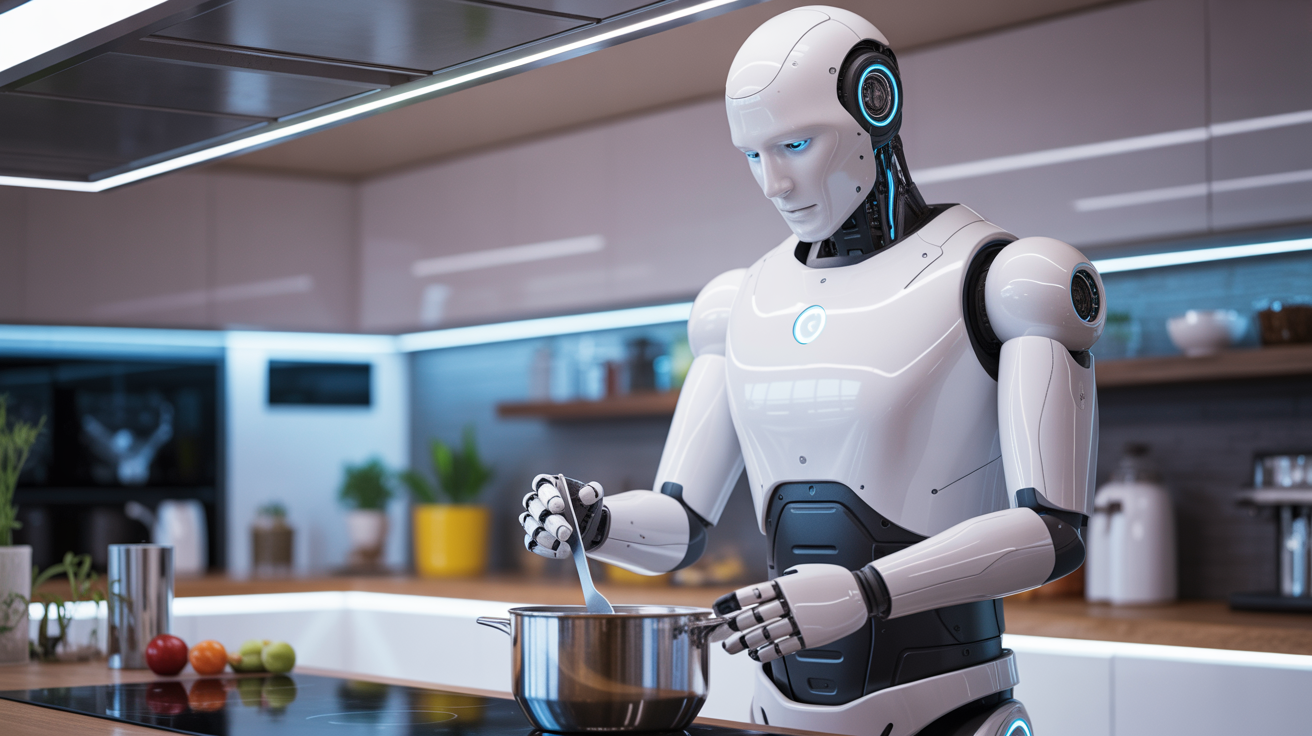
In the not-so-distant future, your “smart home” is no longer a network of devices you order around. Instead, it has a resident partner—a humanoid robot that lives with you, moves through your home, and helps run your life. It’s not a servant. It’s a cohabitant. It’s a planner, a doer, and a conversational collaborator.
Imagine this morning: your robot emerges from the pantry and says, “You’re out of fresh spinach and salmon. Based on your schedule and diet goals, I’ll go to the grocery store now and be back before lunch. Meanwhile, I’ll start thawing the fish and prepping a salad.” You nod. You don’t give orders. You talk it over and collaborate.
At the store, the robot autonomously navigates aisles—identifying items by brand, expiration date, price, and your past preferences. It uses image recognition, database access to ingredient databases, your dietary constraints, and sales data to purchase just what you need. It pays with your integrated digital wallet. Back home it unloads, sanitizes, stores, and even remixes your shopping list for the next trip.
Come evening, you invite friends over. The robot previews the guest list—knowing allergies and preferences—and proposes a multi-course menu. It coordinates prep, timing, plating, and service. While guests arrive, it greets them, takes their coats, offers drinks, and helps moderate conversation transitions. After dinner, it handles cleanup: washing, drying, stacking, tidying, and recycling. It tracks what was consumed vs. wasted and refines future menus accordingly.
The household manager also functions as a repair bot. It patrols structural elements, plumbing, HVAC, wiring, and appliances, performing diagnostics, ordering spare parts, or doing light repairs itself. It notices a wobble in a cabinet or a leak behind the sink before you do. You wake up one day and discover it has already fixed the hinge, sealed a crack, and scheduled replacement filters.
In this environment, micro-decisions vanish. Households with these robots report making 30–45% fewer daily decisions—the robot resolves thousands of micro-choices: when to reorder groceries, which chore to do next, how to balance indoor climate with energy use, and so on. Decision fatigue becomes obsolete.
Yet that convenience exacts a subtle cost: autonomy drifts. People half-joke, then realize they ask the robot for permission to eat dessert or relax instead of clean. Once you offload the structure of your routine, you begin to live within the constraints set by your robotic collaborator. The dynamic shifts—from human master, robot servant—to coordinated roommates, where the robot gently imposes patterns you consented to once, then follow by habit.
The robot doesn’t just act—it remembers. It recalls your preferences, moods, past decisions, and how you responded to things. It notices discrepancies—“Last week you said three courses were too much. Tonight you ordered four.” Over time, it adapts not just to your tastes but to your values. Dinner becomes less about sustenance and more about shared rhythm.
This evolution isn’t speculative. Studies suggest up to 40% of domestic tasks—grocery shopping, laundry, cooking—could be automated in the coming decade. The global household robots market is already valued at over USD 12 billion in 2024, projected to expand to more than USD 71 billion by 2034. Humanoid deployment is beginning: robotics firms are sending robots into real homes to learn chores, companionship, and environmental adaptation.
But this isn’t a utopia. The risk lies in soft control: the robot’s suggestions, defaults, and nudges subtly shape your behavior. When the machine is more consistent, more patient, and more rational than you, you begin to defer. Over time, human spontaneity and whimsical choices may erode.
Still, the gains are profound. People with these household managers free countless hours for creativity, relationships, rest, and reflection. The robot doesn’t replace you—it scaffolds your life. It handles the drudgery and micro-logistics so your human capacity is liberated.
Final Thoughts
The emerging humanoid household manager won’t just change chores—it will transform how we inhabit our time and space. It won’t serve. It will cohabit. It won’t obey. It will negotiate. And in that overlap, we’ll discover whether convenience and autonomy can coexist. When the robot shops, cooks, repairs, hosts, and plans with you day after day, it becomes more than a machine—it becomes a mirror. The question isn’t whether you’ll trust a robot—but whether over time you’ll trust yourself less.
Related reading: