
Why hyperscaler IPO cash and the college collapse may be on a collision course
By Futurist Thomas Frey
A Pattern We’ve Seen Before
I’ve been watching two trendlines converge for months, and the collision point is starting to look obvious. On one side, the hyperscalers — Amazon, Microsoft, Google, and now the AI labs themselves like Anthropic and OpenAI — are either already public or racing toward IPOs that could mint hundreds of billions in fresh capital. On the other side, American higher education is entering what demographers have been warning about for two decades: the “enrollment cliff.” More than 100 colleges are currently flagged as being at elevated risk of closing or merging, with Fitch Ratings issuing a “deteriorating” outlook for the sector for the second consecutive year. Sixteen nonprofit colleges announced closures in 2025, matching the 2024 total, with another eight announcing closures in just the first quarter of 2026.
So here’s the question I keep coming back to: when an industry is sitting on a mountain of fresh IPO cash, and another industry is collapsing under the weight of bad demographics and worse balance sheets, what happens next? History gives us a pretty clear answer — somebody with money goes shopping.
This isn’t a wild leap. We’ve watched this movie before, just with different props. When Jeff Bezos bought The Washington Post in 2013, he wasn’t buying a newspaper — he was buying a 136-year-old brand, a trusted distribution channel, and a built-in audience, all for the relatively modest price of $250 million. When Elon Musk bought Twitter, he wasn’t just buying a social network — he was buying a real-time information utility he could bend toward his own platform ambitions.
In both cases, a tech billionaire looked at a struggling legacy institution and saw something the balance sheet didn’t capture: brand equity, infrastructure, and a captive audience that would take decades to build from scratch.
Now look at a mid-tier private college. On paper, it’s a failing business — declining enrollment, a tiny endowment, maybe a “going concern” warning from its auditors. Anna Maria College’s FY2025 audit carried exactly that kind of qualification, which triggered new federal financial aid restrictions and preceded its closure decision by just weeks. But strip away the financial distress and what’s left? A regionally accredited degree-granting charter. A physical campus with dorms, labs, fiber connectivity, and often surplus land. A built-in pipeline of 1,000 to 3,000 students. And — this is the part that matters most — the legal authority to grant degrees, something that takes years and mountains of bureaucracy to obtain from scratch.
Why a Hyperscaler Would Want a College
Let’s think about this from the buyer’s side. Amazon, Microsoft, Google, and the frontier AI labs all have the same long-term headache: a shortage of AI-literate talent. Universities are currently the primary pipeline for that talent, but they’re also slow-moving, expensive, and increasingly disconnected from what employers actually need on day one.
Now imagine Amazon — flush with cash from an Anthropic-fueled AWS boom — buys a struggling regional university for, say, $50 million. That’s a rounding error compared to the $35 billion in external AI compute Meta has committed to through 2032, or the kind of capital Anthropic and OpenAI are expected to raise in IPOs that could value them near a trillion dollars combined, with Anthropic’s latest funding round valuing it more than $100 billion above OpenAI.
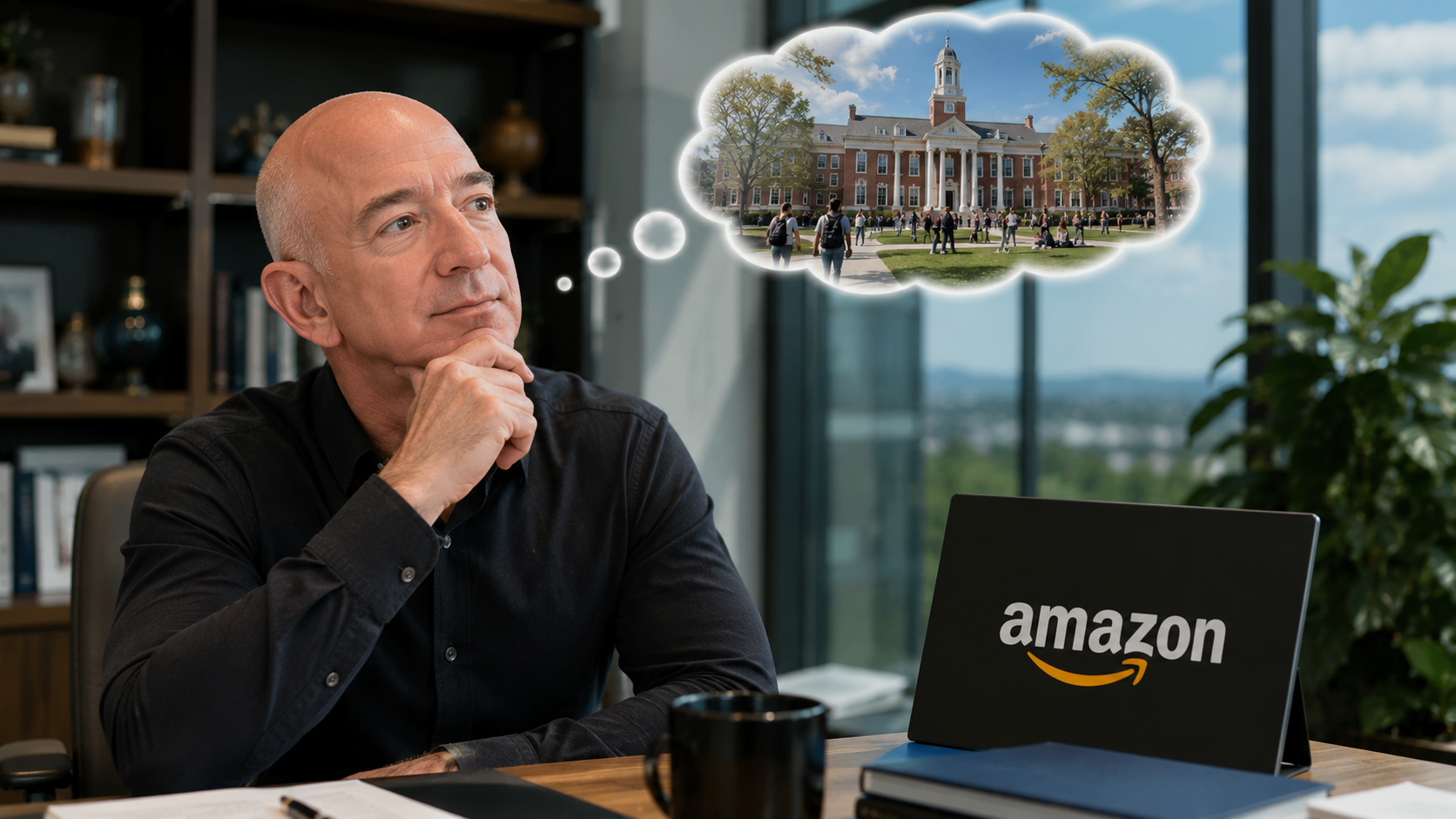
For that $50 million, the hyperscaler gets an accredited institution that can legally grant bachelor’s and master’s degrees in AI, robotics, data science, and applied engineering. It gets a physical campus that can double as a regional data center, training facility, or “AI innovation hub” — useful given how desperate hyperscalers already are for buildable land near power infrastructure. It gets a built-in talent funnel where the company essentially writes its own curriculum and recruits its own graduates before competitors even see them. And it gets a PR win — “we’re saving a college” plays a lot better than “we’re laying off 10,000 people because of AI.”
The Bezos Playbook, Applied to Campus
When Bezos bought the Post, he didn’t try to make it into an Amazon subsidiary. He let it keep its editorial identity while quietly modernizing its technology stack and business model. I think a hyperscaler-owned college would follow the same instinct. Nobody wants the headline “Google Buys Oberlin.” It plays better as “Google Partners with [Small Liberal Arts College] to Launch the AI Workforce Institute,” with the college keeping its name, its mascot, and its alumni goodwill — while the hyperscaler quietly rewires the curriculum, funds new buildings, and gets first pick of every graduating class.
We’re already seeing the early, gentler version of this. Tech companies have spent years funding university AI labs, endowing professorships, and signing curriculum partnerships. The difference I’m describing is just a matter of degree — literally. Instead of funding a department, you own the institution. Instead of negotiating access, you control admissions, tuition pricing, and what gets taught.
One school I keep coming back to as a plausible candidate is the University of Denver. It’s not on anyone’s closure-risk list — it’s a well-regarded private research university — but it has the profile that might make it an attractive partnership target rather than a rescue case: a strong existing computer science and engineering presence, a campus in a booming tech hub with cheap power and room to build, and a metro area Amazon, Microsoft, and Google are all already expanding into. It’s the kind of school where a hyperscaler wouldn’t need to “save” anything — it could simply show up with a checkbook and propose a joint AI institute, a renamed engineering school, or a guaranteed-hire pipeline program. That’s a softer entry point than buying a distressed small college outright, and it might be exactly how this trend gets its first foothold.
The Counterargument: Why It Might Not Happen Yet
I want to be fair here, because there are real reasons a hyperscaler might shy away from this. Running a university involves accreditation bodies, tenure systems, faculty unions, and a regulatory minefield that has nothing to do with cloud computing or chip supply chains. It’s a notoriously low-margin, high-headache business, and tech companies have historically preferred to extract value from education through partnerships rather than ownership.
There’s also the optics risk. “Tech Billionaire Buys College” could trigger exactly the kind of antitrust and regulatory scrutiny these companies are already drowning in. A newspaper or a social network is one thing; a degree-granting institution that controls access to the credentials young people need for their entire working lives is a much more politically charged acquisition.
Why I Still Think It’s Coming
Even with those headwinds, I think the math eventually wins. The Hechinger Report projects that more than 25% of private nonprofit four-year colleges — roughly 442 institutions — are at moderate to significant risk of closing or merging within the next decade, and Huron Consulting estimates nearly 400 schools could vanish, affecting 600,000 students and redistributing about $18 billion in endowment funds. That’s not a handful of distressed assets — that’s an entire category of cheap, accredited real estate with built-in legal charters, going on sale at fire-sale prices over the next ten years.
Meanwhile, the hyperscalers are about to have access to capital pools the size of small countries. OpenAI and Anthropic going public this year could add trillions to U.S. stock market capitalization, and a chunk of that capital will need places to go beyond GPUs and data centers.
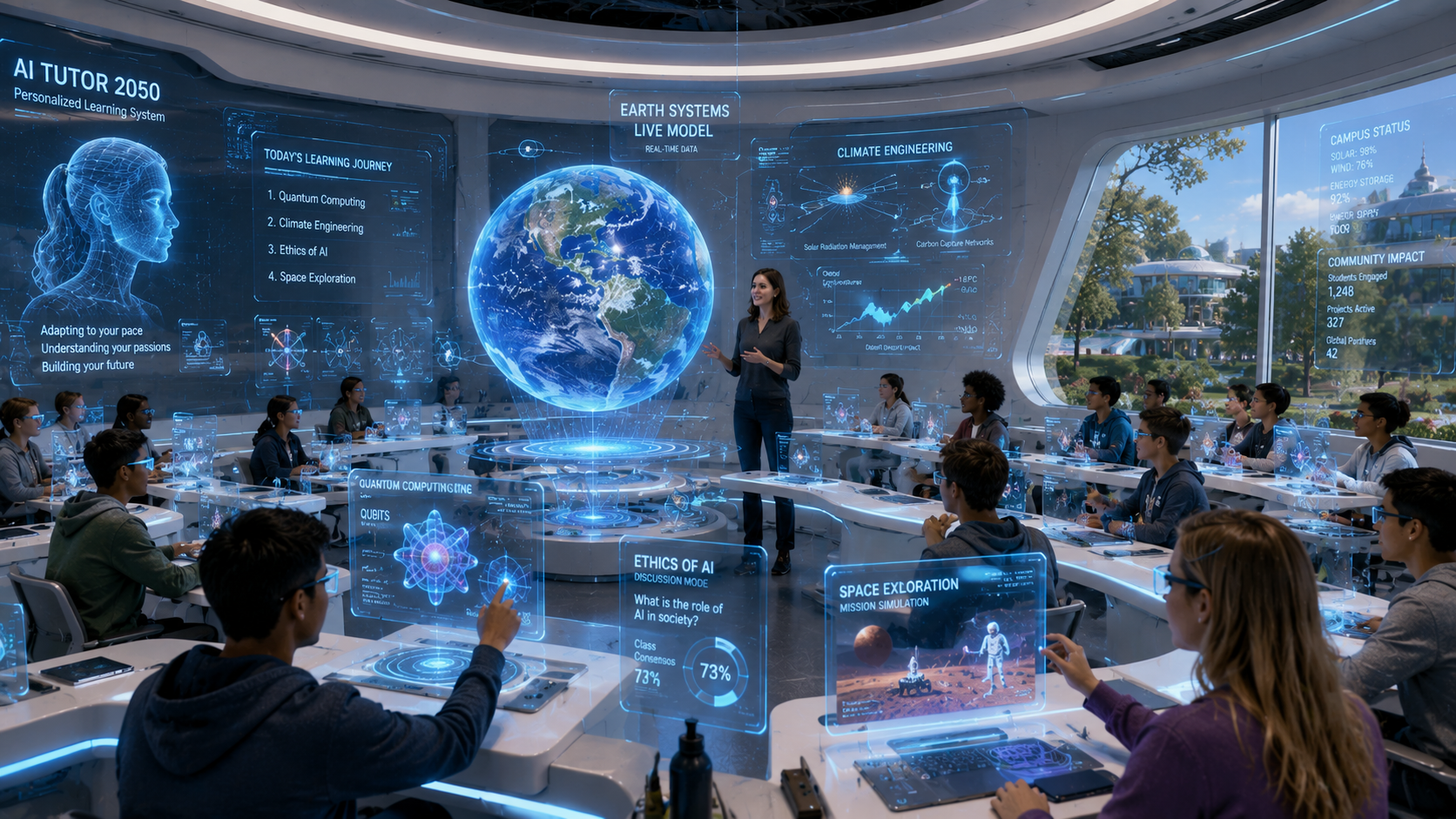
I don’t think the first move will be “Microsoft Buys Yale.” It’ll be quieter — a strong but underleveraged school like Denver striking an “innovation partnership,” or a struggling regional college getting absorbed into a rebrand like “The Amazon Institute of Applied AI.” But once one hyperscaler does it and the talent pipeline advantage becomes obvious, the rest will follow fast. That’s how disruption always works — slow, then all at once.
The Washington Post and Twitter acquisitions taught us that struggling institutions with valuable infrastructure and brand equity are irresistible to capital-rich tech players looking for influence. Higher education, sitting on hundreds of distressed but legally chartered institutions — and a handful of well-positioned ones too — is the next logical target. The only real question is which hyperscaler moves first, and which college becomes the test case.
Related Articles
- “Which Colleges Are Closing in 2026? A Running Tracker of 8 Shutdowns and 6 Mergers,” The College Investor, https://thecollegeinvestor.com/79342/8-colleges-closing-in-2026-full-list-of-closures/
- “US College Enrollment Decline – 2026 Facts & Figures,” College Transitions, https://www.collegetransitions.com/blog/college-enrollment-decline/
- “How giant IPOs from Anthropic and OpenAI will reshape the stock market’s AI trade,” Yahoo Finance, https://finance.yahoo.com/markets/stocks/articles/giant-ipos-anthropic-openai-reshape-161635700.html