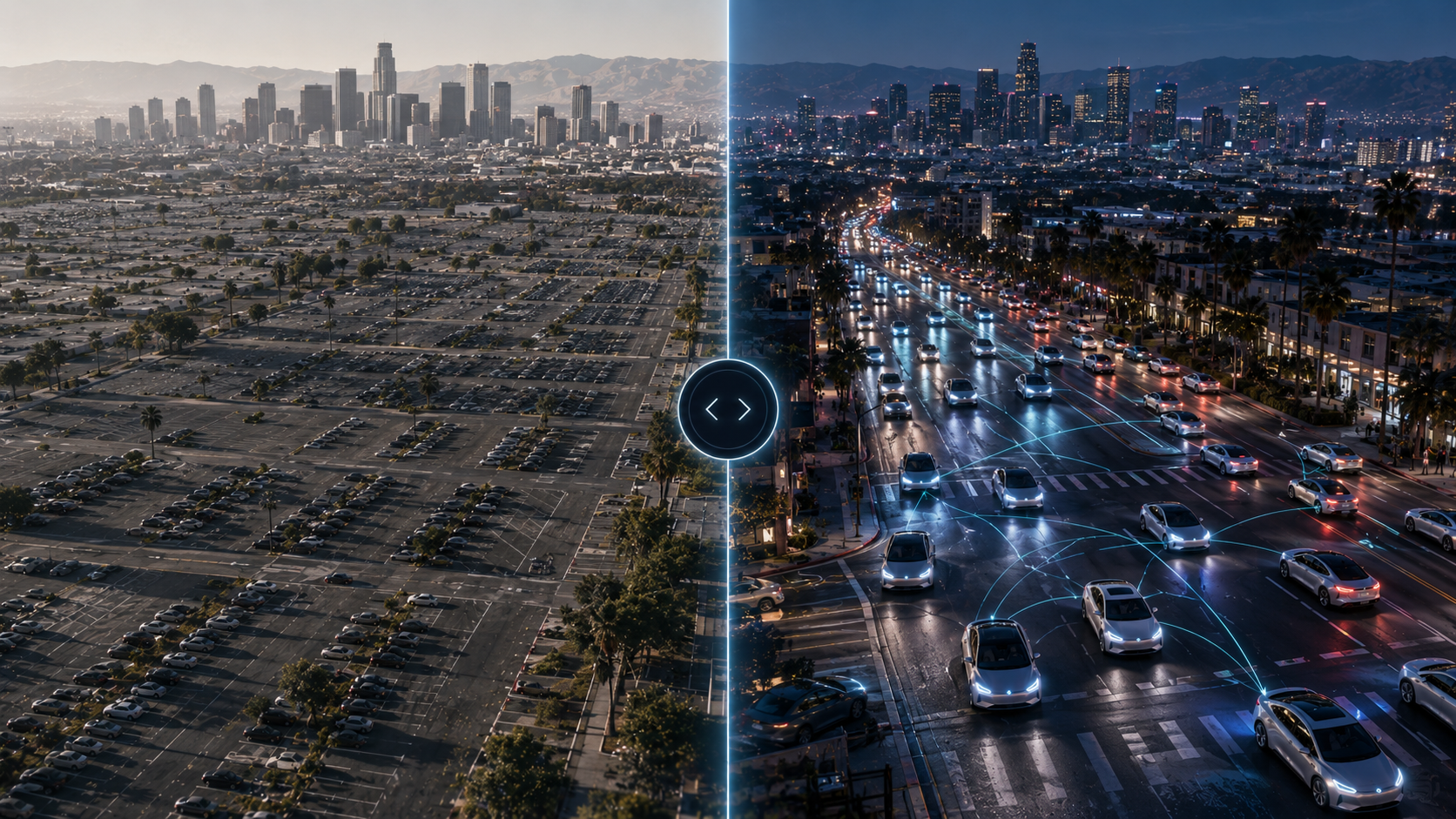
A thought experiment in shared mobility reveals just how much of America’s car fleet exists purely to sit still
The Math Problem Hiding in Plain Sight
Here’s a question worth sitting with: the average car in America is parked about 95% of the time. It sits in a driveway overnight, sits in an office lot all day, and sits in a garage on weekends. So what happens if we replace that ownership model with an on-demand fleet — summon a car, ride it, release it to the next person?
Researchers have actually run this simulation, city by city, using real trip data. A study of an autonomous valet-style service found that a fleet of just 2,300 vehicles could replace the entire private car fleet of a mid-sized European city — a twelve-fold reduction. Berlin researchers found automated vehicles could meet the same demand with a fleet roughly 10% the size of the conventional car fleet. A broader review estimated shared fleets could serve a population with about one-third the number of vehicles currently on the road, and Seoul modeling projected more than an 80% reduction in vehicles needed.
Take a conservative middle estimate — a 75% reduction — and apply it to America’s roughly 280 million registered vehicles. We’d need somewhere between 30 and 70 million cars to do the same job. That means somewhere around 200 to 250 million vehicles currently exist mostly as standby equipment.
The Parking Lot Evidence
If you want to see what all that standby equipment costs us, look at Los Angeles. A landmark study from Arizona State, UCLA, and Georgia Tech found that parking infrastructure covers 14% of the urbanized area of Los Angeles — roughly 200 square miles of pure car storage. For comparison, all of LA County’s freeways and streets combined — the 405, Sunset Boulevard, everything — add up to about 140 square miles. The county has about 18.6 million parking spaces, or roughly 3.3 spaces for every one of its 5.6 million vehicles.
LA isn’t even the worst offender. The Parking Reform Network has mapped downtown cores in over 100 US cities, and San Bernardino and Arlington, Texas top the list at 45% and 42% of city-center land devoted to surface parking, with Las Vegas close behind at 32%. On the other end, New York City devotes just 1% of its core to parking, Washington DC 3%, and Chicago and San Francisco 4%. Nationally, the average across city centers is about 20%, and one widely cited estimate puts total US parking coverage at more than 5% of all urban land — an area bigger than Rhode Island and Delaware combined.
That’s the price of a system built around vehicles that work for 90 minutes a day and rest for the other 22-and-a-half hours.
What Fewer Cars Actually Looks Like
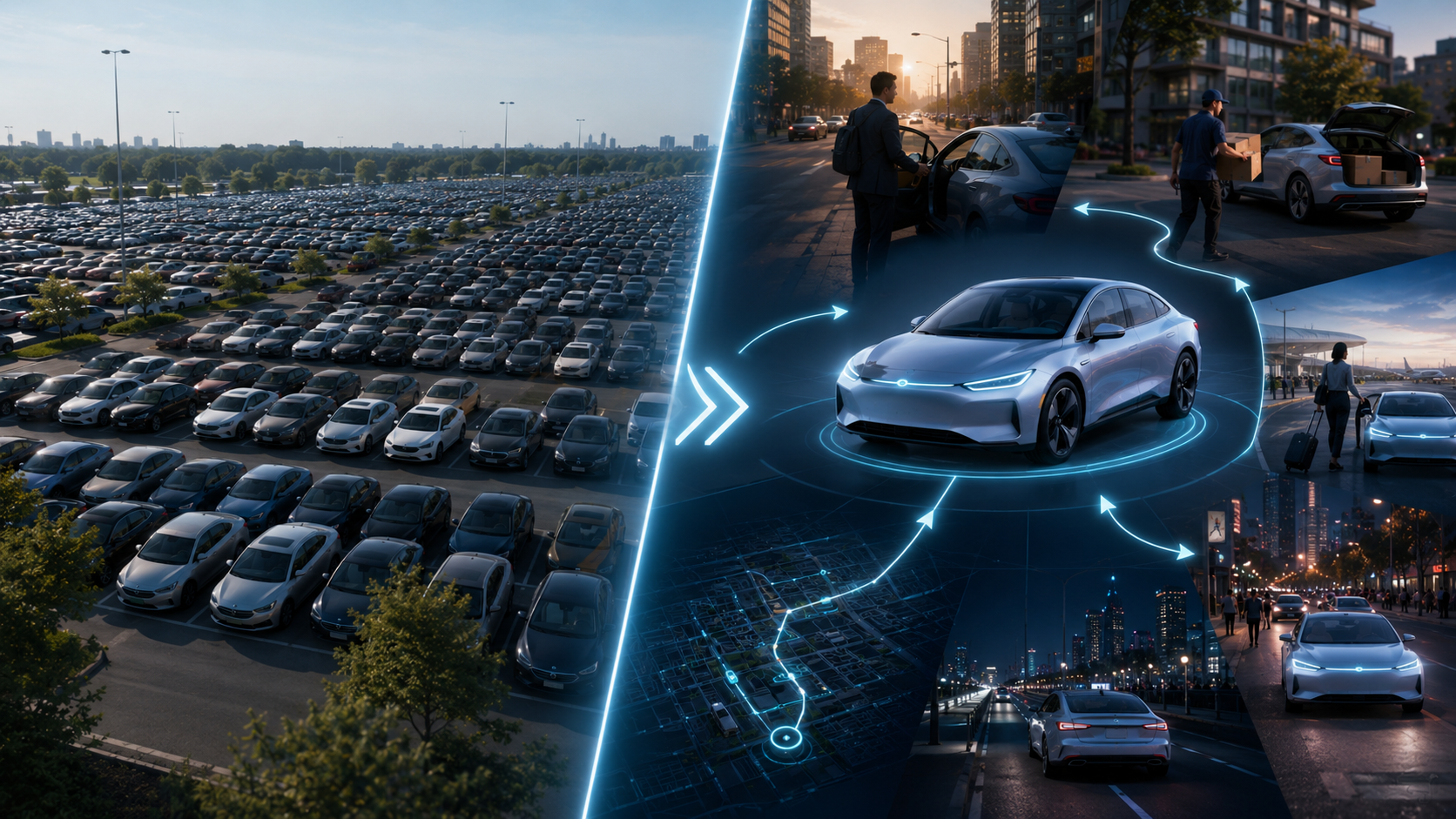
Now imagine shrinking that fleet by 75%. The remaining cars don’t get to rest. A vehicle that used to drive 12,000 miles a year and sit in a driveway most of the time would instead be in near-continuous use — picking up the morning commuter, then a delivery run, then an airport trip, then the evening rush, then overnight repositioning to wherever tomorrow’s demand will be.
Berlin’s modeling captured this shift well: even with a fleet just 10% the size of today’s, those vehicles are still busy for only about 7.5 hours a day and idle for the rest — which sounds like plenty of slack, until you realize that’s roughly five times the daily workload of a typical private car today. Multiply a car’s annual mileage by five, and you’ve taken a vehicle that might have lasted 12-15 years and compressed its useful life into two or three.
This is the part that gets lost in “fewer cars” headlines. Fewer cars doesn’t mean less manufacturing — it might mean more, just on a faster cycle. A fleet vehicle racking up 50,000-60,000 miles a year wears out its tires, brakes, suspension, and battery (in the case of EVs) at a pace no consumer vehicle is designed for today. Ride-hailing companies already see this in practice: vehicles used for Uber or Lyft commonly get retired or sold off after two to three years of heavy-duty service, while a personally owned car of the same age might still have a decade of life left.
The Catch Nobody Likes to Mention
Here’s where the thought experiment gets honest. Some of the same studies that show dramatic fleet reductions also show total miles driven going up, not down. One analysis found shared autonomous fleets could increase overall vehicle miles traveled by around 11%, mostly because vehicles have to drive empty between trips — repositioning to the next rider instead of sitting still.
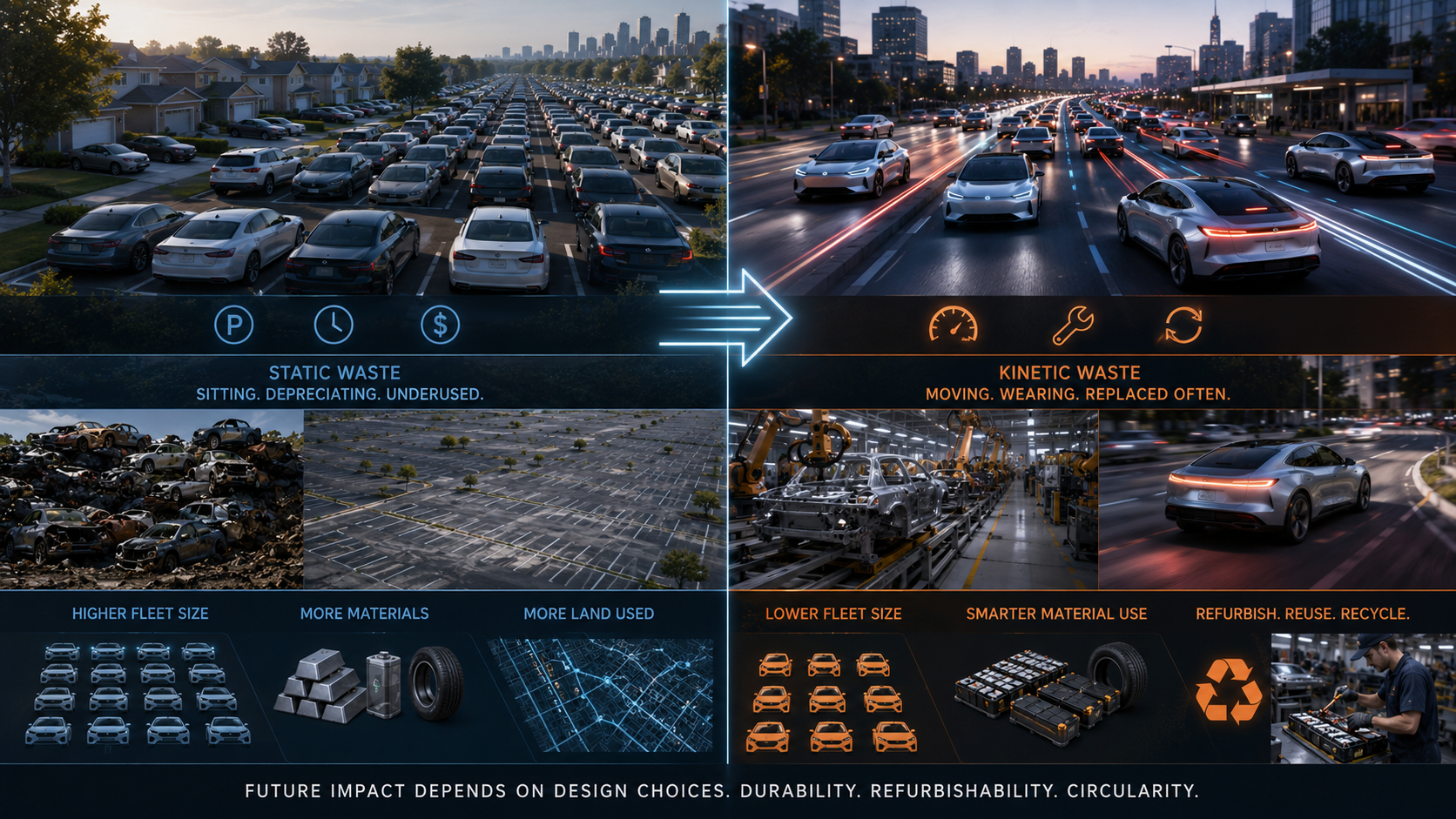
So the waste doesn’t disappear. It moves. Today’s waste is mostly static — steel and rubber sitting motionless in driveways and parking lots, slowly depreciating. Tomorrow’s waste, in a heavily shared system, becomes kinetic — fewer vehicles, but each one logging more miles, wearing out faster, and needing to be replaced more often. You trade a land-use problem for a manufacturing and materials-throughput problem.
That’s not necessarily a bad trade. Replacing 250 million idle cars with 50 million hard-working ones, even if those 50 million wear out twice as fast, could still mean less total steel, aluminum, and lithium consumed over a decade — but only if we design the system around durability and easy refurbishment. A fleet vehicle that’s rebuilt and re-batteried every three years, rather than scrapped, looks very different from one that’s simply discarded.
Why This Still Matters
The honest takeaway isn’t “shared cars solve everything” — it’s that our current system hides its costs in plain sight. Two hundred square miles of LA covered in asphalt, sitting mostly empty, is every bit as wasteful as a fleet of robotaxis burning through tires every eighteen months. We’re just used to looking at one and not the other.
The future probably isn’t zero personal ownership — rural areas, families with kids, and people who simply like driving will keep private cars relevant for a long time. But even a partial shift toward shared, on-demand fleets in dense cities would free up enormous amounts of land while putting new pressure on automakers to build vehicles that can handle commercial-grade mileage without falling apart. Fewer cars, harder lives, and — if we’re smart about how we build and maintain them — less waste overall.
Related Articles
- “How Parking Conquered Los Angeles, in 14 Facts, Maps, and Figures” — Bloomberg — https://www.bloomberg.com/news/articles/2015-12-03/how-parking-conquered-los-angeles-in-14-facts-maps-and-figures
- “Maps: How Much of Your City is Parking?” — Planetizen — https://www.planetizen.com/news/2023/03/122397-maps-how-much-your-city-parking
- “Automated and Connected Driving: State-of-the-Art and Implications for Future Scenario Analysis” — arXiv — https://arxiv.org/pdf/2408.11864