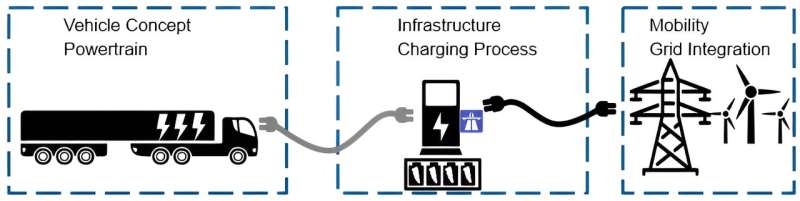
In collaboration with industry partners and research institutions, the Technical University of Munich (TUM) is pioneering efforts to make battery-powered trucks a viable option for long-distance cargo transport. A significant advancement in this mission is the introduction of megawatt charging technology. On Friday, at the Plattling Technology Campus, the first prototypes were unveiled to the public, with the Bavarian Minister of Economic Affairs, Hubert Aiwanger, in attendance. This new technology allows for a truck’s battery to be charged within the regulatory rest period, providing 4.5 hours of operation without additional waiting time.
In Germany, approximately 70% of freight transport, in terms of volume and distance, relies on road transportation, predominantly using diesel-powered trucks. This reliance contributes significantly to environmental pollution, with 40% of the transport-related CO2 emissions (148 million tons) stemming from freight transport. Transitioning from diesel to electric power presents substantial environmental benefits. Under the leadership of the Chair of Automotive Technology at TUM, the NEFTON research consortium is developing the necessary technical and infrastructure solutions to facilitate this switch.
Prof. Markus Lienkamp emphasized, “The scientific facts send a clear message: Battery-powered trucks have an efficiency of around 75%. This puts them far ahead of trucks powered by fuel cells with a 26% efficiency and eFuels with a 14% efficiency.”
However, the infrastructure required for the widespread use of electric trucks is still underdeveloped along major transport routes. Megawatt charging technology represents a significant leap forward in this regard. Dr. Frederik Zohm, Executive Board Member for Research and Development at MAN Truck & Bus, stated, “With NEFTON, we have developed technologies that will make it possible to charge e-trucks rapidly at a power rating of over 1,000 kW. Our research focused on real-world readiness, costs, and grid power output.”
“Together with our project partners, we have demonstrated that electric trucks and megawatt charging are the perfect combination for comprehensive decarbonization of road-based freight transport. The technology is there. Now it’s time to expand the charging infrastructure through close cooperation between policymakers, the energy sector, and vehicle manufacturers.”
Hubert Aiwanger, the Bavarian Minister of Economic Affairs, remarked, “This research project shows that high-tech and expertise from Bavaria will shape the mobility of the future. Initiatives like this will gradually decarbonize logistics and freight transport, boosting the competitiveness of the Bavarian economy.”
“I would like to thank everyone who has contributed to the success of the NEFTON project. The Megawatt Charging System (MCS) will drastically reduce charging times for trucks, marking a milestone in the development of electromobility. MAN has already demonstrated the real-world viability of this technology and played a key role in developing standards. We are also integrating the MCS technology into our current funding program. In the first round, we will finance 86 charge points, with the next call for funding proposals starting in late fall. Along with our hydrogen funding programs, this initiative reflects the Bavarian state government’s commitment to new mobility technologies.”
The NEFTON project has explored the application of electric trucks within real-world logistics. Collaborating with four freight forwarding companies, the consortium analyzed various areas of application, from local distribution to long-distance transport. The findings indicate that for distribution and regional shipping, most charging can occur at the freight forwarder’s premises. However, long-distance operations necessitate a network of high-powered truck charging stations at highway rest stops and parking areas.
The research also suggests that charging stations with a peak power of 1 megawatt should be installed every 50 km along core highway routes to eliminate any time losses from charging. In a research setting, charging outputs of up to 3 megawatts have been studied, which would enhance flexibility in everyday use and allow for smaller batteries, reducing costs and providing ecological benefits. The NEFTON project will continue to investigate these future prospects.
By Impact Lab