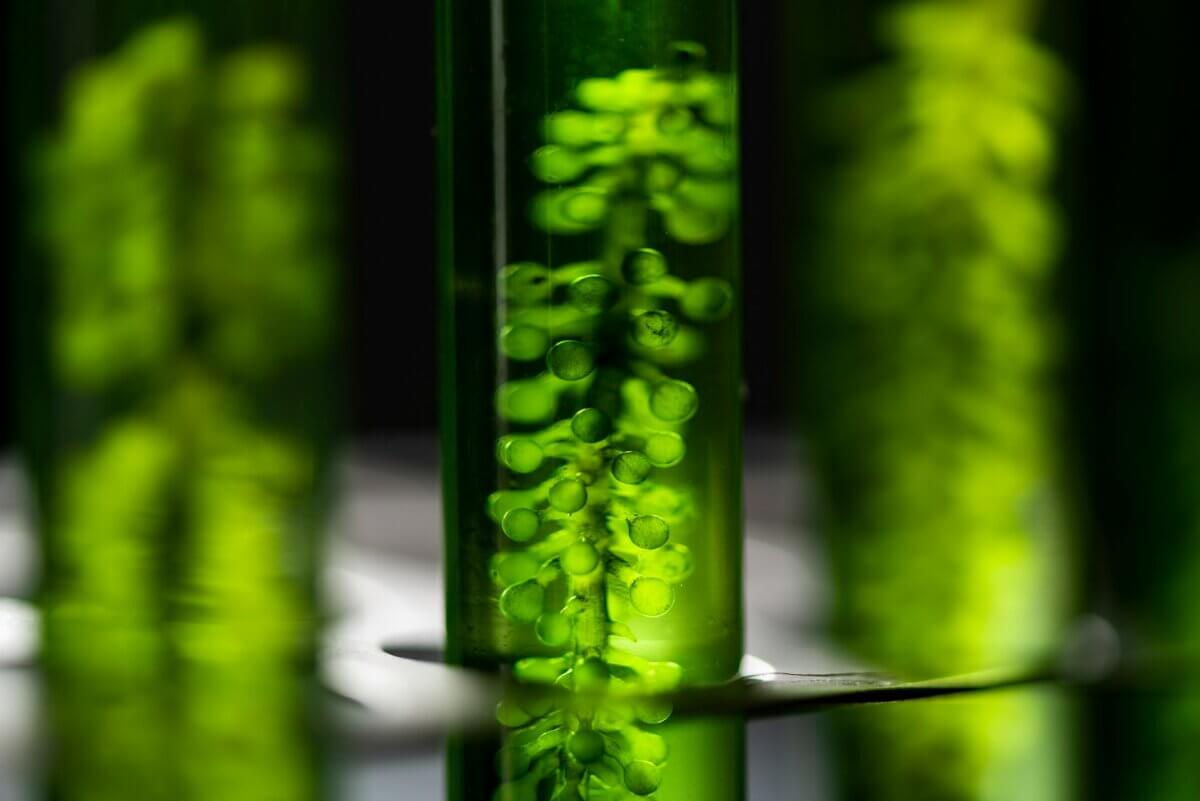
In a world increasingly hungry for sustainable energy sources, scientists are turning to some unlikely heroes: microscopic algae. Researchers at Concordia University have developed a promising new technology called micro-photosynthetic power cells (μPSCs) that harness the natural processes of these tiny organisms to generate electricity. They’ve now discovered a way to dramatically increase the power output of these miniature green energy factories.
At the heart of this innovation is a deceptively simple idea: connecting multiple μPSCs together, much like linking batteries in a flashlight. By arranging these biological power sources in various configurations, the team has unlocked new levels of performance, bringing us one step closer to practical applications for this eco-friendly technology. What makes this technology particularly exciting is its potential to not only produce clean energy but also remove carbon from the atmosphere in the process.
“More than being a zero-emission technology, it’s a negative carbon emission technology: it absorbs carbon dioxide from the atmosphere and gives you a current. Its only byproduct is water,” says Kirankumar Kuruvinashetti, PhD, now a postdoctoral associate at the University of Calgary.
μPSCs tap into the fundamental processes that algae use to survive: photosynthesis and respiration. During photosynthesis, algae use sunlight to split water molecules, releasing electrons in the process. Even in darkness, the algae continue to produce electrons through respiration. The μPSC is designed to capture these free electrons and channel them into a usable electric current.
The real magic happens in the cell’s structure. Picture a sandwich: the bread slices are two chambers, one containing the algae (the anode) and the other holding a special solution that accepts electrons (the cathode). Between them is a thin membrane that allows protons to pass through while directing electrons along a path where they can be harvested as electricity.
Dhilippan Panneerselvam, a PhD candidate and co-author of the study, highlights an important advantage of this system: “Just like humans, algae are constantly breathing — but they intake carbon dioxide and release oxygen. Due to their photosynthesis machinery, they also release electrons during respiration. The electricity generation is not stopped. The electrons are continuously harvested.”
What makes μPSCs particularly exciting is their potential for long-term, maintenance-free operation. Unlike traditional batteries or solar panels, these living power sources can repair and maintain themselves, potentially providing stable energy output for extended periods. However, a single μPSC produces only a tiny amount of electricity – not nearly enough for most practical applications. The maximum possible voltage from a single cell is just 1.0V.
This is where the current study comes in. The researchers explored various ways of connecting multiple μPSCs to boost overall power output. They tested several configurations: connecting cells in series (like a string of Christmas lights), in parallel (like lanes on a highway), and in combinations of both. By carefully analyzing the performance of these different arrangements, the team identified optimal setups that significantly increased both voltage and current.
The most promising configurations were those that combined series and parallel connections. These hybrid arrangements allowed researchers to fine-tune the balance between voltage and current, opening up possibilities for powering a wider range of low-power devices. This breakthrough could pave the way for the μPSCs to find real-world applications in the burgeoning field of the Internet of Things (IoT). Imagine networks of tiny, self-powered sensors monitoring environmental conditions, tracking wildlife, or optimizing agricultural practices – all powered by colonies of industrious algae.
While μPSCs may never replace large-scale power plants or high-output solar arrays, they offer unique advantages for specialized applications. Their ability to operate continuously with minimal maintenance, coupled with their eco-friendly nature, makes them ideal for remote or sensitive environments where traditional power sources are impractical.
“Our system does not use any of the hazardous gases or microfibers needed for the silicon fabrication technology that photovoltaic cells rely on,” explains corresponding author Muthukumaran Packirisamy, a professor with Concordia’s Department of Mechanical, Industrial, and Aerospace Engineering. “Furthermore, disposing of silicon computer chips is not easy. We use biocompatible polymers, so the whole system is easily decomposable and very cheap to manufacture.”
As we face the mounting challenges of climate change and seek to reduce our reliance on fossil fuels, innovations like μPSCs remind us that solutions can come from unexpected places. By looking to nature’s time-tested energy harvesting methods, we may find new ways to power our future – one tiny algae cell at a time.
By Impact Lab