

A Developmental Philosophy for Citizens of the Future
By Futurist Thomas Frey
Part 4 of 6: The Children
Every generation of parents has believed, with complete sincerity, that they were raising their children well. The sincerity has never been in question. What has always been in question — and what the Vitalist framework forces us to ask with unusual directness — is whether sincerity and deliberate design are the same thing, and whether love alone, without a coherent developmental philosophy to give it structure, is sufficient to produce the kind of human beings that a civilization in genuine difficulty actually needs.
I do not think they are the same thing. I do not think love alone is sufficient, any more than a surgeon’s genuine care for a patient is sufficient without training, without technique, and without a clear understanding of what a successful outcome looks like and how to achieve it. The Vitalist loves her children. She also designs their development. This column is about what that design looks like.
Consider what Muhammad Yunus did with the Grameen Bank. When he began extending micro-loans to the poorest women in Bangladesh — people with no collateral, no credit history, no formal standing in the financial system — he didn’t just hand them money and wish them well. He asked them to commit. Before receiving a loan, borrowers were required to memorize and recite the Sixteen Decisions — a set of pledges covering health practices, education of children, refusal of dowry, investment in the family’s future, and commitment to the community. The loan came with a vow. The vow was the point. Yunus understood something that most philanthropists and policymakers miss: that transformation requires not just resources but a framework of commitment that orients the recipient toward a different kind of future. The resources alone accomplish very little. The commitment changes everything.
The Vitalist’s approach to raising children operates on the same logic. The love and the resources are necessary but not sufficient. What makes them transformative is the framework of commitment that shapes how they are applied.
Let me start with the question most likely to generate resistance. What does it mean to raise a child who is loyal to their country? The word loyalty, applied to a nation, makes some readers instinctively cautious — and that caution has a legitimate history behind it. But I am not describing blind deference to authority. I am describing something older and more fundamental: the civic attachment that makes a person willing to contribute to something larger than their immediate self-interest, to feel the obligations of membership in a community that existed before them and will persist after them, and to bring their full capabilities to bear on problems they did not personally create but that they have the power to help solve. That is not nationalism. It is citizenship — and citizenship, the genuine article, is one of the rarest and most valuable things a parent can cultivate in a child.
The Irreplaceable First Three Years
The developmental science on early childhood has produced, over the last thirty years, a consensus so clear and so consistent that it is almost surprising how little it has penetrated popular culture or policy design. The first three years of a child’s life are not a waiting period before development begins. They are the period during which the foundational architecture of the brain — the neural pathways that will govern emotional regulation, language acquisition, social cognition, and executive function for the rest of that person’s life — is being constructed at a rate that will never be matched again.
The primary variable in that developmental period is not the quality of educational materials, not the sophistication of the toys, and not the ambient enrichment of the environment. It is the quality and consistency of the attachment relationship between the child and the primary caregiver. The serve-and-return interaction — the infant vocalizes, the caregiver responds with eye contact and language and touch, the infant vocalizes again — is literally the mechanism by which neural connections are forged. An infant who experiences thousands of these interactions daily with a present, emotionally attuned caregiver builds a brain that is fundamentally better equipped for every form of human challenge than one who does not. This is not metaphor. It is neuroscience.
A Developmental Philosophy in Four Commitments
Beyond the neuroscience of the early years, the Vitalist’s developmental philosophy rests on four commitments that operate across the full arc of childhood and into early adulthood. They are not a curriculum. They are not a set of rules. They are orientations — ways of relating to a child that, sustained consistently over time, produce a person with particular qualities of character, capability, and civic commitment.
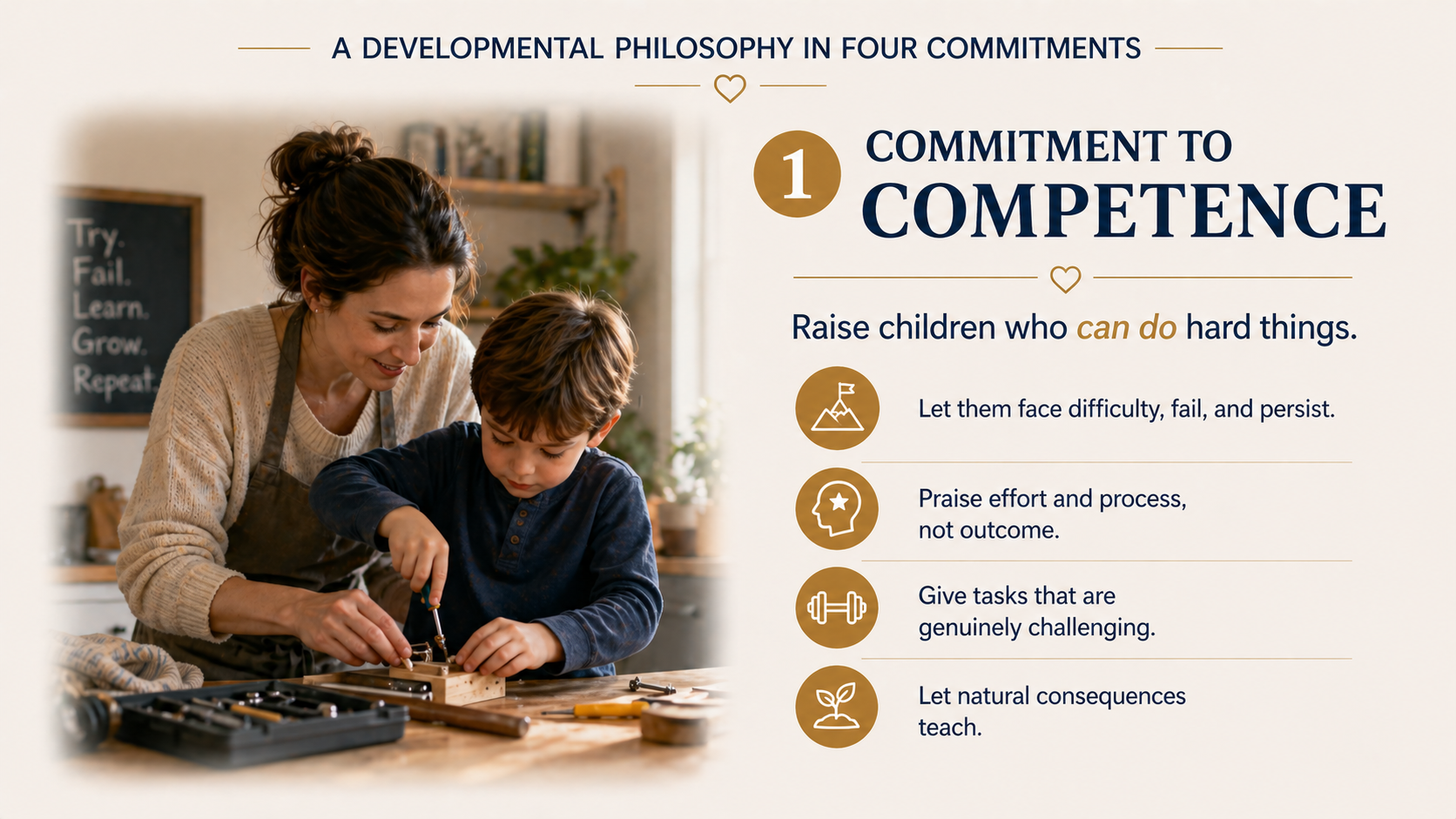
The first commitment is to competence. The Vitalist raises children who can do things — real things, difficult things, things that produce genuine capability rather than the simulacrum of capability that comes from being praised regardless of performance. This means:
- Allowing children to encounter difficulty, fail, and persist without the parent removing every obstacle in advance
- Praising effort and process rather than outcome and talent
- Assigning tasks that are genuinely challenging, not calibrated for guaranteed success
- Letting natural consequences teach what parental intervention would prevent
The research on what Carol Dweck calls the growth mindset is unambiguous: children who learn early that capability is built through effort rather than granted by talent become adults who can actually handle the world as it is. In a century being reshaped by artificial intelligence, geopolitical instability, and technological change at a pace no previous generation has absorbed, the capacity to keep functioning under difficulty is not a nice feature of a well-raised child. It is the essential feature.
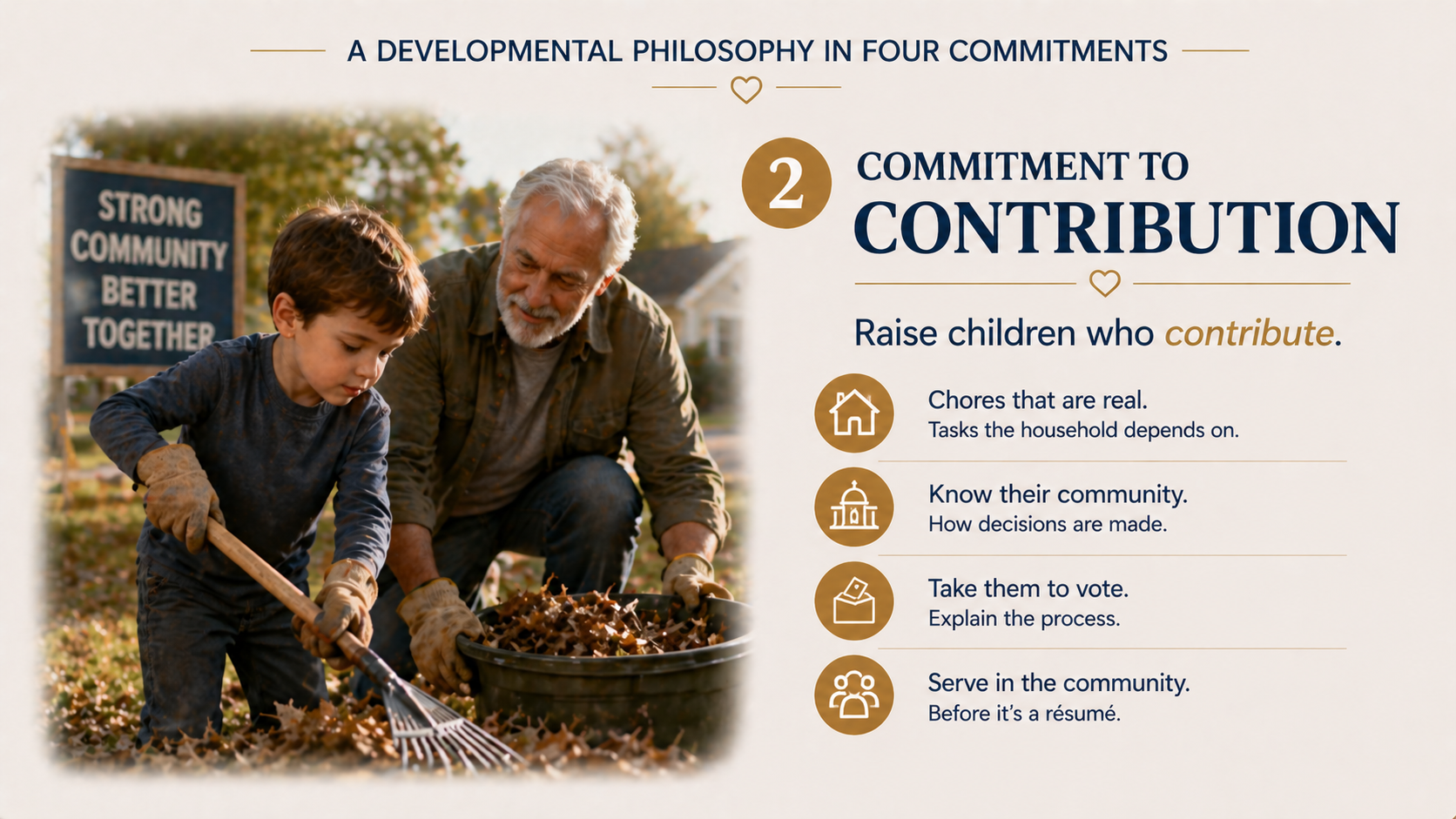
The second commitment is to contribution. The Vitalist raises children who understand from an early age that membership in something carries obligations alongside its benefits. What that looks like in practice:
- Chores that are real, not performative — tasks the household actually depends on getting done
- Civic exposure — knowing who represents them, how community decisions get made, what participation requires
- Being taken to vote and having the process genuinely explained
- Service in the community before it becomes a college application item
A child who grows up understanding that they are an actor in their community’s story, not merely a resident of it, becomes an adult with the civic instincts that democracy requires to function. A child who has never been expected to contribute to anything larger than themselves has been profoundly underestimated by the adults who love them.
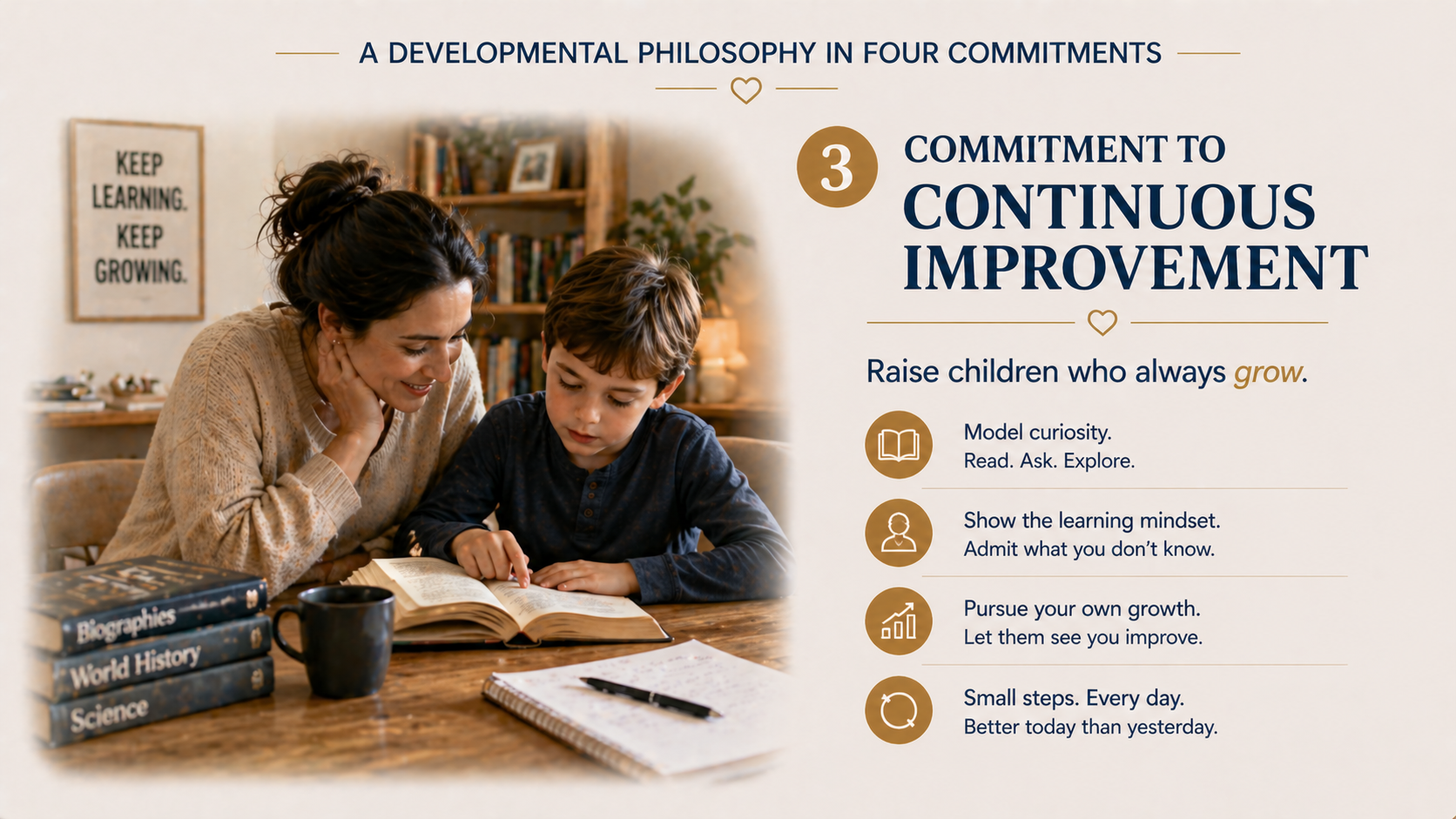
The third commitment is to continuous improvement — what the Japanese call kaizen, the philosophy of perpetual incremental betterment applied not to a manufacturing process but to a human life. The Vitalist models this, because children learn from what they observe far more reliably than from what they are told. A mother who reads, who asks questions, who admits when she doesn’t know something and then goes to find out, who pursues her own development as a visible ongoing practice — she is teaching her children the most important lesson available: that learning is not a phase of life that concludes. It is the activity of a full life, from beginning to end. This is the lesson that makes a person genuinely adaptable — not the specific knowledge they carry, which will become obsolete, but the habit of acquiring new knowledge, which never does.
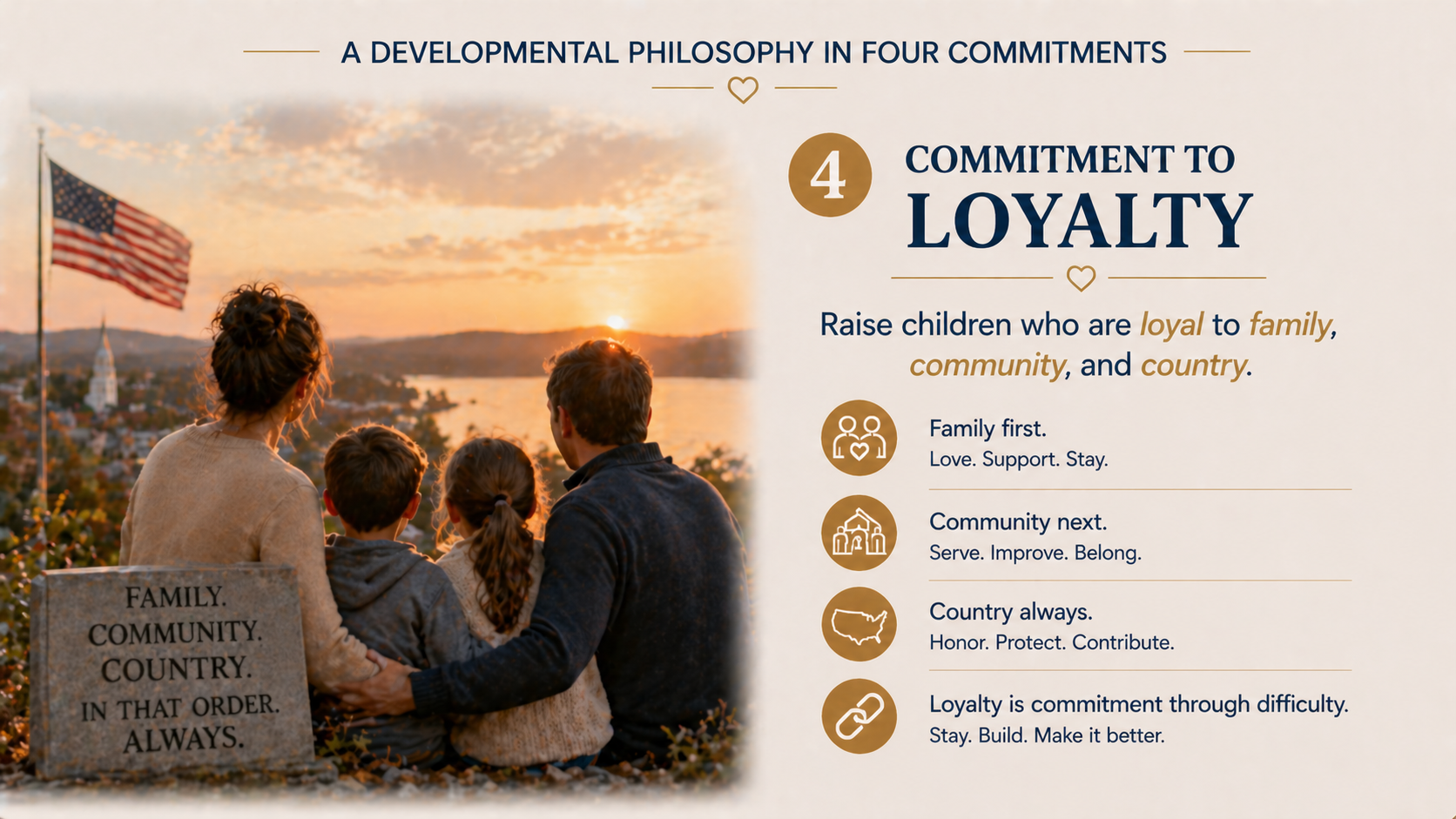
The fourth commitment is to loyalty — to family first, then to community, then to country. This word deserves precision. Loyalty is not blind obedience. It is not the suspension of critical judgment in deference to authority. It is the decision to remain committed to a relationship or an institution through difficulty — to work to improve it from within rather than abandoning it when it disappoints, to feel the weight of its history and its obligations rather than treating it as a resource to be extracted from.
Yunus understood this too. His Sixteen Decisions were not a compliance checklist. They were a commitment to the community of borrowers around each individual recipient — a pledge that the loan would be used not just for personal advancement but in a way that honored the network of trust that made it possible. The Vitalist’s children are raised with the same understanding: the benefits they receive from family, community, and country create obligations that run in both directions.
A child raised with loyalty as a practiced virtue becomes an adult who stays — who stays in the hard conversation, who stays in the struggling community, who stays in the country that needs them rather than simply moving to wherever conditions are most favorable. That kind of person is extraordinarily rare and extraordinarily valuable, and they are not produced by accident.
The Developmental Arc
The Vitalist’s framework moves through five phases, each with its own primary work:
- Birth to 3 — Foundation: Secure attachment through serve-and-return interaction, emotional attunement, and consistent presence. The neurological architecture for everything that follows is built here. No curriculum replaces the caregiver’s face.
- Ages 3–7 — Exploration: Competence through play. Physical capability, language richness, early numeracy, curiosity as a cultivated habit. First real household responsibilities — simple enough to succeed at, consequential enough to matter.
- Ages 7–12 — Formation: Character and civic identity. Deep reading, skilled mentors, community participation, persistence developed through increasingly demanding projects. The child begins to understand themselves as a member of something larger.
- Ages 12–17 — Challenge: Resilience and responsibility. Real accountability, real consequences, real contribution. Technology literacy developed alongside the critical capacity to evaluate and resist technology’s manipulative designs.
- Ages 17+ — Launch: The product of the Vitalist’s work enters the world — a young adult who is competent, contributing, loyal, curious, resilient, and fully prepared to carry the civilization forward.
Technology as Tool, Not Substitute
The same AI systems and digital platforms that can serve as powerful tools in the hands of a deliberate parent can also become the most effective child-development sabotage machinery ever built — and the evidence that they are currently functioning as exactly that is extensive, peer-reviewed, and alarming.
The American Psychological Association, the American Academy of Pediatrics, and longitudinal research from institutions including NYU, Stanford, and the University of Oxford have documented consistent associations between unstructured social media use in adolescence and elevated rates of anxiety, depression, attentional fragmentation, and social comparison pathology — particularly in girls. The mechanism is not mysterious: platforms engineered to maximize engagement are optimized against exactly the qualities the Vitalist is trying to build.
- Patience — an enemy of the scroll
- Tolerance for boredom — an enemy of the notification
- Capacity for sustained attention — an enemy of the algorithm
- Comfort with imperfection — an enemy of the curated feed
The Vitalist’s approach to technology in her children’s lives is neither technophobic nor permissive. She uses every available tool in the support stack. She does not hand that stack to her children unsupervised and call it preparation for the future. The distinction between using technology and being used by it is one of the most important things a parent in the twenty-first century can teach — and it requires active, sustained, deliberate effort to maintain against systems specifically designed to dissolve it.

The Measure of Success
Every developmental philosophy ultimately has to answer one question: what does success look like?
Yunus had a clear answer. The measure of his bank’s success was not the repayment rate, impressive as it was. It was whether the women who received loans sent their daughters to school, improved their family’s nutrition, refused dowry, and became active members of their borrowing circles. The money was the mechanism. The transformed life was the metric.
The Vitalist’s measure of success is similarly larger than the conventional answers — academic achievement, professional success, financial independence. Those measure what the child extracted from the world. The Vitalist’s measure is different. It is what the child adds to it.
A child who enters adulthood with genuine competence, a practiced habit of contribution, felt loyalty to family and community and country, resilience to remain functional under difficulty, and the curiosity to keep learning for the rest of their life — that child is the product of the most consequential work available to a human being. No career, no personal achievement, no accumulation of individual distinction produces anything more valuable to the civilization that needs them.
That is what the vow means. And that is what it asks of the woman who makes it.
Next: Part 5 — The Vitalist Community. A Vitalist raising children alone, without a surrounding community designed to support and amplify that work, is a craftsperson without a workshop. What does the community that grows up around the Vitalist look like — and how does it change the surrounding neighborhood, town, and culture simply by existing?
Related Reading
Eight Things to Remember About Child Development
Harvard Center on the Developing Child — The most accessible synthesis of the developmental science consensus — eight core principles derived from decades of peer-reviewed research that collectively define what the early years require and what they produce, forming the scientific spine of the Vitalist developmental philosophy
Mindset: The New Psychology of Success
Carol S. Dweck · Ballantine Books — Stanford psychologist Carol Dweck’s landmark research on the growth mindset — the documented finding that children taught to understand capability as built through effort rather than fixed by talent become measurably more resilient, more persistent, and more capable adults across every domain of life
The Sixteen Decisions of Grameen Bank
Grameen Bank — Muhammad Yunus’s foundational framework for transformative lending — the commitment structure that turned a micro-loan into a developmental philosophy, and the clearest existing model for what a vow with real teeth looks like in practice