How a simple idea about rocks in a park became a blueprint for healing the loneliness of modern life
Every cemetery tells you that someone was here. A name, two dates, a hyphen between them that holds an entire life.
But what if we could do something more than mark the departure? What if we could create spaces that keep the living connected to those who came before — spaces that breathe, bloom, and change with the seasons — places where grief and joy share the same bench, where strangers become neighbors, and where the stories of ordinary people are woven permanently into the landscape of a city?
That is the quiet, radical promise of the memorial garden. And we need it more than we may realize.
The Loneliness We Don’t Talk About
We are living through an epidemic that gets far less attention than it deserves. A 2025 American Psychological Association survey found that over half of U.S. adults feel isolated, left out, or lonely — and nearly 70% said they receive less emotional support than they need, up from 65% the year before. Surgeon General Vivek Murthy has called loneliness as dangerous to physical health as smoking fifteen cigarettes a day.
At the same time, the informal gathering spaces that once held communities together — the neighborhood diner, the church social hall, the corner park where people simply lingered — are disappearing. Shopping is online. Entertainment is streaming. Work is remote. The spontaneous, unscripted moments of human contact that once constituted daily life have quietly evaporated.
Three-quarters of Americans say they want more activities and community events where they live, and public spaces that are more accessible and connection-focused — green spaces where people can simply show up and belong to something larger than themselves.
Memorial gardens answer that call. They are not monuments to the dead. They are living infrastructure for the living.
A Simple Idea That Grew Into Something Beautiful
The concept began in 2005, with a modest image: large boulders placed in a park beside a public library, inscribed with words from local companies and individuals — a Poetry Park, where the natural and the communal became one. It was a small idea. But small ideas, placed in the right soil, have a way of growing into something extraordinary.
Over time, that image expanded into the fuller vision of a memorial garden — a purposefully designed landscape where remembrance is not relegated to a corner of a cemetery but woven into the very heart of a community. Where a grandmother’s love of roses becomes a rose garden that schoolchildren walk through every morning. Where a firefighter’s sacrifice becomes a reflecting pool that catches the sky. Where a neighborhood’s immigrant heritage becomes a mosaic wall that tells its story in tile and color to everyone who passes.
The entrance itself should feel like a threshold — a crossing from the ordinary world into somewhere quieter, more intentional, more alive.
What a Memorial Garden Actually Is
Unlike a conventional park, a memorial garden is co-authored by the community it inhabits. Individuals, families, businesses, and civic organizations contribute to its creation — funding features, selecting designs, dedicating elements — and in doing so, they invest something of themselves into a shared public space.
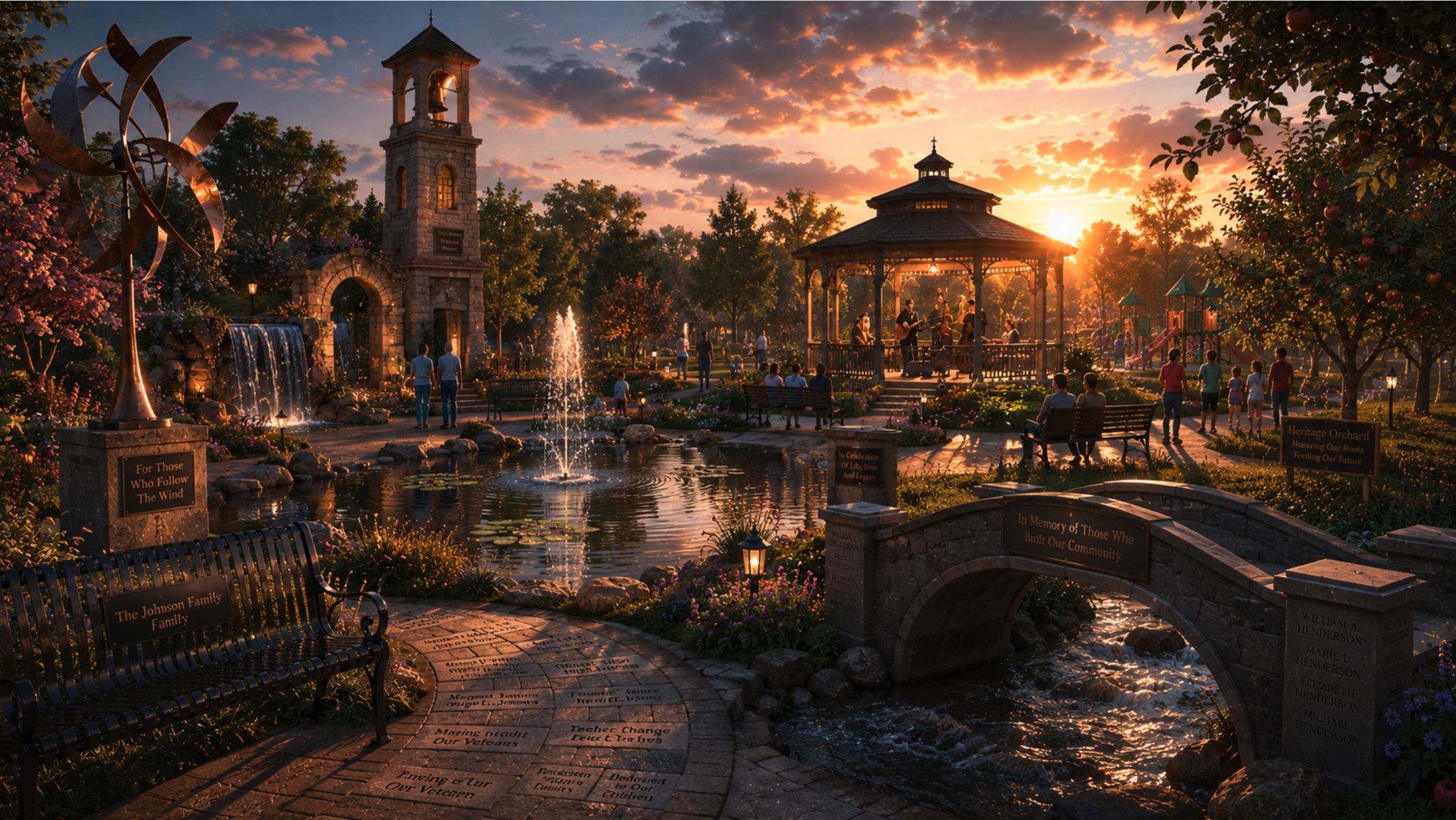
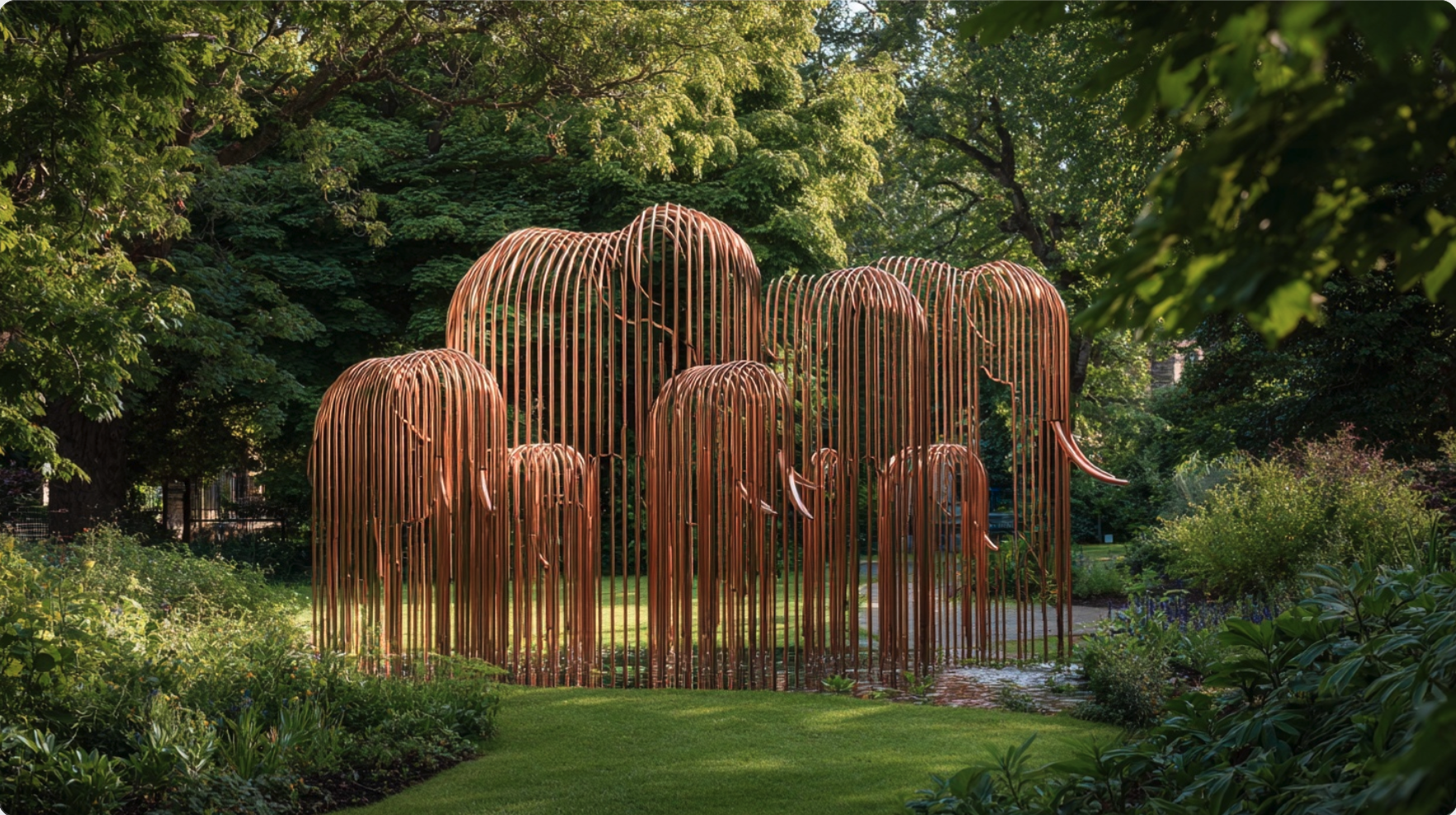
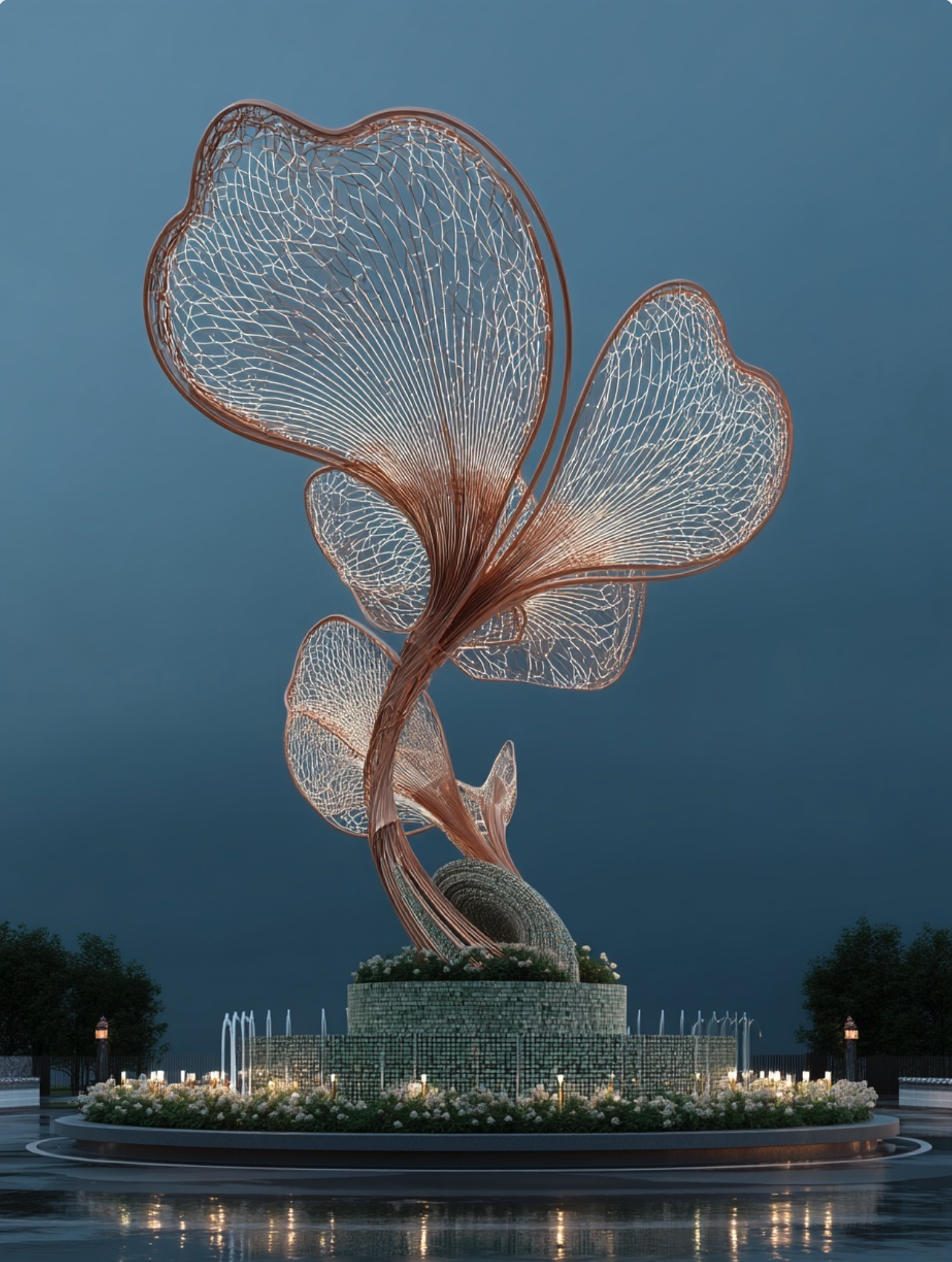
The range of what can exist within such a garden is limited only by imagination and thoughtful curation. A kinetic sculpture that turns with the wind can honor a sailor or a dreamer. A heritage orchard of heirloom apple trees can commemorate a family farm that fed a county for three generations. A gazebo with acoustic paneling can become a performance stage where local musicians play every Sunday, filling the air with sound as their instrument of tribute.
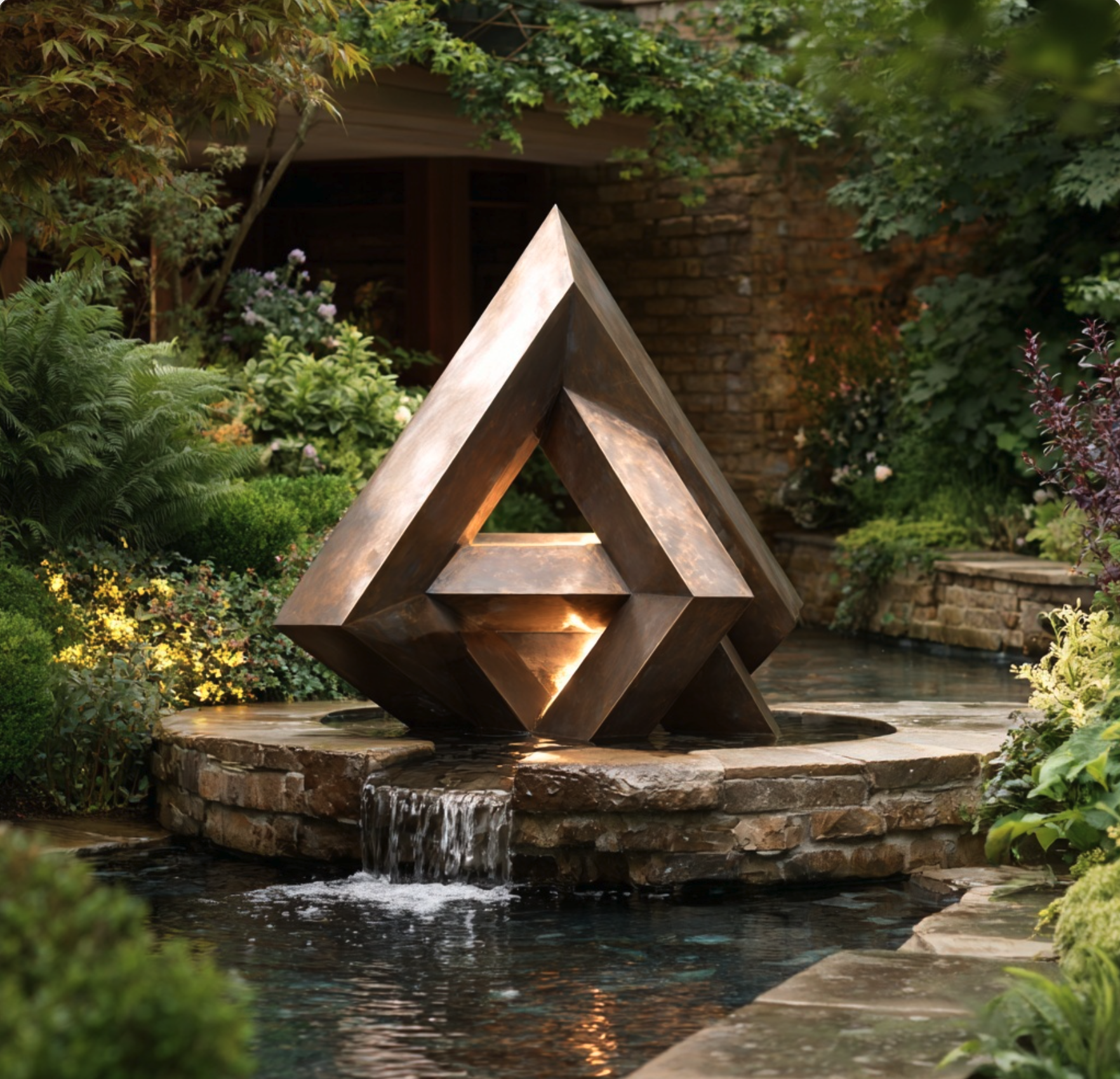
Water features — fountains, reflective pools, ponds, and falling water — carry a particular resonance. Water has always been humanity’s symbol of continuity and cleansing. A still pool that mirrors the sky asks us to look both outward and inward at the same time. A waterfall at dusk, lit from beneath, becomes something close to sacred.
Bridges inscribed with names. Pathways paved with personalized stones. A tower whose bells ring on the hour. A children’s playground dedicated to a teacher who spent thirty years believing in other people’s kids. These are not abstract ideas — they are the specific, irreplaceable language of a community telling its own story.
The Science Behind the Beauty
What makes memorial gardens so powerful is not only their symbolic resonance but their measurable impact on human wellbeing. Extensive research now confirms that contact with nature in urban environments reduces stress, lowers blood pressure, heightens perceived restorativeness, and increases what researchers call “subjective vitality” — the felt sense that life is worth living.
Biophilic design — the intentional integration of natural elements into built environments — is recognized as one of the most effective tools in urban planning for improving mental health. Urban parks and green spaces create what attention restoration theory describes as “a sense of being away” — a psychological retreat from overstimulation that allows the mind to recover and reconnect.
But a memorial garden adds something that a conventional park typically lacks: meaning. It is not just a place to walk among trees. It is a place where the trees mean something. Where the bench you sit on carries a name. Where the path you follow has a story behind it. That layer of human significance transforms a restorative space into something that also feeds the soul.
The Community It Builds
Perhaps the most underappreciated dimension of a memorial garden is what it does for the people who build it — not just the people who visit it.
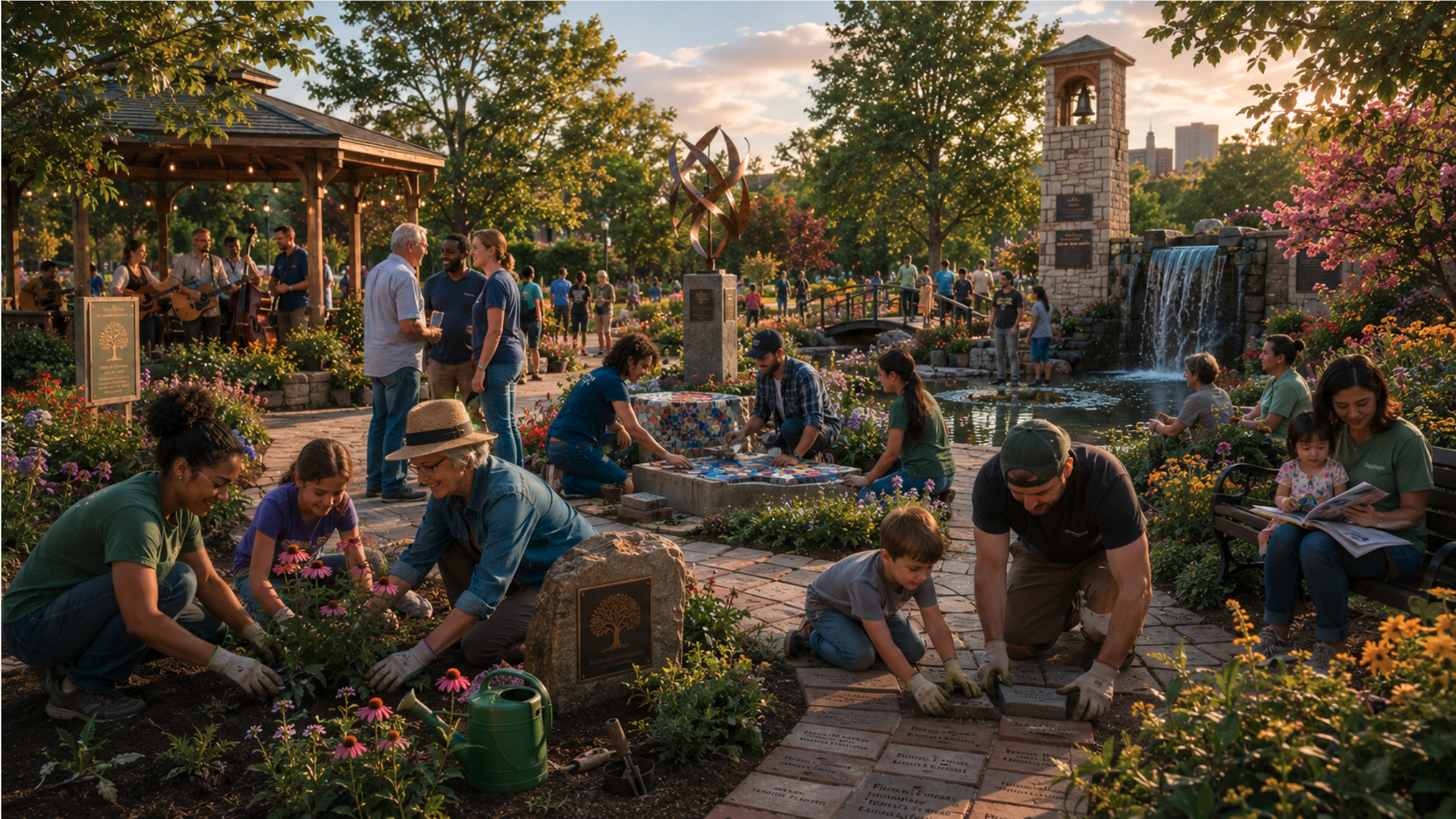
When neighbors come together to plant, plan, commission art, and dedicate spaces to people and values they care about, something shifts. They begin to know each other. They learn whose grandmother loved irises and whose grandfather built houses by hand. They discover that the city around them is not an anonymous backdrop to their individual lives but a layered, storied place shaped by real people with real histories.
That participatory act of creation is itself a form of healing. It moves remembrance from private grief into shared meaning. It transforms a park from a public amenity into a public commitment — a place the community has invested in, shaped, and claimed as its own.
The governance of a memorial garden matters enormously for this reason. It should be structured so that diverse voices have a genuine role in shaping what gets added, what gets preserved, and how the garden evolves over time. A well-governed memorial garden is not finished at its dedication ceremony. It is alive, perpetually growing, perpetually deepening.
A Different Kind of Monument
For most of human history, monuments have been built for the powerful. Generals on horseback. Politicians in marble. Buildings named for donors.
The memorial garden inverts that hierarchy. It creates a landscape where an ordinary life can leave an extraordinary mark — where the florist, the schoolteacher, the volunteer firefighter, the quiet neighbor who kept a beautiful yard, can all find a place in the permanent story of a place.
In an age when so much of life is ephemeral — posts that disappear, feeds that refresh, attention that moves on in seconds — there is something profoundly countercultural about building something meant to last. Something meant to grow more beautiful with time. Something that asks the people who come after us to slow down, to read a name, to sit for a moment, and to remember.
We talk often about the cities we want to leave to our children. Memorial gardens are one of the most honest answers to that question — green, breathing, meaning-saturated places that say, quite simply: people lived here, people loved here, and what they were is worth remembering.
That may be the most important infrastructure a community can build.
Related Articles
Futurist Speaker / Thomas Frey — Ten New Parks to Inspire the Mind and Redefine the Communities We Live In https://futuristspeaker.com/future-scenarios/ten-new-parks-to-inspire-the-mind-and-redefine-the-communities-we-live-in/
MRSC (Municipal Research & Services Center) — Building Belonging: Urban Strategies to Combat America’s Loneliness Crisis https://mrsc.org/stay-informed/mrsc-insight/february-2026/building-belonging
Congress for the New Urbanism — Fighting Loneliness with Parks and Third Places https://www.cnu.org/publicsquare/2025/01/14/fighting-loneliness-parks-and-third-places
AARP Research — Disconnected: The Escalating Challenge of Loneliness Among Adults 45-Plus https://www.aarp.org/pri/topics/social-leisure/relationships/loneliness-social-connections-2025/
ScienceDirect — Does Perceived Biophilic Design Contribute to Human Well-Being in Urban Green Spaces? https://www.sciencedirect.com/science/article/abs/pii/S161886672500086X
Harvard Graduate School of Education — What Is Causing Our Epidemic of Loneliness and How Can We Fix It? https://www.gse.harvard.edu/ideas/usable-knowledge/24/10/what-causing-our-epidemic-loneliness-and-how-can-we-fix-it