

By Futurist Thomas Frey
What sounds like science fiction today will be as unremarkable as checking email — a window into the ordinary morning of an ordinary man in an extraordinary decade
The Alarm That Isn’t an Alarm
Wilson doesn’t wake up to a sound. He wakes up because his sleep system — a thin mesh woven into his mattress and pillow — has been monitoring his sleep cycles since midnight and has been gently nudging his body temperature and ambient light toward wakefulness for the past twenty-two minutes, timing his emergence to coincide with the lightest phase of his sleep cycle. He surfaces feeling rested in a way that, in 2026, would have required a two-week vacation to achieve.
Before his feet hit the floor, his health agent — a persistent AI that has been running continuously for six years and knows his biomarkers better than any physician he’s ever visited — has already reviewed the night’s data. Resting heart rate slightly elevated. HRV down four points from his seven-day average. It cross-references his calendar, notes he has a presentation at 11 AM, and adjusts his morning protocol accordingly: slightly longer breathing exercise, modified coffee timing, a suggested twenty-minute walk instead of his usual morning run. It doesn’t ask his permission. He set these preferences years ago. He trusts it the way he once trusted a good doctor, except this one is available every second of every day and has never once confused him with another patient.
None of this strikes Wilson as remarkable. It’s Tuesday.
Breakfast With the Boardroom
While Wilson makes coffee, his business agent — a separate AI that manages his professional life — runs its morning briefing. Not a list of emails. A synthesized intelligence summary: three clients whose sentiment has shifted negative based on communication patterns over the past week, one contract clause in a pending agreement that carries unusual risk given a regulatory change that passed in Brussels forty-eight hours ago, and a recommended sequence for his afternoon calls based on where each relationship currently stands emotionally and strategically.
Wilson listens while his kitchen surfaces display relevant context — a graph here, a timeline there — projected softly onto the countertop. He pushes back on one recommendation, asking his agent why it’s suggesting he call a particular client before another. The agent explains its reasoning in plain language, cites two prior interactions where a similar sequence produced better outcomes, and acknowledges there’s a 30% scenario where Wilson’s instinct is correct. Wilson overrides it. The agent notes his decision and will factor it into future recommendations without argument or passive aggression. This is what he values most about working with AI that has matured past its early, sycophantic phase: it tells him when it thinks he’s wrong, and it accepts his final call without theater.
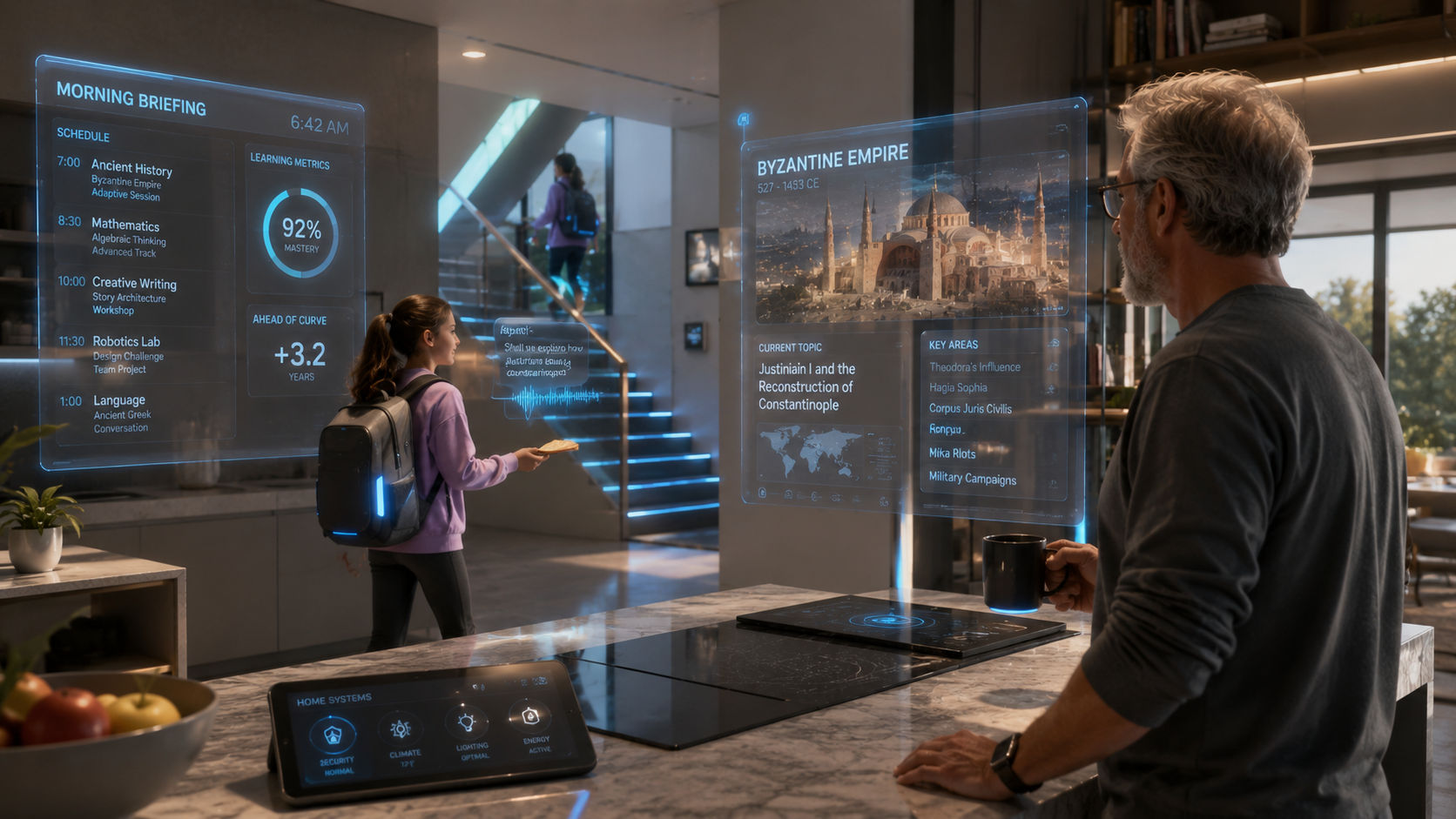
His twelve-year-old daughter passes through the kitchen. Her own education agent has already prepared her morning — a personalized curriculum that has been adapting to her learning patterns, interests, and pace since she was six. She’s three years ahead of what would have been called “grade level” in 2026, not because she’s exceptional, though she is, but because she has never once had to wait for a class to catch up, sit through a lesson she already understood, or struggle alone with a concept for weeks before a teacher noticed. She grabs her toast and heads upstairs, already mid-conversation with her learning agent about the Byzantine Empire.
Wilson finds none of this extraordinary. His daughter has never known anything different.
The Commute That Isn’t
Wilson doesn’t commute. Most people in their forties in 2040 don’t, at least not daily. But today he needs to be in the office — a physical collaboration space that his company maintains for the two or three days a week when embodied presence genuinely matters. He steps into a vehicle that has been waiting outside for ninety seconds, summoned automatically when his morning routine indicated he was four minutes from departure. There is no driver. There is no steering wheel. There is a seat that adjusts to his exact preferences before he sits down, ambient sound calibrated to a focus frequency his agent knows helps him think, and a quiet thirty minutes during which he reviews materials for his presentation while the city moves past the window.
The vehicle knows his stress indicators are slightly elevated. It takes a slightly longer route through a tree-lined corridor rather than the faster highway option. He doesn’t notice. He arrives calmer than he would have otherwise. This is what intelligent infrastructure looks like in 2040 — not dramatic, not science-fictional, just systems that have learned to optimize for human wellbeing at a granularity that no human dispatcher, driver, or city planner could ever replicate.
The Meeting That Actually Works
The 11 AM presentation involves colleagues in seven cities and two countries. Nobody thinks this is complicated. The spatial collaboration environment makes presence feel genuine — not the flat-screen videoconference of the 2020s, but something closer to sitting around the same table, with spatial audio, shared three-dimensional objects that everyone can manipulate simultaneously, and an ambient AI that is transcribing, translating, summarizing, and flagging logical inconsistencies in real time without anyone having assigned it the task.
When a colleague in São Paulo raises an objection to a financial projection, the meeting AI quietly surfaces three supporting data points and one counterargument simultaneously, visible only to Wilson, within half a second of the objection being spoken. He incorporates the context into his response without breaking eye contact or reaching for his phone. Nobody in the room notices the assist. This is what cognitive augmentation looks like when it has matured — not a heads-up display cluttering your field of vision, but a whisper in the moment you need it, invisible to everyone else.
After the meeting, an automatically generated summary — with decisions, action items, and individual accountability assignments — is in every participant’s task system before the virtual room has cleared. No one took notes. No one needs to follow up asking what was decided. The action items have already been woven into Wilson’s afternoon schedule, with time blocked, relevant context pre-loaded, and preliminary research already queued.

The Afternoon Nobody Scheduled
The part of Wilson’s 2040 Tuesday that would most unsettle a visitor from 2026 isn’t the technology. It’s the time. Wilson has four hours in the middle of his day that belong entirely to him — creative thinking, a long lunch with a friend, an hour reading a physical book, an unstructured walk. He is not, by 2040 standards, unusually productive or unusually successful. He is an ordinary professional in his forties. But the administrative, organizational, and informational labor that consumed forty percent of a knowledge worker’s day in 2026 — the emails, the scheduling, the searching, the summarizing, the formatting, the following up, the remembering — has been absorbed almost entirely by his constellation of AI agents, which handle it continuously, in the background, without drama.
He doesn’t feel surveilled by them. He feels supported. The distinction took most of the 2020s to establish — not technologically, but culturally. There was a period when people resisted the intimacy of AI that actually knew them, fearful of what that knowledge implied. Then, gradually, the usefulness overwhelmed the anxiety. People began to understand that an AI that knew your stress patterns wasn’t watching you — it was working for you, the way a great assistant works for an executive, except available to everyone regardless of income or status.
What Today Will Sound Like Tomorrow
Wilson ends his Tuesday the same way he ends every Tuesday — with a brief review session with his health agent, checking in on the day’s data, adjusting tomorrow’s protocol in small ways. It takes six minutes. He closes his eyes and thinks about almost none of it.
Somewhere, someone in 2026 is reading about what Wilson’s life looks like and finding it overwhelming. Too much technology. Too much optimization. Too little friction. What they’re missing is that friction was never the point. The point was always the Tuesday afternoon — the four free hours, the long lunch, the book, the walk. Every piece of technology in Wilson’s life exists to give him more of that. In 2040, for the first time in the history of the knowledge economy, it’s actually working.
Related Articles
- “The Singularity Is Nearer” — Ray Kurzweil — https://www.penguinrandomhouse.com/books/542579/the-singularity-is-nearer-by-ray-kurzweil/
- “Human Compatible: Artificial Intelligence and the Problem of Control” — Stuart Russell — https://people.eecs.berkeley.edu/~russell/papers/russell-robotics19.pdf
- “The Coming Wave: Technology, Power, and the 21st Century’s Greatest Dilemma” — Mustafa Suleyman — https://www.thecomingwave.com