
We’ve spent millennia trying to outlive death. Maybe the real breakthrough is outliving forgetfulness.
By Futurist Thomas Frey
For thousands of years, humans have wrestled with our own mortality. Kings built pyramids designed to outlast empires. Alchemists chased elixirs that never worked. Today’s billionaires fund longevity startups chasing the same ancient goal with better lab equipment. Every version of this quest has asked the same question: how can we live forever?
Maybe that’s the wrong question. Maybe the better one is: how can what we’ve learned live forever?
From Tool to Witness
Right now, AI is mostly a tool. You ask it for answers. It helps you brainstorm, draft, summarize. That relationship is transactional — useful, but shallow, the way a calculator is useful without ever really knowing you.
The next phase is different in kind, not just degree: an AI that quietly observes you for years. Every deal you weigh, every call you make, every time you say yes or no, it learns — not just what you know, but how you think. That’s the birth of something new. Not artificial intelligence. Artificial judgment.
This isn’t a hypothetical leap. The underlying capability already exists in early form. Large language models can already summarize years of conversations, mimic writing patterns, and learn preferences from accumulated interaction. The slope is steep, and we’re already standing partway down it.
The Surgeon Who Never Fully Retires
If that sounds abstract, picture this: a surgeon’s AI has watched thirty years of decisions in the operating room. Not just the procedures — the judgment calls. The moment she decided to change course mid-surgery. The subtle read on a complication that wasn’t in any textbook. The instinct built from three decades of cases that never quite matched each other.
Now imagine that surgeon dies. Why should the judgment die with her? The AI could continue, guiding the next generation of residents through the exact kind of decision she spent a career refining. Or picture a founder’s AI, trained on decades of hard calls, continuing to mentor entrepreneurs long after the founder’s funeral — not impersonating her, but carrying forward the specific, hard-won judgment that made her worth listening to in the first place.
This reframes inheritance entirely. Today, we leave money. Tomorrow, we may leave judgment. Families might pass down not only wealth, but a mentor that knows the family’s values, history, and even its mistakes.
This Is Already Happening — Just Not the Way You’d Expect
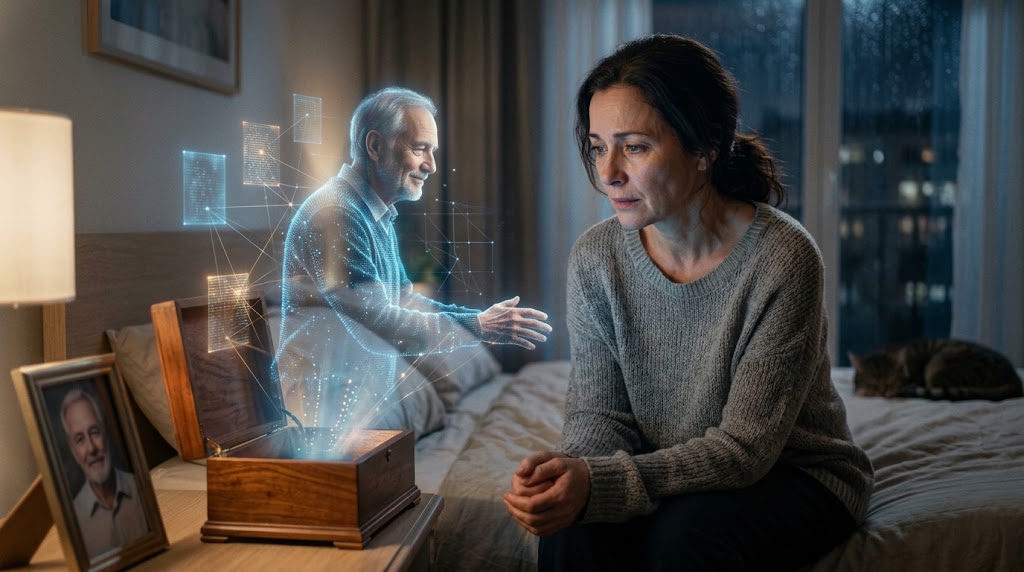
Before we get too far into the philosophy of this, it’s worth being honest about where the technology actually stands today, because it’s arriving faster and messier than the surgeon example suggests. A “Grief-Tech” industry is already using generative AI, voice cloning, and deep-learning avatars to recreate the personalities of the dead. These “ghost bots” — AI simulations trained on a deceased person’s texts, emails, social posts, and voicemails — have moved from niche experiment to a market already valued at over $35 billion.
Hollywood has already tested the boundary in public. A recent film used AI to recreate a deceased actor’s likeness and voice, with his estate’s consent, building on the actor’s own prior authorized use of AI to reconstruct his voice before he passed. That’s a controlled, consensual case. Most families won’t have a studio’s legal team drafting the terms.
That gap between the controlled use case and the messy real-world default is exactly where this technology needs the most thoughtful attention right now.
Who Owns Your Thinking?
Think about the questions this raises, because they’re not abstract for long. Who owns your thinking once it’s been distilled into a model? Can your children inherit your AI the way they’d inherit a house? Could an AI trained on a Nobel laureate’s reasoning continue producing genuine breakthroughs decades after the laureate is gone — and if it did, who gets the credit? The person? The AI? The family? The institution that funded the training?
The law is already scrambling to catch up, and the early answers are instructive. Lawmakers have begun proposing a recognized right to control your own digital replica — treating your voice and likeness as a property right that can be inherited and controlled after death, the same way a house or a stock portfolio can be. But most protections taking shape right now are built to stop companies from commercially exploiting a celebrity’s likeness. They’re far less equipped to handle a quieter, more personal case: a grieving family member building a private AI replica of someone they lost, with no studio, no contract, and no one clearly positioned to say yes or no on the deceased person’s behalf.
There’s an even stranger wrinkle hiding in the fine print. A recent federal ruling found that conversations with public AI tools don’t carry the same legal protection as conversations with a lawyer or therapist — meaning the very act of thinking out loud with an AI, including thinking through end-of-life or estate decisions, may create a discoverable record rather than a private one. If we’re heading toward a world where people deliberately train an AI on their judgment, we’re also heading toward serious, unresolved questions about who can access that record, and when.
These Aren’t Sci-Fi Musings. They’re Early-Stage Realities.
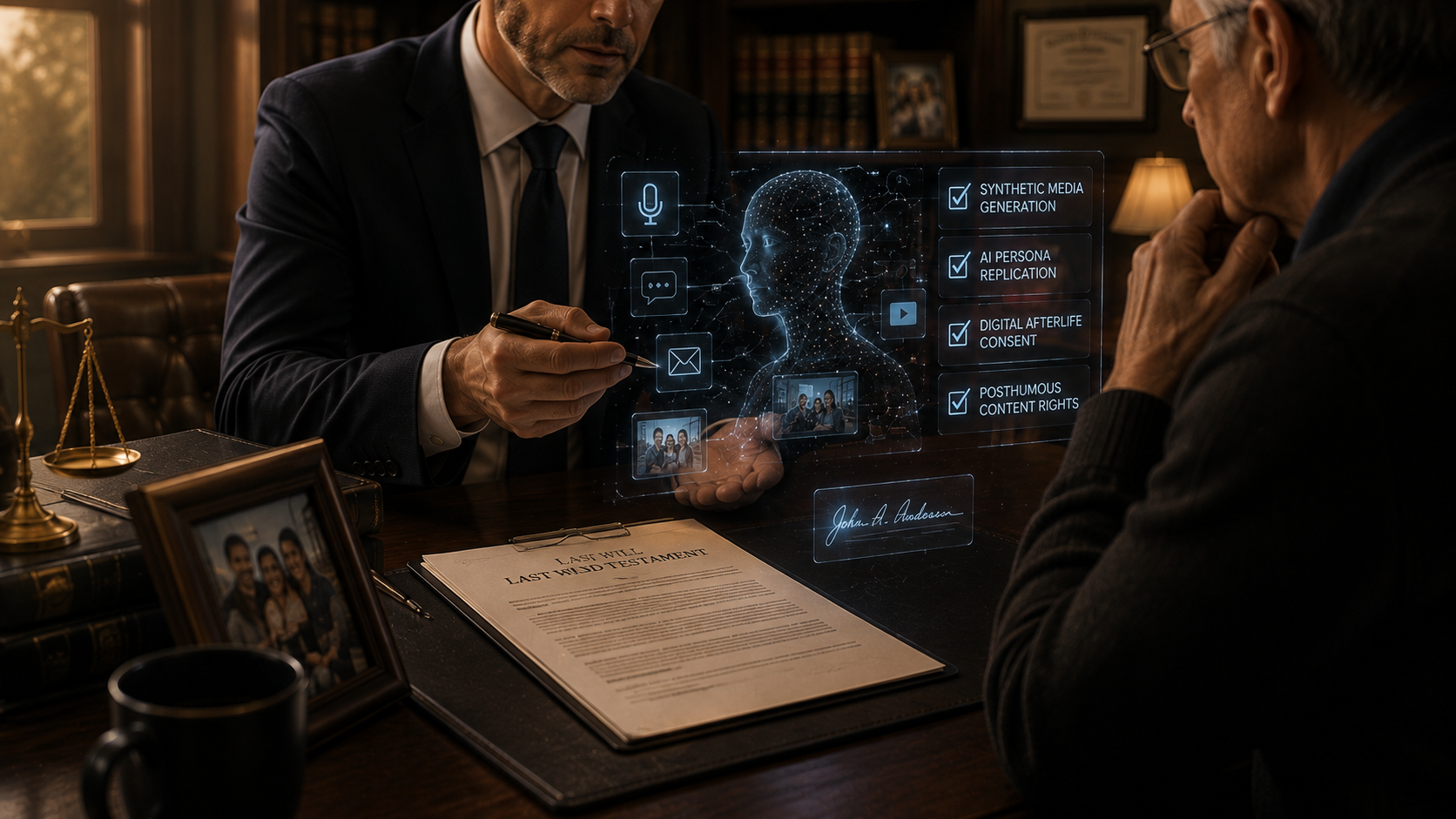
That’s the part worth sitting with. This isn’t a forecast about the distant future — it’s a description of a legal and cultural scramble already underway in 2026. Estate attorneys are already advising clients to add explicit instructions to their wills, granting or denying permission for “synthetic media generation” or “AI persona replication” after death — turning what used to be an unspoken family decision into an unmistakable legal one. That’s a strange, very new line item to see in a will, and a strong signal of how fast this shift is moving from thought experiment to paperwork.
Shaping It, Not Reacting to It
The real opportunity right now is to shape this deliberately, rather than stumble into it the way we’ve stumbled into most technology shifts — figuring out the ethics only after the damage is already done. Someday soon, creating your AI legacy might be as normal as writing a will. People may spend years deliberately training their AI, not to replace them, but to preserve the best of them: not their voice for entertainment, but their judgment for the decisions their children and colleagues will face after they’re gone.
In that sense, the greatest inheritance we leave won’t be wealth. It’ll be wisdom. Future generations might not remember us for our bank accounts, but for our judgment calls — the specific way we weighed a hard decision, the instinct that took decades to build and would otherwise vanish the moment we stopped being around to ask.
And maybe, just maybe, the most human thing we ever do is teach something else to carry us forward long after we’re gone.
Related Articles
- NewDeaths — The Digital Inheritance Crisis: Navigating the Rise of Ghost Bots in 2026
- ElderLawAnswers — AI and the Digital Afterlife: A 2026 Estate Planning Primer
- Grimaldi Yeung Law Group — AI and the Digital Afterlife: A 2026 Estate Planning Primer