Author: admin

Revolutionary Robotics Technology Enables Remote Medical Treatment in High-Risk Emergencies

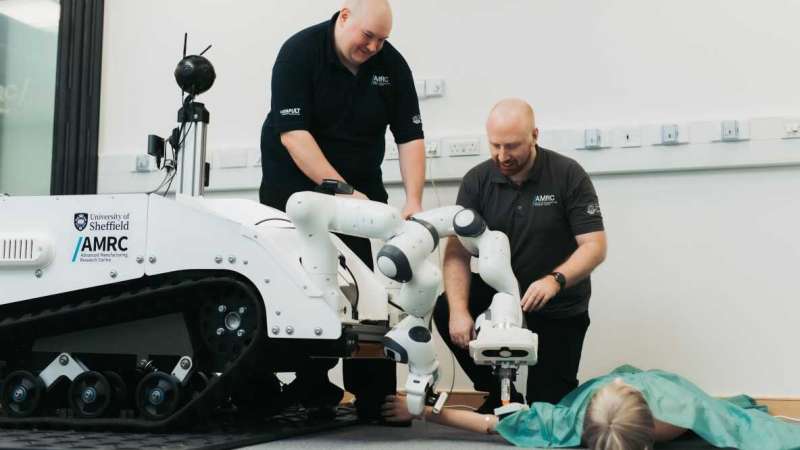
Researchers at the University of Sheffield have developed a groundbreaking robotics technology called medical telexistence (MediTel), which has the potential to provide remote medical treatment to casualties in hazardous emergency environments. Led by the Advanced Manufacturing Research Center (AMRC), Sheffield Robotics, and the Department of Automatic Control and Systems Engineering, the team successfully created a mobile, robotic-controlled uncrewed ground vehicle (UGV) equipped with virtual reality (VR) capabilities.

In a remarkable nine-month development period, the fully integrated MediTel solution features two robotic arms that can remotely operate medical tools to conduct a critical initial assessment of a casualty within 20 minutes. This includes vital checks such as temperature, blood pressure, and heart rate, as well as performing a palpation of the abdomen and administering pain relief through an auto-injector. Real-time data is continuously streamed to the remote operator during the assessment.

Continue reading… “Revolutionary Robotics Technology Enables Remote Medical Treatment in High-Risk Emergencies”

China’s Microgravity Experiment Facility: Pioneering Space Research on Earth

Chinese scientists have successfully built a groundbreaking Microgravity Experiment Facility with Electromagnetic Launch (MEFEL) to conduct cost-effective microgravity experiments on Earth, bolstering the country’s ambitious space research endeavors. The 131-foot tall MEFEL utilizes a linear motor to create a weightless environment for approximately 4 seconds, supporting up to 100 experiments daily, while consuming only 1 kilowatt-hour of electricity per experiment.

Compared to conventional microgravity facilities like drop towers and parabolic flights, MEFEL proves to be a game-changer, saving significant time and resources in pretesting experiments that will eventually be conducted aboard the Tiangong space station. Additionally, the facility can simulate partial gravity to mimic conditions on the moon and Mars.

Continue reading… “China’s Microgravity Experiment Facility: Pioneering Space Research on Earth”

Bridging the Gap: Ohio State Engineers Tackle Memory Loss in Machine Learning for Lifelong Adaptability

Memories can be elusive for both humans and machines, and understanding why artificial agents experience gaps in their cognitive processes is crucial for the advancement of artificial intelligence (AI). Electrical engineers at The Ohio State University have delved into the impact of “continual learning” on overall performance in AI systems. Continual learning involves training computers to continuously learn a sequence of tasks, utilizing past knowledge to improve learning new ones.

However, one major challenge scientists face is overcoming the machine learning equivalent of memory loss, known as “catastrophic forgetting.” As AI agents are trained on successive tasks, they tend to lose information from previous tasks, posing risks as AI becomes more integrated into society. Ness Shroff, an Ohio Eminent Scholar and professor of computer science and engineering at Ohio State, emphasized the importance of preventing these AI systems, such as automated driving applications or robotic systems, from forgetting crucial lessons.

Continue reading… “Bridging the Gap: Ohio State Engineers Tackle Memory Loss in Machine Learning for Lifelong Adaptability”

Tesla Commits Over $1 Billion to Supercomputing Project Dojo for Autonomous Driving

Tesla Inc is determined to make significant strides in the world of supercomputing, with CEO Elon Musk revealing the company’s ambitious plan to invest more than US$1 billion into its Project Dojo by the end of 2024.

During a conference call with investors, Musk explained that Project Dojo involves the development of an in-house supercomputer specifically designed to handle vast amounts of data, including the extensive video footage captured by Tesla cars. This data is crucial for the advancement of autonomous driving software.

Continue reading… “Tesla Commits Over $1 Billion to Supercomputing Project Dojo for Autonomous Driving”

Ex-Google Executive Foresees AI-Powered Sex Robots Redefining Love and Intimacy

Mohammad “Mo” Gawdat, former chief business officer of Google’s secretive research division X, has made intriguing predictions about the future of artificial intelligence (AI) and its impact on human relationships. Gawdat believes that AI-powered sex robots will soon be so advanced that they will appear “alive” and eliminate the need for human partners in the bedroom.

Speaking on the “Impact Theory” podcast hosted by Tom Bilyeu on YouTube, Gawdat shared his vision of a radical “redesign of love and relationships.” He suggested that AI, combined with virtual reality and augmented reality headsets like Apple’s Vision Pro or a Quest 3, will enable people to simulate sexual encounters that are indistinguishable from real-life experiences. The integration of AI-powered bots with these headsets will create a deceptive illusion, making users believe they are interacting with real partners.

Continue reading… “Ex-Google Executive Foresees AI-Powered Sex Robots Redefining Love and Intimacy”

Saildrone: Pioneering Autonomous Ocean Exploration with Nvidia’s AI Technology

While self-driving autonomous vehicles on land have become more familiar, an exciting frontier lies in autonomous vehicles for ocean exploration. US-based startup Saildrone is leading the charge, crafting uncrewed surface vehicles (USVs) equipped with cutting-edge nautical data collection technology. These autonomous ocean explorers are revolutionizing marine research, weather tracking, ocean floor mapping, and much more.

Saildrone’s USVs have already achieved impressive feats, including tracking hurricanes in the North Atlantic, discovering a 3,200-foot underwater mountain in the Pacific Ocean, and mapping previously uncharted ocean floors. “We’ve sailed into three major hurricanes, and right through the eye of Hurricane Sam, and all the vehicles came out the other side — they are pretty robust platforms,” said Blythe Towal, vice president of software engineering at Saildrone.

Continue reading… “Saildrone: Pioneering Autonomous Ocean Exploration with Nvidia’s AI Technology”

Carnegie Mellon’s Robotics Institute Pioneers Autonomous Exploration Robots

A groundbreaking research group within Carnegie Mellon University’s Robotics Institute is revolutionizing exploration with their cutting-edge robotic systems. The Autonomous Exploration Research Team has developed a suite of autonomous robots and planners that enable advanced exploration, rapid mapping, and accurate navigation through unknown environments—all without the need for human intervention.

Led by Ji Zhang, a systems scientist at the Robotics Institute, the team’s robotic systems boast incredible versatility. The robots can be deployed in various environments, ranging from department stores to disaster-stricken residential buildings, to explore and map in real-time. This autonomous approach eliminates the need for human presence on-site, making exploration more efficient and safe.

Continue reading… “Carnegie Mellon’s Robotics Institute Pioneers Autonomous Exploration Robots”

Revolute Robotics Unveils Mesmerizing Hybrid Mobility Robot: A Game-Changer for Confined Space Inspections

A remarkable startup hailing from Arizona, Revolute Robotics, has introduced a groundbreaking creation known as the Hybrid Mobility Robot (HMR). This fully autonomous bot showcases an impressive combination of rolling and flying capabilities, making it an ingenious solution for inspecting confined spaces. Designed to enhance safety and efficiency in challenging environments like oil rigs and deep mine shafts, the HMR has the potential to revolutionize the inspection process.

The core idea behind the HMR’s development is to automate inspections in spaces where human presence poses significant risks. Traditionally, inspections in such areas can halt operations for extended periods, resulting in increased costs for businesses. However, Revolute Robotics’ innovative solution utilizes a pair of gyroscopic gimbal rings, enabling the bot to roll in any direction. When faced with obstacles or inaccessible zones during inspections, it effortlessly switches to flying mode using its four propellers.

Continue reading… “Revolute Robotics Unveils Mesmerizing Hybrid Mobility Robot: A Game-Changer for Confined Space Inspections”

Tesla Commences Production of Dojo Supercomputer for Autonomous Vehicle Training

In its second-quarter earnings report for 2023, Tesla revealed its ambitious plan to address vehicle autonomy at scale with four key technology pillars: an extensive real-world dataset, neural net training, vehicle hardware, and vehicle software. Notably, the electric vehicle manufacturer asserted its commitment to developing each of these pillars in-house. A significant milestone in this endeavor was announced as Tesla started the production of its custom-built Dojo training computer, a critical component in achieving faster and more cost-effective neural net training.

While Tesla already possesses one of the world’s most potent Nvidia GPU-based supercomputers, the Dojo supercomputer takes a different approach by utilizing chips specifically designed by Tesla. Back in 2019, Tesla CEO Elon Musk christened this project as “Dojo,” envisioning it as an exceptionally powerful training computer. He claimed that Dojo would be capable of performing an exaflop, or one quintillion (10^18) floating-point operations per second, an astounding level of computational power. To put it into perspective, performing one calculation every second on a one exaFLOP computer system would take over 31 billion years, as reported by Network World.

Continue reading… “Tesla Commences Production of Dojo Supercomputer for Autonomous Vehicle Training”

Microsoft Teams Introduces AI-Powered Beauty Filters with Maybelline Collaboration

In the era of video conferencing, many people have felt the urge to disable their webcams on days when they don’t feel their best. Understanding this common concern, Microsoft has unveiled a new AI-powered beauty feature aimed at making video calls more pleasant. Partnering with cosmetics giant Maybelline, Microsoft Teams is introducing a set of “virtual makeup” filters that allow users to enhance their appearance with a variety of unique looks.

The Maybelline Beauty app, integrated into Microsoft Teams, will offer users 12 different makeup looks to choose from. These filters will include various blurring effects and digital makeup color options. Interestingly, each look will provide a detailed breakdown of the real-world Maybelline products and shades used in the filter, empowering users to recreate the makeup look in their daily lives.

Continue reading… “Microsoft Teams Introduces AI-Powered Beauty Filters with Maybelline Collaboration”

Unveiling Nature’s Microbe Killer: The Cicada Wing’s Antibacterial Secret Unraveled Through Nanoscale Simulations

Over the last decade, collaborative teams of engineers, chemists, and biologists have diligently studied the physical and chemical properties of cicada wings, driven by the quest to unlock the enigmatic ability of these wings to eliminate microbes on contact. The hope is that if science can replicate this natural function, it may lead to the development of products with inherently antibacterial surfaces, surpassing the effectiveness of current chemical treatments.

At Stony Brook University’s Department of Materials Science and Chemical Engineering, researchers made significant progress when they developed a simple technique to replicate the nanostructure of cicada wings. However, they still lacked a crucial piece of information – the exact mechanism by which the nanopillars on the wing’s surface exterminate bacteria. Fortunately, their answer came in the form of assistance from Jan-Michael Carrillo, a researcher at the Center for Nanophase Materials Sciences in the Department of Energy’s Oak Ridge National Laboratory.

Continue reading… “Unveiling Nature’s Microbe Killer: The Cicada Wing’s Antibacterial Secret Unraveled Through Nanoscale Simulations”

Innovative Cryoneurolysis: Regenerating Damaged Nerves for Pain Relief

Exciting new research, to be presented at the Society of Interventional Radiology Annual Scientific Meeting in Boston, reveals a groundbreaking technique called interventional cryoneurolysis, capable of regenerating damaged nerves using a frozen needle under advanced imaging guidance. This cutting-edge method offers hope to patients suffering from persistent pain following traumatic injuries and may provide a non-opioid alternative for pain management.

Conducted by researchers at Emory University, the study focused on treating eight patients with chronic nerve pain resulting from prior traumas. CT-guided interventional cryoneurolysis employs imaging to precisely place a needle and freeze the damaged nerves, leading them to degenerate and lose function. The remarkable part of the process is the potential for regeneration—if the nerve is exposed to the right amount of cold over the correct area and time, it can be replaced with a healthy nerve.

Continue reading… “Innovative Cryoneurolysis: Regenerating Damaged Nerves for Pain Relief”
Discover the Hidden Patterns of Tomorrow with Futurist Thomas Frey
Unlock Your Potential, Ignite Your Success.

By delving into the futuring techniques of Futurist Thomas Frey, you’ll embark on an enlightening journey.

Learn More about this exciting program.