People laughed when ThyssenKrupp, a company synonymous with elevators, announced it was developing one that goes every which way. Who’d ever heard of such a thing? Everyone knows elevators go just two directions: Up and down. Some took to calling it the Wonkavator, after Willy Wonka’s wacky lift that goes sideways, slantways, and longways.
Building a home or temporary shelter by hand can be both time-consuming and expensive.
Ten Fold Engineering, a housing startup based in the UK, has created self-deploying buildings that can pop up in a matter of eight minutes. Owners push a button, and the rooms fold out like an accordion using a counterbalance system.
Blockchain, or distributed ledger technology, could soon give rise to a new internet era even more disruptive and transformative than the current one, according to a white paper, Realizing the Potential of Blockchain, published by the World Economic Forum today.
A startup out of Los Angeles, California, wants to bring small, pre-fabricated living spaces into the backyards of the country’s hottest real estate markets.
The homes range in size from 300 to 1,200 square feet — but don’t call them tiny homes.
Elon Musk’s new Boring Company tunnels look pretty, well, not boring.
The company on Friday published an animated concept video on YouTube that shows how tunnels underneath a city could work. In the video, a car drives onto a metal platform that then lowers itself underground. The platform, with the car on top of it, speeds along at 124 mph, while other platforms carrying cars do the same. When the car reaches its destination, the platform lifts it back to the earth’s surface.
When I was a kid I always wondered about how cool it would be if we could live in the world of the popular American animated sitcom The Jetsons. The show aired from 1962 to 1963, but the cartoon was set 100 years in the future. As it sometimes turns out with sci-fi stories, the future becomes reality. The Jetsons featured 3D printing, tablets, holograms, smart watches, flying cars and other strange inventions. While the flying cars may not have become a reality quite yet – they are testing drones as a method of delivery – I used to love the Jetsons’ food replicator that could churn out anything from asparagus to stroganoff. This now is a reality with companies like Foodini and CojoJet making it possible to create delicious 3D-printed entrées and desserts with the press of a button.
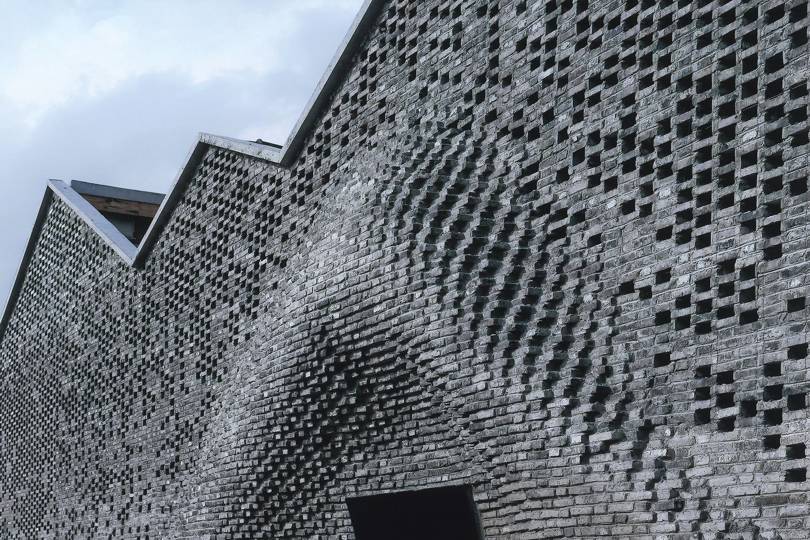
If you want curves like this, you’ll need a robot. Designed by architects Archi-Union, the undulating exterior of the Chi She Gallery in Shanghai was made using an adapted car-manufacturing robot. “We used digital tools to transform geometry data to digital-fabrication data,” says Li Han, chief architectural designer at Archi-Union, who spent five years making the cyborg helper.
Could the skyscraper of the future dispense homes like a vending machine?
Growing and adapting to Tokyo’s housing demand, this Pod Skyscraper is constantly under construction. Residents can order a ready-to-use modular dwelling manufactured by 3D printers on the top floor of the building, and then cranes lower it into place.
Much of the focus in the technology world currently is on artificial intelligence, machine learning and big data – and how they will affect the way we use products and how machines operate. But developing just as quickly, although with slightly less hype, is 3D printing, or additive manufacturing (AM), which is going to have at least as big an impact on how we make things as AI et al. The process creates products by depositing layers of material, generally ground metal or plastic, to a template, lasering that material into place and repeating the process to build the required product – anything from replacement hips to jet engine parts.
South Korea is seeking to develop a train-like public transport concept that is almost as fast as the speed of sound up 1,000 km / h, the Korea Railroad Research Institute (KRRI) said Tuesday. The state-run institute will join forces with other research groups and Hanyang University to build the near-supersonic “train”, which would be able to travel from Seoul to Busan in half an hour.
A company is planning to build the world’s first floating city in the middle of the Pacific Ocean. The government of French Polynesia has signed an agreement with a US firm and they hope construction work will begin in 2019. The Seasteading Institute has spent the past five years trying to work out how to build “permanent, innovative communities floating at sea”.
Dubai, the largest city in the United Arab Emirates and an increasingly powerful World City, has launched the Dubai 3D Printing Strategy, a unique and wide-reaching initiative that seeks to exploit the power of 3D printing to add value to the national economy, and to humanity as a whole.