The fight against childhood obesity has been dealt a blow. The U.S. House of Representatuves passed a bill that abandons proposals that threatened to end the reign of pizza and French fries on federally funded school lunch menus.
Wikipedia just got a big financial shot in the arm.
We’re all used to hearing of über-rich gazillionaires donating to charitable causes like finding cures for diseases and feeding hungry children in Africa. But what about websites? Now you can say that you’ve heard that too, as Google co-founder Sergey Brin has forked over $500,000 to Wikipedia.
The donation is actually from Brin’s charity, the Brin Wojcicki Foundation, which he founded with his wife, Anne Wojcicki. Before these big bucks were sent to the Wikimedia Foundation (the nonprofit that runs Wikipedia), the couple had donated to Michael J. Fox’s fund for finding a cure for Parkinson’s disease…
Looking at some of the most beautiful libraries in the world, like the Wiblingen Monastery Library in Ulm, Germany seen above, is truly fascinating. But if you’re like me, it might also make you feel depressed about the sad state of your town’s library.
Hydrogen is the most abundant element in the universe, but it’s not all that useful as a gas. Two scientists say they’ve coaxed it to become a metal, which could be used in ways that would radically change our lives.
Two scientists at the Max Planck Institute in Germany say they applied intense pressure and manipulated a few other conditions to transformed hydrogen into a metal. If their results, which they published in Nature Materials, can be reproduced it could lead to amazing things like super-efficient transportation systems, powerful medical devices, and major advances in computing…
If you’re a snack-sized squid or octopus living in the ocean zone where the last bit of daylight gives way, having some control over your reflection could be a matter of life and death. Most predators cruising 600 to 1,000 meters below the surface spot the silhouette of their prey against the light background above them. But others use searchlights mounted on their heads…
Nokia apparently feels like the smart phones we have today aren’t rubbery or flexible enough to take us into the future, so they are introducing a design that will change the way we use, and touch, our phones.
Called the HumanForm, this rubbery surfboard shaped device is virtually unbreakable, has twist control functionality, and will supposedly allow us to feel textures via “electro tactile technology”.
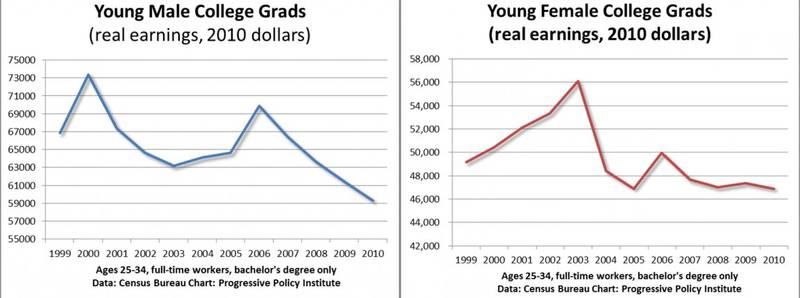
According to analysis from economist Michael Mandel, the average wages of US college grads have experienced sharp declines in the last decade. On the other hand, college keeps getting more expensive, and the collection of student loans has become much more aggressive. Sounds like a recipe for disaster…
We’ve always heard that it is better to give than to receive. And the research is there to prove the old adage is right. A post at PsyBlog has links to several studies about this phenomenon.
But why? Why is it that spending our money on others—prosocial spending—makes us happier?
Buckminster Fuller only designed about a dozen of domed structures to begin with, and many have either been torn down in lieu of new construction or simply left to rot. But not the dome at Materials Park in Ohio, it just received a $7 million facelift and is now listed on the National Register of Historic Places (NRHP)…
Nature provides another model for technological advancement.
Ohio State University researchers have discovered that a weed, Salvinia molesta, that clogs up the waterways of many parts of the Americas and Australia actually holds the clues to creating a new type of waterproof coating for materials — all thanks to a very unusual characteristic.
This weed has eggbeater-shaped hairs that trap air and keep the plant floating on the surface of the water — and these odd hairs have inspired a brand new type of coating for things like boats or submarines…
0.03-inch wide close-up of the super-black, carbon nanotube coating.
Even though NASA has drastically scaled back its missions into space, that doesn’t mean the agency has stopped research for the benefit of space exploration. Evidence of this comes in the form of a new, super-black material that just got unveiled during the SPIE Optics and Photonics conference.
NASA is claiming it is the most light absorbent material ever developed, and capable of absorbing 99% of ultraviolet, infrared, far-infrared, and visible light. That may not sound too impressive on its own until you find out what it can be used for and the benefits it brings…
The video is released today, and it does not disappoint.
Succinctly but effectively, Annie Leonard tells the story of how our tax dollars are being misappropriated to prop up an ailing, energy intensive, resource hungry and ultimately counterproductive “dinosaur economy”. And she then goes on to make the case of how we could do things better…