Scientists have developed a new type of “super wood” that is more than 10 times stronger and tougher than normal wood – and this innovation could potentially become a natural and inexpensive substitute for steel and other materials.
This millimeter-scale robot designed by researchers at the Max Planck Institute for Intelligent Systems could enable “applications in microfactories such as the construction of tissue scaffolds by robotic assembly, in bioengineering such as single-cell manipulation and biosensing, and in healthcare such as targeted drug delivery and minimally invasive surgery” with bots inside the body controlled by magnets. From their scientific paper in Nature:
Revolve was invented and designed by Andrea Mocellin with the aim to be the first modular wheel, which in turn will open new frontiers for the present and future of foldable vehicles.
Finnish start-up ICEYE has designed tiny micro-satellites that can image through poor weather and darkness. Their plans to launch fleets of these satellites are ambitious, but how much privacy are we owed?
Harvard’s robot bees have really evolved over the years. The RoboBee project was first unveiled in 2013, when the bots were only capable of takeoff and flying. Since then, they’ve been modified to stick to surfaces and swim underwater, and now their creators say they’re able to dive in and out of water — a big achievement for a tiny robot bee.
The red segment represents the “proof-of-concept” tunnel that would be used to run tests. The blue segments are potential expansion routes if the tunnels are approved to use for public transportation.
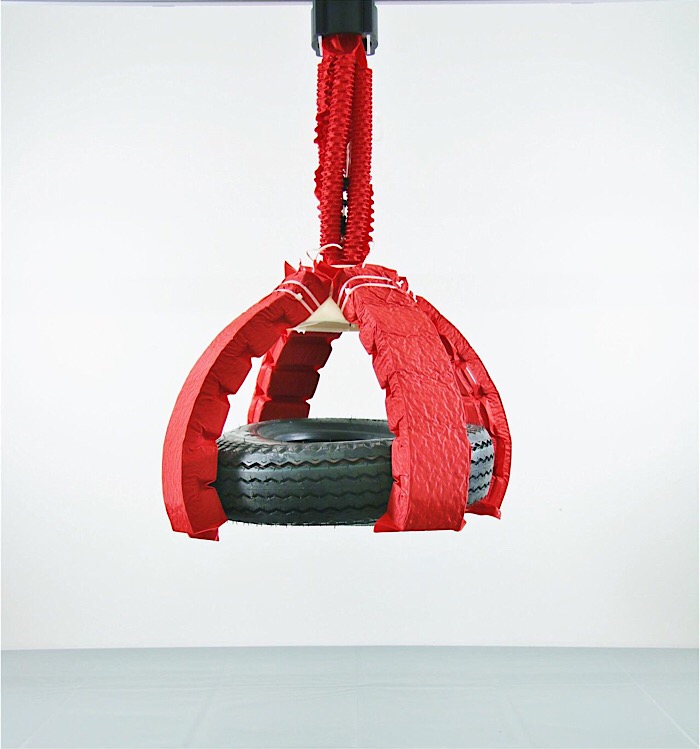
Soft robotics has made leaps and bounds over the last decade as researchers around the world have experimented with different materials and designs to allow once rigid, jerky machines to bend and flex in ways that mimic and can interact more naturally with living organisms. However, increased flexibility and dexterity has a trade-off of reduced strength, as softer materials are generally not as strong or resilient as inflexible ones, which limits their use.
September 23, 2017 – If you can make a robot small enough and then give it an arm like the Canadarm on the International Space Station, could you have it build things a molecule at a time? That’s the challenge that scientists at The University of Manchester decided to accept, and voila, the result, a robot a mere one-millionth of a millimeter in size that is programmable, can move and has a tiny robotic arm. They published their results in the September 20, 2017, edition of the journal Nature in an article entitled, “Stereodivergent synthesis with a programmable molecular machine.”