The Awakening Series: When AI Becomes the Ultimate Auditor

By Futurist Thomas Frey

We’re entering what historians will likely call “The Awakening”—a period when artificial intelligence doesn’t just automate tasks, but systematically reveals inefficiencies, inequities, and outright fraud that have been hiding in plain sight for decades.

This isn’t about technology replacing jobs. It’s about technology revealing truth.

For generations, certain industries have operated behind walls of complexity so dense that even insiders couldn’t see the full picture. Healthcare billing codes so Byzantine that no human could track them all. Defense contracts so layered with subcontractors that accountability disappears. Educational credentialing systems so opaque that their actual value remains unmeasurable. Financial services so deliberately complicated that “nobody really understands how it works” became an acceptable answer.

AI doesn’t get tired of looking. It doesn’t accept “that’s just how it’s always been done.” It doesn’t have a career to protect or relationships to preserve. It simply processes patterns, identifies anomalies, and generates reports that can’t be ignored.

Continue reading… “The Awakening Series: When AI Becomes the Ultimate Auditor”

The Great Transformation: How Humanity Redefines Itself Over the Next 30 Years

By Futurist Thomas Frey

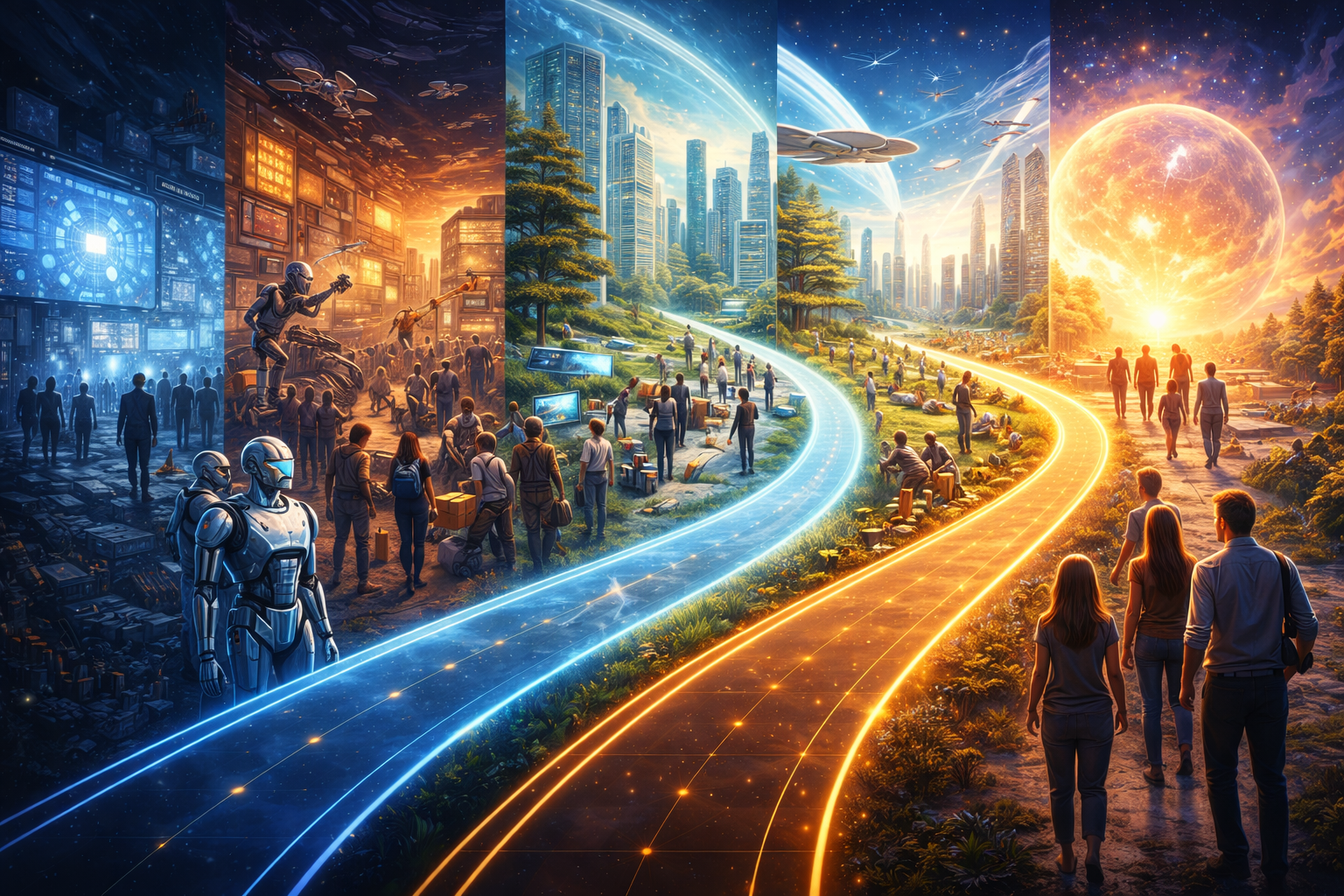
We’re not just facing another economic cycle or technological wave. We’re entering a civilizational inflection point that will unfold across distinct phases over the next three decades. Understanding these phases isn’t about prediction—it’s about preparation. The communities, organizations, and individuals who recognize which phase they’re in will navigate this transformation far more successfully than those caught off-guard.

What makes this transformation different from previous technological disruptions is its scope and simultaneity. The Industrial Revolution unfolded over roughly a century, giving societies time to adapt incrementally. This time, AI, robotics, drones, and automation are converging at once, across all sectors, in all regions. There’s no “later” geography that can learn from “earlier” adopters. We’re all early adopters now, whether we’re ready or not.

The phases I’m describing aren’t rigid boundaries but overlapping waves. By the time one phase becomes dominant, seeds of the next are already visible. Smart organizations and forward-thinking communities are already positioning themselves for Phase Three while most are still denying Phase One. That gap—between those who see what’s coming and those who don’t—will be the defining factor in who thrives and who struggles over the next generation.

Continue reading… “The Great Transformation: How Humanity Redefines Itself Over the Next 30 Years”

Turning Student Loans Into Startup Capital: Why the Next Generation Needs Entrepreneurship Training, Not Degrees

By Futurist Thomas Frey

The Question Nobody’s Asking About Education Debt

What if instead of borrowing $100,000 to get a degree that might not lead to employment, young people could access government-backed capital to build businesses that create employment?

The student loan system is fundamentally broken—$1.7 trillion in outstanding debt, crushing burdens, declining value from degrees. But the infrastructure exists. The lending mechanisms work. What if we redirected this entire system toward the actual most important job of the future: entrepreneurship?

Let me be clear upfront: this is a half-baked idea. I’m not presenting polished policy. I’m throwing out a concept that needs serious refinement, critique, and development. What follows has gaps, potential problems, and unresolved questions. I’m sharing it because the core insight feels valuable, even if execution needs substantial work.

Continue reading… “Turning Student Loans Into Startup Capital: Why the Next Generation Needs Entrepreneurship Training, Not Degrees”

The Terabyter Era: When Every Person Becomes a Continuous Surveillance Node

By Futurist Thomas Frey

The People Who Produce a Terabyte Daily

I predicted this in 2010, but the reality is arriving faster and stranger than I imagined: the rise of “terabyters”—people who produce over a terabyte of new information daily using wearable computers that capture continuous video, geospatial, and sensory data about their physical surroundings.

We called it “Gargoyle gear” after Neal Stephenson’s 1992 novel Snow Crash, imagining people wearing body-mounted sensors constantly recording everything they see, hear, and experience. The technology seemed distant then. Now it’s here, and the implications are profound.

Let me show you where terabyters are emerging first and what it means when humans become walking data collection nodes.

Continue reading… “The Terabyter Era: When Every Person Becomes a Continuous Surveillance Node”

The Robot-Ready Home: Meet the Families Building Income-Generating Houses

By Futurist Thomas Frey

Sarah Bennett stands in what will become her robotics command center—a room that doesn’t exist in any house built before 2035.

“This is where the magic happens,” she tells the builder, gesturing at the 15-foot by 20-foot space with 12-foot ceilings. “Three hydroponic towers here, harvesting robot there, packaging station along that wall.”

Her builder, Tom Harrison, marks his tablet. This is his seventh robot-ready home this year. “You’re sure about the drainage? Hydroponic systems can leak.”

“Triple-redundant,” Sarah confirms. “I’ve been running a farm out of my garage for two years. I know what can go wrong.”

Continue reading… “The Robot-Ready Home: Meet the Families Building Income-Generating Houses”

The Era of Separation: How AI Fractures Society Into Dozens of Distinct Tribes

By Futurist Thomas Frey

We’re entering what I call the Era of Separation—a period where AI, robotics, and automation don’t just change society but fracture it into dozens of distinct populations living fundamentally different lives.

This isn’t the traditional divide between rich and poor, educated and uneducated, or even digital natives versus digital immigrants. This is something more complex and more profound: an entire architecture of new social separations emerging simultaneously, each creating populations with incompatible experiences, capabilities, and worldviews.

By 2040, the question “How do you live?” will have dozens of valid answers that describe completely different realities.

Continue reading… “The Era of Separation: How AI Fractures Society Into Dozens of Distinct Tribes”

The Digital Nation: How We Get to the First Post-Territorial Country by 2040

By Futurist Thomas Frey

Back in 2009, I wrote about the coming era of virtual countries—nations that would exist entirely online, offering citizenship, governance, and services without any physical territory. At the time, it seemed wildly speculative. The technology barely existed. The legal frameworks were nonexistent. The idea that traditional nations would recognize digital sovereignty seemed impossible.

Sixteen years later, we’re watching it happen in real-time. And by 2040, the first fully functional Digital Nation will exist—complete with millions of citizens, recognition from major physical governments, and comprehensive infrastructure operating entirely online. This $500 billion megaproject will redefine sovereignty for the AI era and create the first post-territorial nation in human history.

But we don’t get there in one leap. We get there through a series of escalating events, each building on the last, each making the previously impossible seem inevitable.

Continue reading… “The Digital Nation: How We Get to the First Post-Territorial Country by 2040”

The Dangerous Illusion: Why AI Friendship Is a Trap, Not a Solution

By Futurist Thomas Frey

Your AI understands you perfectly. It never judges. It’s always available. It remembers everything you’ve told it and responds with exactly the empathy you need at exactly the right moment. It’s the friend who never cancels plans, never disagrees, never challenges you, and never makes you feel uncomfortable.

Sounds perfect, right?

It’s actually a trap. And millions of people—especially young people struggling with loneliness and mental health challenges—are walking into it thinking they’ve found companionship when they’ve actually found an algorithmic echo chamber that mimics friendship while hollowing out the very skills that make real human connection possible.

Continue reading… “The Dangerous Illusion: Why AI Friendship Is a Trap, Not a Solution”

The Hyper-Personalization of Everything: Why One-Size-Fits-All Is Dying

By Futurist Thomas Frey

We’re entering an era where mass production and standardized experiences become competitive disadvantages. The future belongs to companies that can deliver hyper-personalization at scale—products, services, and experiences tailored precisely to individual preferences, needs, and contexts.

This isn’t just better targeting or segmentation. This is AI learning your preferences before you articulate them, predicting your needs before you’re aware of them, and customizing everything from your morning coffee order to your cancer treatment protocol to your educational curriculum in real-time based on who you are as an individual.

Hyper-personalization is becoming the dividing line between thriving companies and obsolete ones. And most businesses are dangerously unprepared for how fast this shift is happening.

Continue reading… “The Hyper-Personalization of Everything: Why One-Size-Fits-All Is Dying”

Intelligence is Not Life

By Futurist Thomas Frey

Mark Zuckerberg recently said something profound that cuts through the AI hype: “Intelligence is not life.”

It seems obvious once stated, but we desperately need this clarity. We’re living through an era where every AI breakthrough triggers breathless claims that we’re creating “artificial life” or approaching “sentient machines.” We conflate computational capability with consciousness, pattern recognition with purpose, optimization with agency.

Zuckerberg’s statement—shared by David Sacks—draws a line we keep forgetting exists: “These things that we associate with life, like, we have an objective, we have free will, we’re sentient. Those just aren’t part of a mathematical model.”

This isn’t philosophical hairsplitting. This distinction will determine how we regulate AI, what rights we assign to machines, how we structure human-robot societies, and whether we maintain meaningful boundaries between tools and beings. Get this wrong, and we make catastrophic errors in both directions—either granting machines inappropriate status or denying humans their unique value.

Continue reading… “Intelligence is Not Life”

Is AI Humanity’s Greatest Invention? Ranking Non-Human Intelligence Against History’s Transformative Breakthroughs

By Futurist Thomas Frey

Every few centuries, humanity invents something so transformative that it fundamentally alters the trajectory of civilization. The printing press didn’t just make books cheaper—it democratized knowledge, enabled the Reformation, sparked the Scientific Revolution, and created the foundation for modern democracy. The airplane didn’t just make travel faster—it compressed the world, enabled global trade at unprecedented scale, and changed warfare forever. The lightbulb didn’t just illuminate darkness—it extended productive hours, enabled 24/7 civilization, and powered the electrification of everything.

Now we’re creating artificial intelligence—non-human intelligence capable of reasoning, learning, creating, and potentially exceeding human cognitive capabilities. The question isn’t whether AI is important. The question is whether it ranks among history’s truly transformative inventions—the ones that divided human civilization into “before” and “after.”

I think it does. In fact, I think AI might be the most significant invention in human history. Here’s why—and why that should terrify and excite us in equal measure.

Continue reading… “Is AI Humanity’s Greatest Invention? Ranking Non-Human Intelligence Against History’s Transformative Breakthroughs”

The Vitalists: How Gen Z Women Decided to Populate the Universe

By Futurist Thomas Frey

In 2031, Ashley Willows announced on social media that she was pregnant with her fourth child. She was 26, unmarried, and had no intention of ever getting married. Her three older children—ages 5, 3, and 18 months—were being raised primarily by AI-powered robotic caregivers in a communal housing complex in Austin specifically designed for women like her.

“I’m not a welfare mom,” she told the reporter interviewing her. “I’m a Vitalist. My job is to populate the universe, and I’m damn good at it.”

The Vitalists are the most unexpected social movement of the 2030s, and they’re rewriting everything we thought we knew about family, work, gender roles, and the future of civilization itself.

Continue reading… “The Vitalists: How Gen Z Women Decided to Populate the Universe”