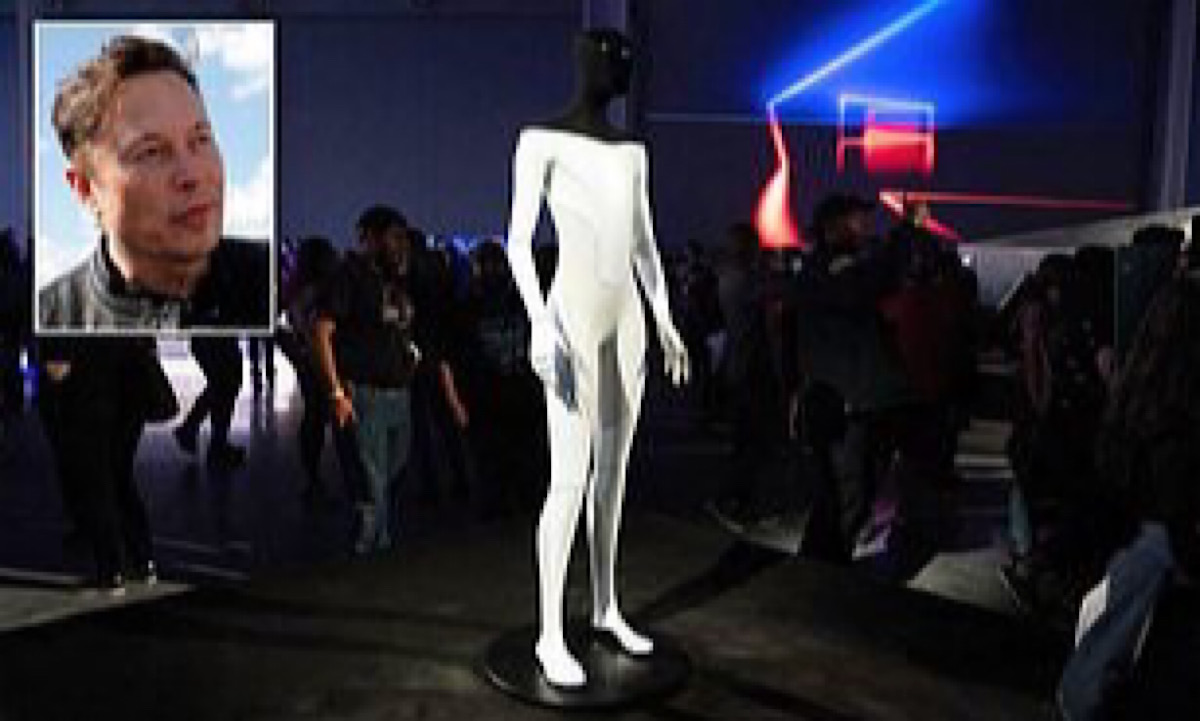
Elon Musk says Tesla’s Optimus humanoid robot will eventually cost ‘less than a car’ and people will buy them as birthday presents for their parents within a decade

By CHRISTOPHER CARBONE

  • Tesla’s Optimus humanoid robots are intended to replace humans in ‘repetitive, boring and dangerous tasks,’ according to CEO Elon Musk 
  • They will eventually serve millions – handling tasks like cooking, mowing lawns and caring for the elderly
  • Their price will come down in the future – as Tesla figures out how to scale production – eventually costing less than a car
  • Tesla’s Optimus robot is set to debut at AI Day on September 30 

Elon Musk shared new details about Tesla’s Optimus humanoid robot – including information about the cost and likely uses for it – in an essay published online. 

The robot, which is intended for industrial and domestic uses, will debut at AI Day September 30 after first being announced at AI Day in August 2021.

‘Tesla Bots are initially positioned to replace people in repetitive, boring, and dangerous tasks. But the vision is for them to serve millions of households, such as cooking, mowing lawns, and caring for the elderly,’ Musk wrote in the essay published in China Cyberspace magazine. 

Continue reading… “Elon Musk says Tesla’s Optimus humanoid robot will eventually cost ‘less than a car’ and people will buy them as birthday presents for their parents within a decade”

The Staggering Economics of the Tesla Semi

The economics of the Tesla semi show that it is about 83% cheaper to drive and haul goods than a standard diesel truck. Not to mention the reduction in cost due to less maintenance. The Tesla semi will truly disrupt the trucking industry.

By Jeremy Johnson 

The Tesla Semi is going to start deliveries this year and there is some staggering economics of how much better it will be than a diesel truck.

Elon Musk has stated that the Tesla semi will start shipping this year and that it will have 500 miles of range. This is after many delays, but Tesla is finally ready to start delivering it to customers. In Elon’s Master Plan, Part 2, he made reference to building an electric semi.

The first customer of the Tesla semi is not known to the public yet. Some think it will be PepsiCo because they place an order for 100 electric semi trucks. Tesla will build out Mega Chargers for the Tesla semi in order to make sure it can charge quickly.

Continue reading… “The Staggering Economics of the Tesla Semi”

This New Supersonic Jet Will Fly From London to NYC in 3.5 Hours—on 100% Biofuel

Boom’s Overture Supersonic Jet to Fly From London to NYC in 3.5 Hours

By ROHIT JAGGI 

But the Boom Overture is not Concorde 2.0. It’ll be faster, quieter and more fuel efficient, with a larger interior space. 

Supersonic air travel has always messed with the concept of time. Such as being able to fly across the Atlantic and land before your scheduled departure time.

But planemaker Boom managed to reach new heights of temporal irony with the latest iteration of its Overture supersonic aircraft. Its production-conforming design revealed recently at the Farnborough Air Show in the UK has managed to turn the clock back to the 1960s and look astonishingly similar to Concorde. Huge delta wings, four underslung engines and a long, slim fuselage make a comparison hard to avoid.

But given the six decades of technological innovation since French and British designers penned the world’s first supersonic airliner, Boom has been able to bring in some improvements. Its composite Overture has a conventional tail, its wing has a sinuous twist and the medium-bypass turbofan engines do away with the need for afterburners—which were responsible for a substantial part of the noise levels that helped kill off Concorde.

Continue reading… “This New Supersonic Jet Will Fly From London to NYC in 3.5 Hours—on 100% Biofuel”

A new shortcut for quantum simulations could unlock new doors for technology

Two of the “maps” of quantum phase transitions generated by the technique. The different colors represent different phases or transitions between different phases.

By Louise Lerner

From water boiling into steam to ice cubes melting in a glass, we’ve all seen the phenomenon known as a phase transition in our everyday lives. But there’s another type of phase transition that’s much harder to see, but just as stark: quantum phase transitions.

When cooled to near absolute zero, certain materials can undergo these quantum phase transitions, which can make a physicist’s jaw drop. The material can flip from being magnetic to non-magnetic, or it can suddenly acquire the superpower to conduct electricity with zero energy lost as heat.

The mathematics behind these transitions is tough to handle even for supercomputers—but a new Physical Review A study from the University of Chicago suggests a new way to work with these complicated calculations, which could eventually yield technological breakthroughs. The shortcut pulls only the most important information into the equation, and creates a “map” of all possible phase transitions in the system being simulated.

“This is a potentially powerful way of looking at quantum phase transitions that can be used with either traditional or quantum computers,” said David Mazziotti, a theoretical chemist with the Department of Chemistry and the James Franck Institute at the University of Chicago and senior author of the study.

Continue reading… “A new shortcut for quantum simulations could unlock new doors for technology”

How AI is being used to improve 3D printing

By Adam Zewe

  • Scientists and engineers often manually use trial-and-error to find the optimum parameters to consistently 3D print new materials effectively.
  • But researchers have now streamlined the process by training a machine-learning model to monitor and adjust the 3D printing process to correct errors in real-time.
  • The system could help engineers easily incorporate novel materials into their prints and allow technicians to adjust the printing process if material or environmental conditions change unexpectedly.

Scientists and engineers are constantly developing new materials with unique properties that can be used for 3D printing, but figuring out howto print with these materials can be a complex, costly conundrum.

Often, an expert operator must use manual trial-and-error — possibly making thousands of prints — to determine ideal parameters that consistently print a new material effectively. These parameters include printing speed and how much material the printer deposits.

MIT researchers have now used artificial intelligence to streamline this procedure. They developed a machine-learning system that uses computer vision to watch the manufacturing process and then correct errors in how it handles the material in real-time.

Continue reading… “How AI is being used to improve 3D printing”

Should self-driving cars come with black box recorders?

Every commercial airplane carries a “black box” that preserves a second-by-second history of everything that happens in the aircraft’s systems as well as of the pilots’ actions, and those records have been priceless in figuring out the causes of crashes.

Why shouldn’t self-driving cars and robots have the same thing? It’s not a hypothetical question.

Federal transportation authorities are investigating a dozen crashes involving Tesla cars equipped with its “AutoPilot” system, which allows nearly hands-free driving. Eleven people died in those crashes, one of whom was hit by a Tesla while he was changing a tire on the side of a road. 

Yet, every car company is ramping up its automated driving technologies. For instance, even Walmart is partnering with Ford and Argo AI to test self-driving cars for home deliveries, and Lyft is teaming up with the same companies to test a fleet of robo-taxis.

But self-directing autonomous systems go well behind cars, trucks, and robot welders on factory floors. Japanese nursing homes use “care-bots” to deliver meals, monitor patients, and even provide companionship. Walmart and other stores use robots to mop floors. At least a half-dozen companies now sell robot lawnmowers.  (What could go wrong?)

Continue reading… “Should self-driving cars come with black box recorders?”

A radical vision for reinventing the suburbs

Nicknamed the Orbit, the plan would turn a rural suburb into a transit-oriented commuter city.

Outside Toronto, in a field surrounded by farmland, the seeds of a seemingly implausible high-density, transit-oriented community are taking root.

The community is the Orbit, a futuristic-sounding name for a new district on the edge of the town of Innisfil, Ontario, a commuter city about a half-hour drive north of Toronto. The plan for the Orbit is a grid of streets radiating around a dense central district, with proposed mid-rise towers, plentiful open spaces, and a mix of residential, commercial, and civic buildings. The center point of the plan is a commuter rail station that links Innisfil and other suburban communities to Toronto.

Continue reading… “A radical vision for reinventing the suburbs”

NASA Space Robotics Dive into Deep-Sea Work

What’s the difference between deep space and the deep sea? For a robot, the answer is: not much. Both environments are harsh and demanding, and, more importantly, both are far removed from the machine’s operator.

By Loura Hall

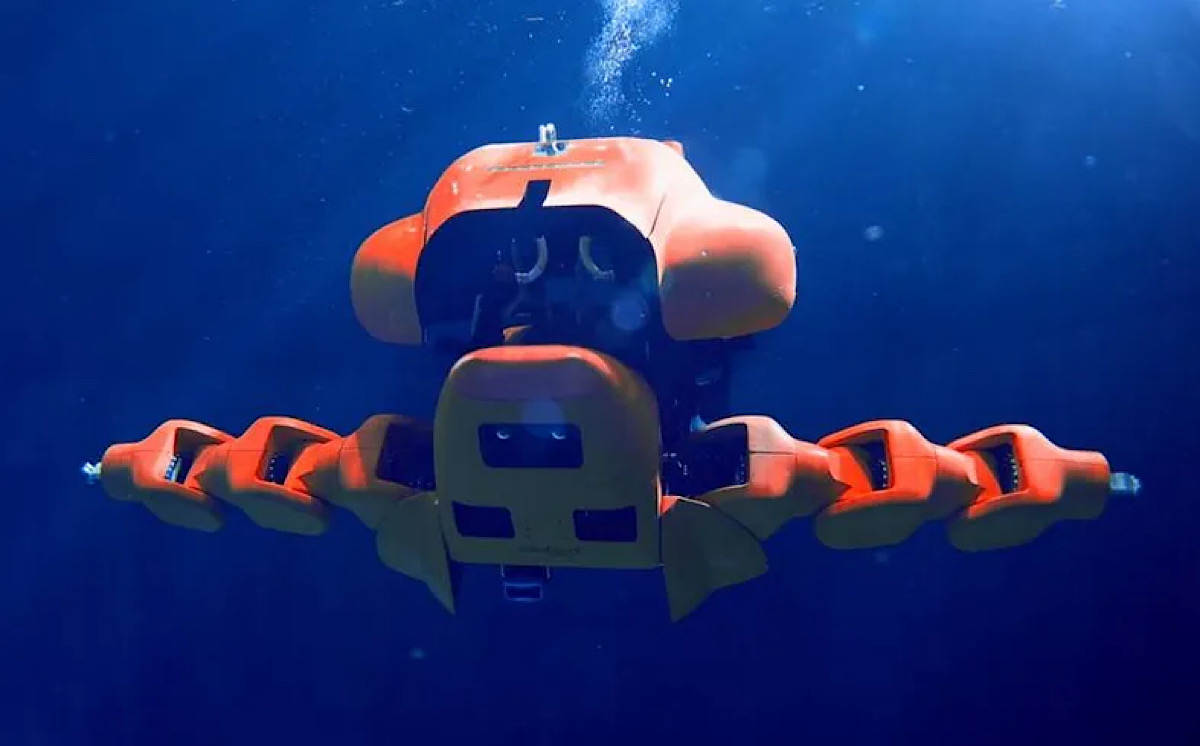
Nauticus Robotics’ Aquanaut robot can swim to a destination and carry out tasks with minimal supervision, saving money for offshore operations from oil wells and wind turbines to fish farms and more. Credits: Nauticus Robotics Inc.

What’s the difference between deep space and the deep sea? For a robot, the answer is: not much. Both environments are harsh and demanding, and, more importantly, both are far removed from the machine’s operator.

That’s why a team of roboticists from NASA’s Johnson Space Center in Houston decided to apply their expertise to designing a shape-changing submersible robot that will cut costs for maritime industries.

Continue reading… “NASA Space Robotics Dive into Deep-Sea Work”

Ottonomy.IO raises $3.3 million to expand network of autonomous robots for deliveries

By Jagmeet Singh

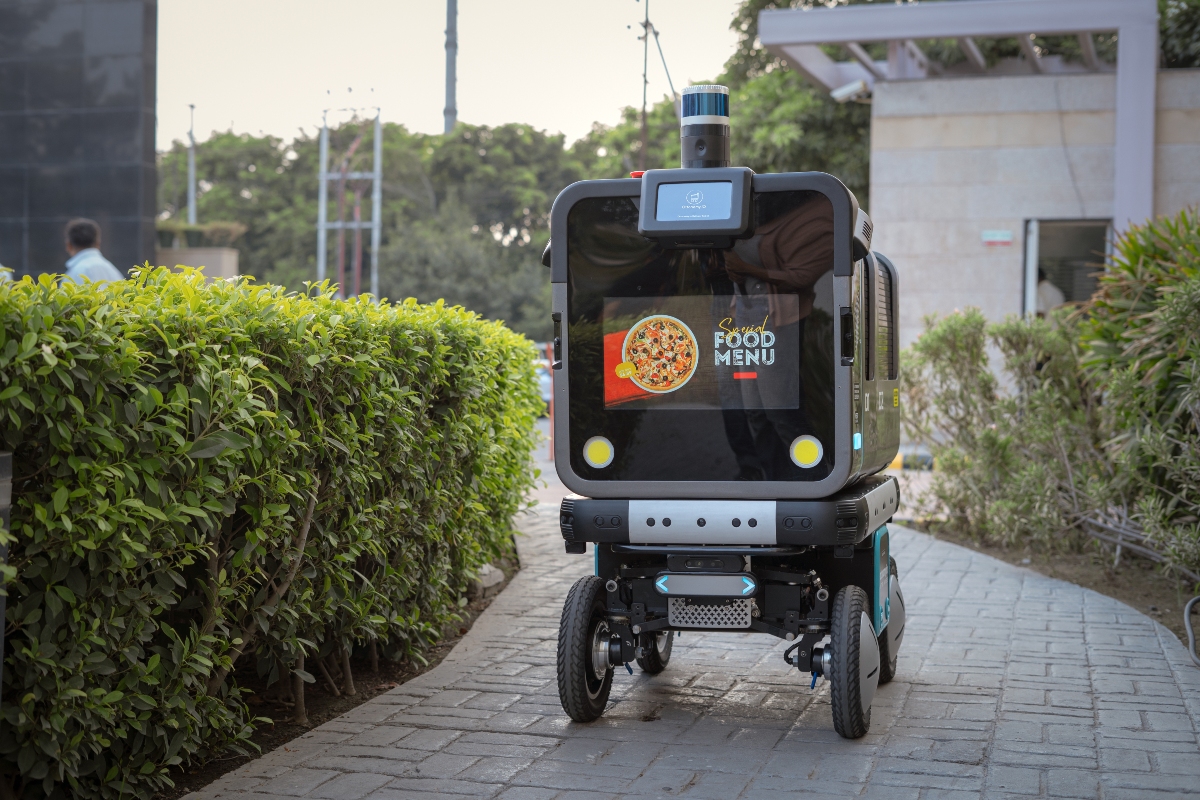
Ottonomy.IO, a startup working on solving delivery problems using autonomous robots, has raised $3.3 million in a seed funding round as it looks to expand its market and deploy robots to existing customers.

Led by Bengaluru-based Pi Ventures, the latest funding round included participation from Connetic Ventures and Branded Hospitality Ventures. Sangeet Kumar, founder and chief executive of Uttar Pradesh-based Addverb Technologies, also joined the round.

Founded in late 2020 by Ritukar Vijay along with Pradyot Korupolu, Ashish Gupta and Hardik Sharma, New York-headquartered Ottonomy.IO develops robots that feature sensors, including 3D lidar sensors and cameras. The company, which employs about 25 people in the U.S. and India, also writes software and AI algorithms to power the sensors.https://jac.yahoosandbox.com/1.2.0/safeframe.html

“One of the most important problems which we are trying to solve with these autonomous delivery robots is around labor shortages,” said Vijay, who serves as the chief executive of Ottonomy.IO, in an interaction with TechCrunch. He added that due to the labor shortages, there is a substantial increase in the hourly wages of laborers — to $18 to $45 per hour from $9 to $12 — in the U.S.

“So, that’s almost a 100% hike in hourly wages, making it very difficult for enterprise customers to provide the same services to the customers they were given earlier. And what happens at the end is that customers start paying more for deliveries.”

Continue reading… “Ottonomy.IO raises $3.3 million to expand network of autonomous robots for deliveries”
Discover the Hidden Patterns of Tomorrow with Futurist Thomas Frey
Unlock Your Potential, Ignite Your Success.

By delving into the futuring techniques of Futurist Thomas Frey, you’ll embark on an enlightening journey.

Learn More about this exciting program.