The future of remote work is a lot like living in a video game

BY JOSEPH VOLPE

I didn’t know the closest I’d get to bonding with my coworkers in 2020 would be by strapping a screen to my face. 

I never got to meet the bulk of them — you know, my East Coast work “family” — before lockdown life locked me into the Bay Area. Sure, there was the occasional weekly video chat. But that was really the extent of it. 

“We’ll fly you out for a visit in the New Year,” management told me. That was the plan and I was fine with that. 

Thing is, that New Year — the 2020 that will go down in infamy — brought with it a very unwelcome surprise. (Do I even need to spell it out?) 

Eventually, we all adjusted to our new socially distanced world. Zoom soon became a buzzword even grandmothers knew. Webcams were often out of stock online.  Life became one unending series of scheduled screen time.

Then the novelty wore off, the WFH fatigue set in, the cold winter months approached, and many wondered how we could continue on living and working this way. 

And when would it end?

Continue reading… “The future of remote work is a lot like living in a video game”
SberAutoTech launches its first fully autonomous vehicle

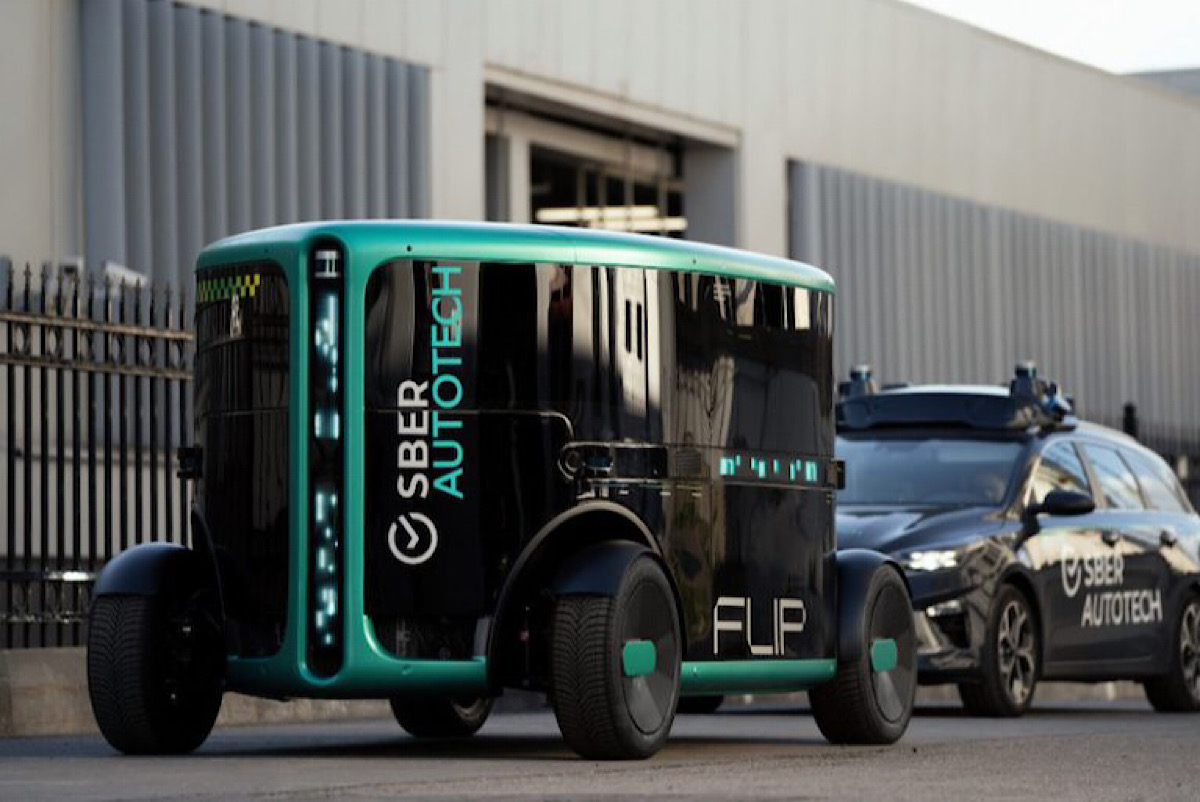
SberAutoTech, a Sber ecosystem company, has revealed a prototype of its own autonomous vehicle for future mobility, which it has named “FLIP”.

By David Rafalovsky, CTO, Sberbank Group; executive vice president, head of technology, Sberbank

The brand-new and fully self-driving vehicle has been developed to match the highest level in international driving automation classification. It pursues the new mobility concept providing quick, safe, and comfortable transportation for passengers through cutting-edge IT and automotive technologies.

There is a proprietary electric platform driven by an electric motor powered by a replaceable battery module at the core of FLIP. Key differentiating know-how is that fast-swappable batteries can be replaced in five minutes.  So the vehicle is ready to continue the journey in time comparable to a fueling of a conventional car.

Fast-swappable batteries is a solution that removes the current challenges of EV market, such as extensive charging time and high battery prices resulting from their expected capacity and range.

Moreover, FLIP is designed to be powered from both electricity and other alternative fuels like natural gas and hydrogen.

Continue reading… “SberAutoTech launches its first fully autonomous vehicle”

How Emotion AI Can Make the World a Better Place

By Jenna Delport 

Most of us take it for granted that we can read another person’s emotions through subtleties such as body language, yet this is a real struggle for many others. Enter emotion AI.

Researchers at Stanford University modified Google’s augmented reality glasses to read emotions in others and notify the wearer. The glasses detect someone’s mood through their eye contact, facial expressions and body language, and then tell the wearer what emotions it’s picking up.

“Emotion AI taps into the individual,” explains Zabeth Venter, CEO and co-founder of Averly. “If you think about facial recognition, which is a kind of emotion AI, I can pick up if you like what I’m saying by whether your smile is a smirk or a real genuine smile.”

Such nuances go deeper. Another example is polling: what is your favourite colour? Maybe it’s purple. But did you say that enthusiastically? Did you hesitate? Did you just say it to say something? Did you even understand the question?

We simply can’t get this level of context from the available surveys, sales data and the many other ways we try to understand humans through information. But through emotion AI, we can grasp incredible nuance.

Continue reading… “How Emotion AI Can Make the World a Better Place”

More than half of Europeans want to replace lawmakers with AI, study says

People walking at Strandvagen in Stockholm

By Sam Shead

KEY POINTS

  • Researchers at IE University’s Center for the Governance of Change asked 2,769 people from 11 countries worldwide how they would feel about reducing the number of national parliamentarians in their country and giving those seats to an AI that would have access to their data.
  • The results, published Thursday, showed that despite AI’s clear and obvious limitations, 51% of Europeans said they were in favor of such a move.
  • Outside Europe, some 75% of people surveyed in China supported the idea of replacing parliamentarians with AI, while 60% of American respondents opposed it.

LONDON — A study has found that most Europeans would like to see some of their members of parliament replaced by algorithms.

Researchers at IE University’s Center for the Governance of Change asked 2,769 people from 11 countries worldwide how they would feel about reducing the number of national parliamentarians in their country and giving those seats to an AI that would have access to their data.

The results, published Thursday, showed that despite AI’s clear and obvious limitations, 51% of Europeans said they were in favor of such a move.

Continue reading… “More than half of Europeans want to replace lawmakers with AI, study says”

Acer’s SpatialLabs is glasses-free 3D in a prototype laptop

By Chris Davies 

Acer wants to bring stereoscopic 3D to laptops, with a new SpatialLabs display that promises to float graphics right out of a laptop’s screen without demanding you wear special glasses to see them. The system instead combines a switchable lenticular lens screen with an eye-tracking camera, all fitted into a prototype ConceptD notebook.

3D certainly isn’t new, and neither are attempts to bring it to graphics pros in a usable way. The reality, though, is that clunky glasses and mediocre visual quality has generally undermined such efforts. 

Continue reading… “Acer’s SpatialLabs is glasses-free 3D in a prototype laptop”

Scientists Have Found a Way to Break the Limit of Human Longevity

Schematic illustration of loss of resilience along aging trajectories.

By GERO

The research team of Gero, a Singapore-based biotech company in collaboration with Roswell Park Comprehensive Cancer Center in Buffalo NY, announces a publication in Nature Communications, a journal of Nature portfolio, presenting the results of the study on associations between aging and the loss of the ability to recover from stresses.

Recently, we have witnessed the first promising examples of biological age reversal by experimental interventions. Indeed, many biological clock types properly predict more years of life for those who choose healthy lifestyles or quit unhealthy ones, such as smoking. What has been still unknown is how quickly biological age is changing over time for the same individual. And especially, how one would distinguish between the transient fluctuations and the genuine bioage change trend.

The emergence of big biomedical data involving multiple measurements from the same subjects brings about a whole range of novel opportunities and practical tools to understand and quantify the aging process in humans. A team of experts in biology and biophysics presented results of a detailed analysis of dynamic properties of the fluctuations of physiological indices along individual aging trajectories.

Healthy human subjects turned out to be very resilient, whereas the loss of resilience turned out to be related to chronic diseases and elevated all-cause mortality risks. The rate of recovery to the equilibrium baseline level after stresses was found to deteriorate with age. Accordingly, the time needed to recover was getting longer and longer. Being around 2 weeks for 40 y.o. healthy adults the recovery time stretched to 6 weeks for 80 y.o. on average in the population. This finding was confirmed in two different datasets based on two different kinds of biological measurements — blood test parameters on one hand and physical activity levels recorded by wearable devices on the other hand.

Continue reading… “Scientists Have Found a Way to Break the Limit of Human Longevity”

Seoul to expand network of poles to charge vehicles and drones

By Christopher Carey

Analysis of the project in the Seongdong district showed savings of 12-21 percent. 

Seoul is set to expand its network of smart poles (S-poles) – which act as streetlights, traffic lights, environmental sensors, footfall counters, smartphone chargers, Wi-Fi access points and CCTV points – from 26 to 216 by the end of the year.

The poles, launched in February, will also have the potential to charge drones and electric vehicles as part of a pilot project set to be launched in the second half of this year.

“S-poles are the core infrastructure of a smart city, which can reduce the cost while improving the scenery, safety, and convenience,” said Lee Won-Mok, Director General of Seoul’s Smart City Policy.

“We will work on developing newly-demanded features for smart cities from electric car charging to drone-related technologies to create smarter urban infrastructures.”

Continue reading… “Seoul to expand network of poles to charge vehicles and drones”

Hyundai raises hydrogen game with new line of fuel-cell trucks

A new class of the Xcient Hyundai truck, equipped with more efficient fuel cells with longer life-span, is due to arrive in Europe in the fourth quarter, said Mark Freymueller, CEO of Hyundai Hydrogen Mobility (HHM).

And it’s not the only one taking steps in that direction.

FRANKFURT — South Korea’s Hyundai Motor plans to ship a new series of fuel-cell trucks to Europe later this year, turning up the heat on rivals in a battle to test the viability of hydrogen-powered heavy goods transport.

Hydrogen lags electric batteries in the green transport stakes because it is more expensive, but proponents say for long-haul transport hydrogen-powered trucks have the advantage because they have a greater range.

HHM, a joint venture between Hyundai and Swiss hydrogen company H2 Energy, has been renting out “green” hydrogen trucks to commercial clients in Switzerland since last October in the world’s most advanced pilot in the field.

HHM plans to go into other European countries next year. “Germany and the Netherlands are the most likely,” Freymueller told Reuters, adding there was also interest for pilots from Austria, Norway, France, Italy, Spain and Denmark.

Hyundai’s latest push will put more pressure on local players, which are developing their own hydrogen plans.

These include Germany’s Daimler with Sweden’s Volvo and Italy’s Iveco, a unit of Italian-American vehicle maker CNH Industrial, which is cooperating with low-emission truckmaker Nikola .

Hydrogen has come into the spotlight in Europe, where EU environment ministers want truck CO2 emissions cut by a third by 2030 from 2019 levels, threatening potential diesel bans and higher taxes but promising up to 75% of lower road tolls for greener vehicles.

Continue reading… “Hyundai raises hydrogen game with new line of fuel-cell trucks”

How psychologists are using VR to profile your personality

TECH NEWS) VR isn’t just for gamers. Psychologists are using it to research how people emotionally respond to threats. But does it come at the cost of privacy?

ByVeronica Garcia,

When you put on a VR headset for the first time, most people have that ‘whoa’ moment. You’ve entered an enchanting otherworldly place that seems real, but you know it isn’t. You slowly tilt your head up to see a nicely lit blue sky. You turn your head around to see mountains and trees that weren’t there before. And, you finally look down to stare at your hands. Replaced by bright-colored gloves, you flex your hands to form a fist, then jazz hands, and back.

Playing VR games is exciting and interesting for a lot of gamers, and you would (or maybe wouldn’t) be surprised to know that psychologists think so, too. According to The Conversation, psychologists have started researching how people emotionally respond to potential threats using VR.

Continue reading… “How psychologists are using VR to profile your personality”

3D printing stem cells to transform neuroscience

by Barbara Ricco

3D printing, also called additive manufacturing, has become widespread in recent years. By building successive layers of raw material such as metals, plastics, and ceramics, it has the key advantage of being able to produce very complex shapes or geometries that would be nearly impossible to construct through more traditional methods such as carving, grinding, or molding.

The technology offers huge potential in the health care sector. For example, doctors can use it to make products to match a patient’s anatomy: a radiologist could create an exact replica of a patient’s spine to help plan surgery; a dentist could scan a patient’s broken tooth to make a perfectly fitting crown reproduction. But what if we took a step further and apply 3D printing techniques to neuroscience?

Stems cells are essentially the body’s raw materials; they are pluripotent elements from which all other cells with specialized functions are generated. The development of methods to isolate and generate human stem cells, has excited many with the promise of improved human cell function understanding, ultimately utilizing them for regeneration in disease and trauma. However, the traditional two-dimensional growth of derived neurones—using flat petri dishes—presents itself as a major confounding factor as it does not adequately mimic in vivo three-dimensional interactions, nor the myriad developmental cues present in real living organisms.

Continue reading… “3D printing stem cells to transform neuroscience”

The Perseverance rover split CO2 on Mars to make breathable air

The MOXIE instrument, shown here being lowered into the Mars Perseverance rover while still on Earth, is a small “electrical tree” that converts carbon dioxide into oxygen on Mars.JPL-CALTECH/NASA

By Lisa Grossman

The test also shows astronauts could also make oxygen this way to fuel their trip home.

The Perseverance rover has created a breath of fresh air on Mars. An experimental device on the NASA rover split carbon dioxide molecules into their component parts. This created enough breathable oxygen to sustain a person for about 10 minutes. It was also enough oxygen to make tiny amounts of rocket fuel.

The toaster-size instrument that did this is called MOXIE. The acronym stands for Mars Oxygen In-Situ Resource Utilization Experiment. Carbon dioxide, or CO2, is the primary gas in the atmosphere on Mars. MOXIE’s job is to break the chemical bonds in CO2, releasing oxygen

Continue reading… “The Perseverance rover split CO2 on Mars to make breathable air”

Experts are convinced that self-flying planes will roam the skies by 2025 — here’s how one startup is working to win over the FAA and the public

A Boeing 787 Dreamliner taking off

By Thomas Pallini 

  • Xwing, founded by Marc Piette, is one of the startups working to make self-flying planes a reality. 
  • Its Cessna 208B Grand Caravan can already fly on its own, as Insider found on a demonstration flight. 
  • Self-flying planes will start by flying cargo and then regional passenger flights as early as 2025. 

Teaching a 27-year-old aircraft how to fly on its own was the easy part for Marc Piette and his team at Xwing. The real challenge is how to get the technology flying on commercial aircraft, and accepted by the public.

Piette had the idea to conquer self-flying aircraft when driving from San Francisco to Eureka, California, a near-300 mile journey that takes five hours by car. As a student pilot taking flight lessons at Palo Alto Airport at the time, he couldn’t accept that driving was the most efficient way to travel regional distances for the average person. 

“The time it takes me to get to places like [Eureka] from San Francisco is about the same time it takes me to get to New York,” Piette, the founder and CEO of Xwing, told Insider. “It’s absurd. Traveling 250 miles shouldn’t take me the same amount of time it takes to travel across the cross country.”

And the idea for Xwing was born. The vision was to use the vast aviation infrastructure that already exists but make it more accessible and bring costs down by using autonomous technology. 

“The only way to travel fast on the ground is through massive infrastructure investment … which isn’t happening anytime soon,” Piette said.

Continue reading… “Experts are convinced that self-flying planes will roam the skies by 2025 — here’s how one startup is working to win over the FAA and the public”
Discover the Hidden Patterns of Tomorrow with Futurist Thomas Frey
Unlock Your Potential, Ignite Your Success.

By delving into the futuring techniques of Futurist Thomas Frey, you’ll embark on an enlightening journey.

Learn More about this exciting program.