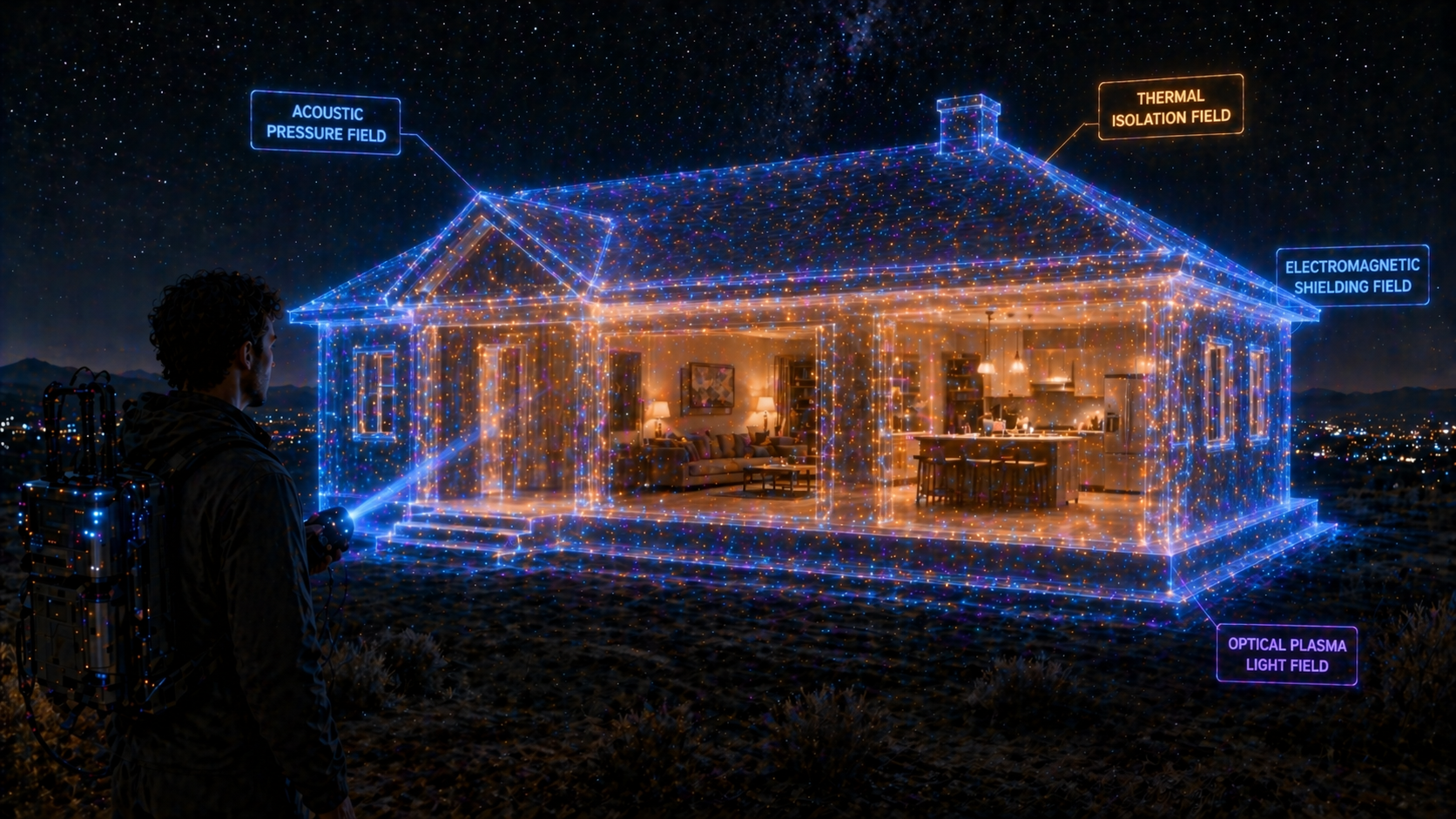
When the building is made of energy rather than matter, everything we assume about shelter, ownership, and place dissolves along with the walls.
By Futurist Thomas Frey
Part 3 of 3: The Projected House
The oldest human technology is the wall.
Before the wheel, before writing, before agriculture, human beings were building barriers against the world — piling stones, stretching skins, weaving branches, mixing mud and straw into something that would hold back the wind and the rain and the things that moved in the dark. Every architectural tradition in human history, on every continent, in every climate, starts from the same premise: shelter is a physical object. It is made of matter. It sits in a place. It stays where you put it.
That premise is about to become optional.
In the first column of this series, I traced a twenty-year-old thought experiment about creating floating points of light from intersecting invisible beams of energy — no bulb, no wire, no surface — and showed that the physics not only works but has been demonstrated in laboratories around the world. In the second column, I followed that physics into the future of display technology, where a million floating points of light become a three-dimensional video environment that fills a room and makes the rectangle of the screen obsolete.
In this column I want to follow the same physics to its most radical conclusion. Because the same principles that allow intersecting energy fields to create light at a point in space can, in principle, create other physical effects at a point in space. Thermal resistance. Acoustic damping. Electromagnetic shielding. Mechanical pressure sufficient to deflect physical objects.
Fields that behave like walls without being walls. Boundaries that exist in space without matter to define them. A house made entirely of energy that can be summoned, configured, and dismissed — and moved to a different location the next morning.
Continue reading… “The House That Isn’t There”