A thought experiment in shared mobility reveals just how much of America’s car fleet exists purely to sit still
The Math Problem Hiding in Plain Sight
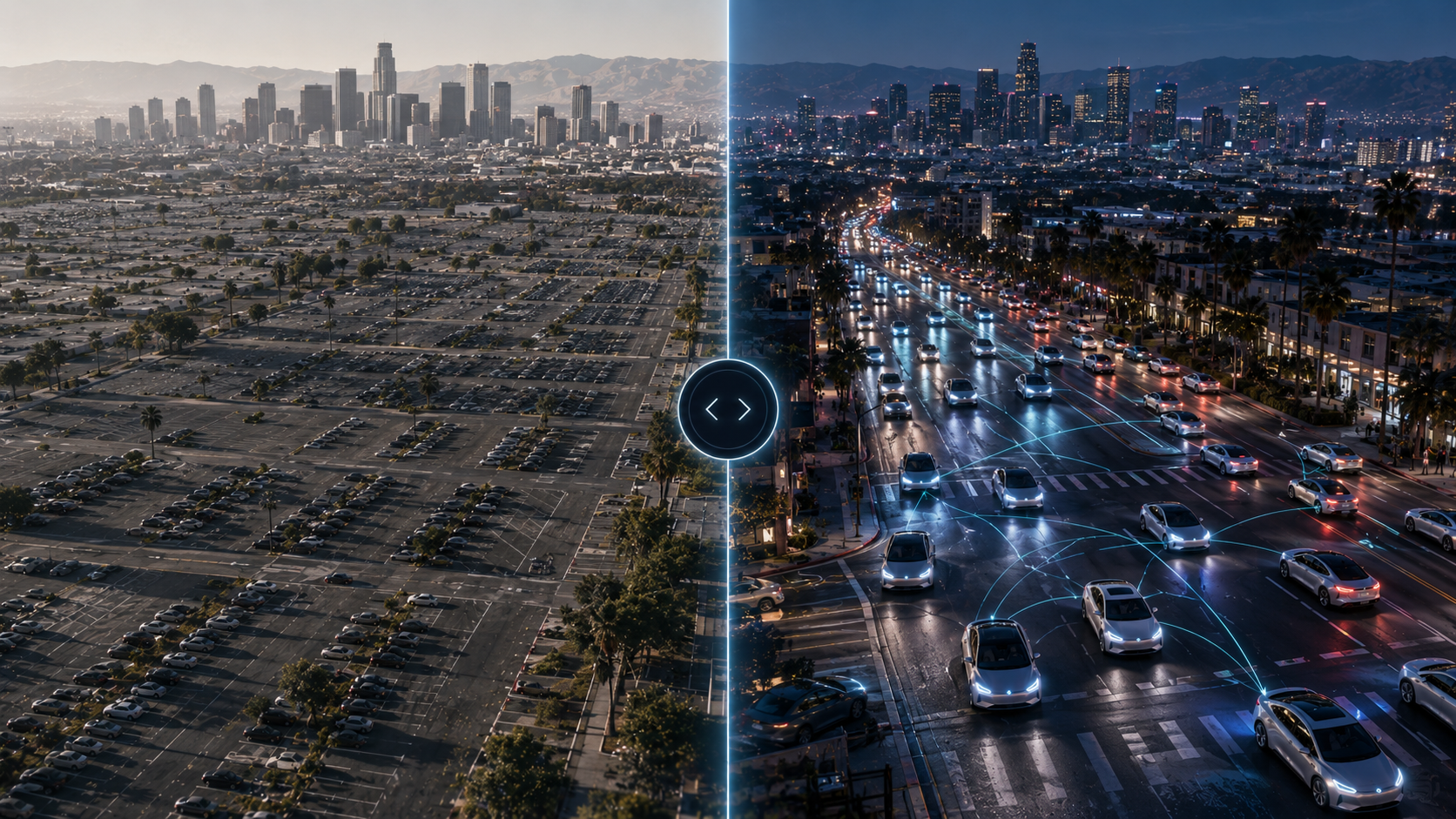
Here’s a question worth sitting with: the average car in America is parked about 95% of the time. It sits in a driveway overnight, sits in an office lot all day, and sits in a garage on weekends. So what happens if we replace that ownership model with an on-demand fleet — summon a car, ride it, release it to the next person?
Researchers have actually run this simulation, city by city, using real trip data. A study of an autonomous valet-style service found that a fleet of just 2,300 vehicles could replace the entire private car fleet of a mid-sized European city — a twelve-fold reduction. Berlin researchers found automated vehicles could meet the same demand with a fleet roughly 10% the size of the conventional car fleet. A broader review estimated shared fleets could serve a population with about one-third the number of vehicles currently on the road, and Seoul modeling projected more than an 80% reduction in vehicles needed.
Take a conservative middle estimate — a 75% reduction — and apply it to America’s roughly 280 million registered vehicles. We’d need somewhere between 30 and 70 million cars to do the same job. That means somewhere around 200 to 250 million vehicles currently exist mostly as standby equipment.
Continue reading… “The Phantom Fleet: What Happens When 250 Million Cars Disappear”