When Big Tech Goes Shopping for Diplomas

Why hyperscaler IPO cash and the college collapse may be on a collision course

By Futurist Thomas Frey

A Pattern We’ve Seen Before

I’ve been watching two trendlines converge for months, and the collision point is starting to look obvious. On one side, the hyperscalers — Amazon, Microsoft, Google, and now the AI labs themselves like Anthropic and OpenAI — are either already public or racing toward IPOs that could mint hundreds of billions in fresh capital. On the other side, American higher education is entering what demographers have been warning about for two decades: the “enrollment cliff.” More than 100 colleges are currently flagged as being at elevated risk of closing or merging, with Fitch Ratings issuing a “deteriorating” outlook for the sector for the second consecutive year. Sixteen nonprofit colleges announced closures in 2025, matching the 2024 total, with another eight announcing closures in just the first quarter of 2026.

So here’s the question I keep coming back to: when an industry is sitting on a mountain of fresh IPO cash, and another industry is collapsing under the weight of bad demographics and worse balance sheets, what happens next? History gives us a pretty clear answer — somebody with money goes shopping.

This isn’t a wild leap. We’ve watched this movie before, just with different props. When Jeff Bezos bought The Washington Post in 2013, he wasn’t buying a newspaper — he was buying a 136-year-old brand, a trusted distribution channel, and a built-in audience, all for the relatively modest price of $250 million. When Elon Musk bought Twitter, he wasn’t just buying a social network — he was buying a real-time information utility he could bend toward his own platform ambitions.

In both cases, a tech billionaire looked at a struggling legacy institution and saw something the balance sheet didn’t capture: brand equity, infrastructure, and a captive audience that would take decades to build from scratch.

Now look at a mid-tier private college. On paper, it’s a failing business — declining enrollment, a tiny endowment, maybe a “going concern” warning from its auditors. Anna Maria College’s FY2025 audit carried exactly that kind of qualification, which triggered new federal financial aid restrictions and preceded its closure decision by just weeks. But strip away the financial distress and what’s left? A regionally accredited degree-granting charter. A physical campus with dorms, labs, fiber connectivity, and often surplus land. A built-in pipeline of 1,000 to 3,000 students. And — this is the part that matters most — the legal authority to grant degrees, something that takes years and mountains of bureaucracy to obtain from scratch.

Continue reading… “When Big Tech Goes Shopping for Diplomas”

A Morning Inside the Mind of a Futurist — Where Every Question Leads to a Drone

A stream-of-consciousness journey through the AI-controlled skies of our immediate future

By Futurist Thomas Frey


Every morning begins the same way — in that warm, blurry corridor between sleep and awareness where the best thinking happens and no alarm clock is welcome.

The transition from dream-state to conscious thought is never clean. Ideas arrive half-formed, like signals from a frequency that only tunes in clearly for a few minutes before the day crowds them out. This morning, before my feet touch the floor, a single question presents itself with unusual clarity:

Who — or what — is actually in control of the drones?

That question alone will occupy the next hour of my thinking. Maybe longer.

Continue reading… “A Morning Inside the Mind of a Futurist — Where Every Question Leads to a Drone”

Memorial Gardens — Where the Living Come to Remember, and Communities Come Alive

How a simple idea about rocks in a park became a blueprint for healing the loneliness of modern life


Every cemetery tells you that someone was here. A name, two dates, a hyphen between them that holds an entire life.

But what if we could do something more than mark the departure? What if we could create spaces that keep the living connected to those who came before — spaces that breathe, bloom, and change with the seasons — places where grief and joy share the same bench, where strangers become neighbors, and where the stories of ordinary people are woven permanently into the landscape of a city?

That is the quiet, radical promise of the memorial garden. And we need it more than we may realize.

Continue reading… “Memorial Gardens — Where the Living Come to Remember, and Communities Come Alive”

We Have Already Passed Peak Car — And Most People Missed It

A column on the quiet death of automobile culture and the mobility revolution already underway

Here is a question worth sitting with: what if the single most transformative shift in transportation history happened without a press release, without a ribbon-cutting ceremony, and without most of us noticing?

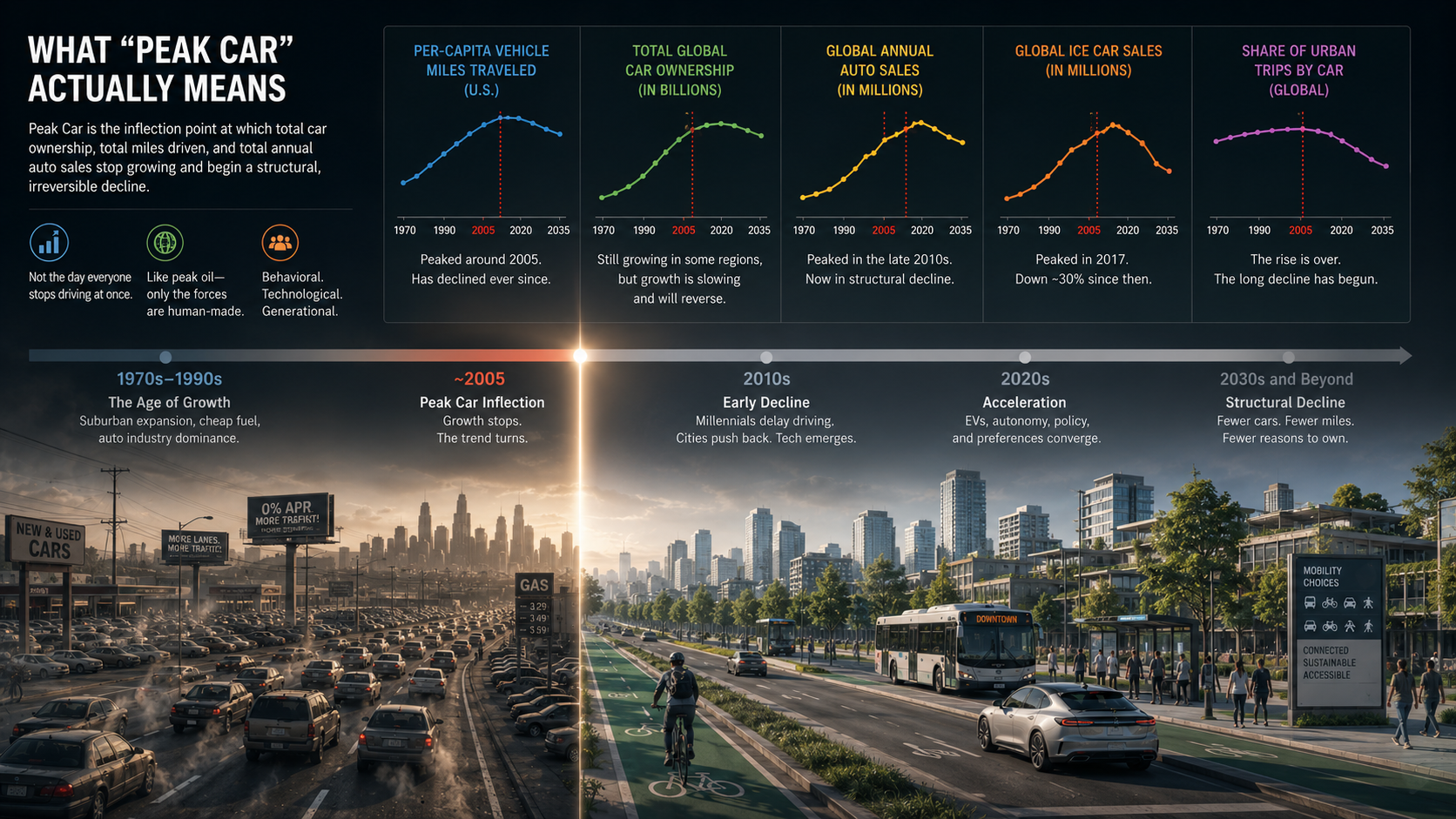
That is exactly what occurred. The global market for internal combustion passenger vehicles quietly peaked in 2017 — and according to the International Energy Agency, has since fallen by 30%. The car as the centerpiece of modern civilization is beginning a long, slow exit. We have arrived at Peak Car.

Continue reading… “We Have Already Passed Peak Car — And Most People Missed It”

When the Business Model Itself Becomes the Invention

By Futurist Thomas Frey

Peter Diamandis and Salim Ismail have a name for what is happening to organizations right now. They call it the Organizational Singularity — the point at which AI agents, AI-native workflows, and recursive self-improvement restructure companies faster than traditional hierarchy can adapt. It is not a future event. According to Ismail, it is already underway, and the companies that survive it will be one hundred times more performant than the ones that don’t.

One hundred times. Not ten percent better. Not twice as productive. One hundred times.

That number should reframe every conversation happening in boardrooms, city halls, and small business back offices right now. Because it means the question is no longer whether to adapt. It is whether you can adapt fast enough to remain relevant at all.

The Organizational Singularity doesn’t ask for your permission. It asks for your attention — and it is running out of patience.

Five business model developments from just this past week reveal exactly how the singularity is already reshaping the architecture of value creation. Taken together, they are not isolated experiments. They are the early structure of the economy that replaces the one we currently inhabit.

Continue reading… “When the Business Model Itself Becomes the Invention”

12 Laws of the Future

By Futurist Thomas Frey

I have spent decades doing something my colleagues find equal parts fascinating and slightly unhinged: I treat the future as a living force. Not a destination. Not a deadline. A force — as real and as powerful as gravity, as indifferent to our preferences as a river deciding which way to run.

People ask me all the time why anyone should study something that hasn’t happened yet. My answer is always the same. You are going to spend the rest of your life in the future. That alone seems like sufficient reason to understand how it works.

What follows are twelve laws I have developed over decades of watching the future arrive. They are not predictions. They are operating principles — the physics of what is coming, whether we are ready or not.

Continue reading… “12 Laws of the Future”

The Trust Stack: Why Confidential Computing Plus Sovereign AI Is the Infrastructure Category Nobody Has Built Yet

By Futurist Thomas Frey

The Intersection of Swiss Neutrality, Hardware-Level Privacy, and Regulated Industry Demand Is Pointing at a Multi-Billion Dollar Gap in the Global AI Infrastructure Market

The hyperscalers built for scale. Nobody has built for trust. That gap is now large enough to found a category on.

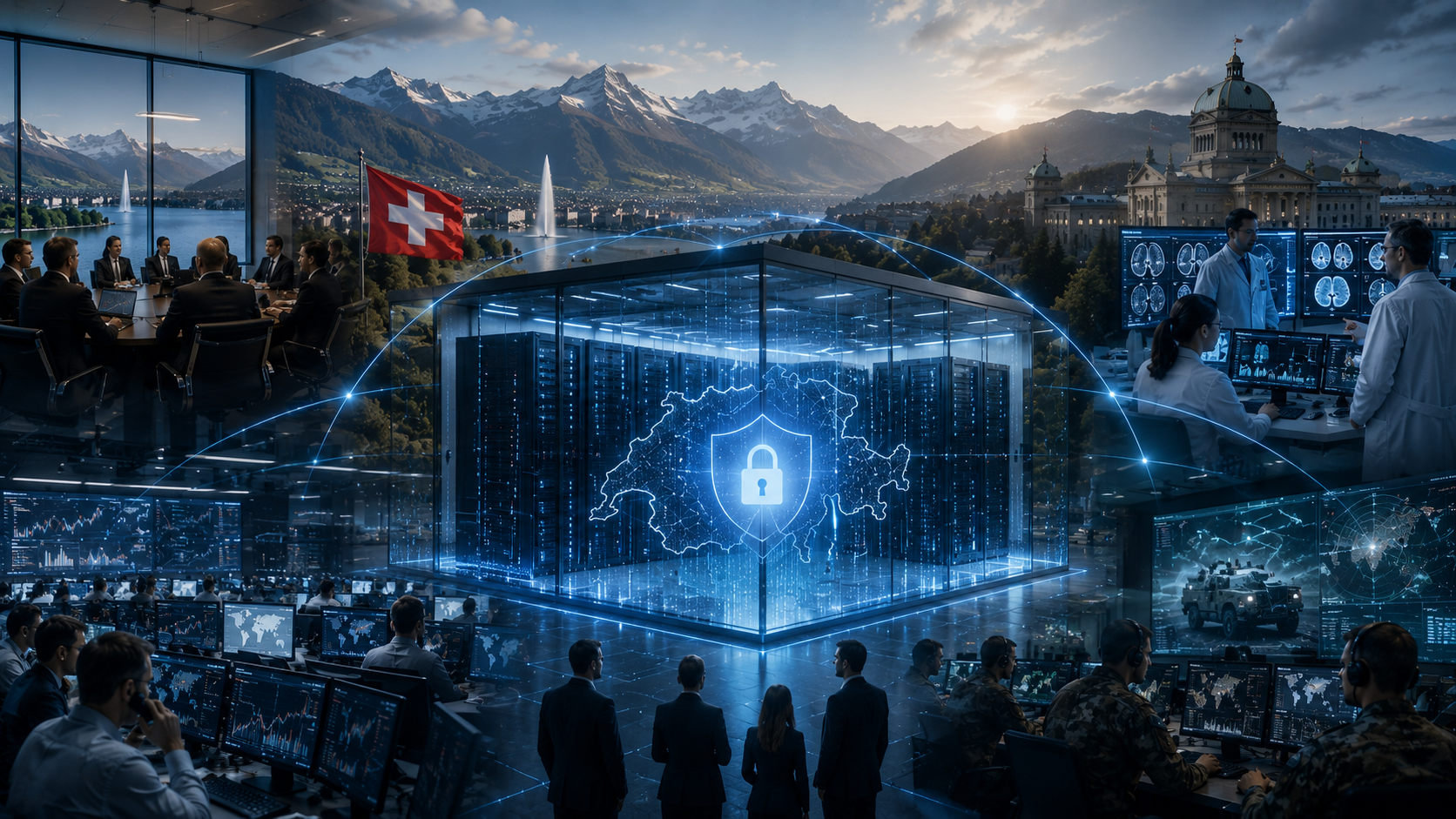
There is a conversation happening in the boardrooms of European banks, Gulf sovereign wealth funds, Asian healthcare ministries, and defense agencies on every continent, and it sounds roughly like this: we understand that AI is going to be central to our competitive position, our operational efficiency, and our national capability. We also understand that we cannot put our most sensitive data — patient records, financial positions, defense intelligence, proprietary models — into infrastructure we do not control, governed by laws we are not subject to, processed in facilities we cannot audit, by companies whose first obligation is to a foreign government’s legal process. We want the capability. We cannot accept the dependency. Tell us what to do.

Right now, nobody has a complete answer. That is the gap. And in infrastructure terms, an unanswered question at that scale and with that level of institutional demand is not a problem. It is a category waiting to be built.

Continue reading… “The Trust Stack: Why Confidential Computing Plus Sovereign AI Is the Infrastructure Category Nobody Has Built Yet”

The Future Is Already in Motion – Part 4: The Futurist as Signal Reader

What Separates the People Who See What’s Coming From Everyone Else

By Futurist Thomas Frey

Everything This Series Has Been Building Toward

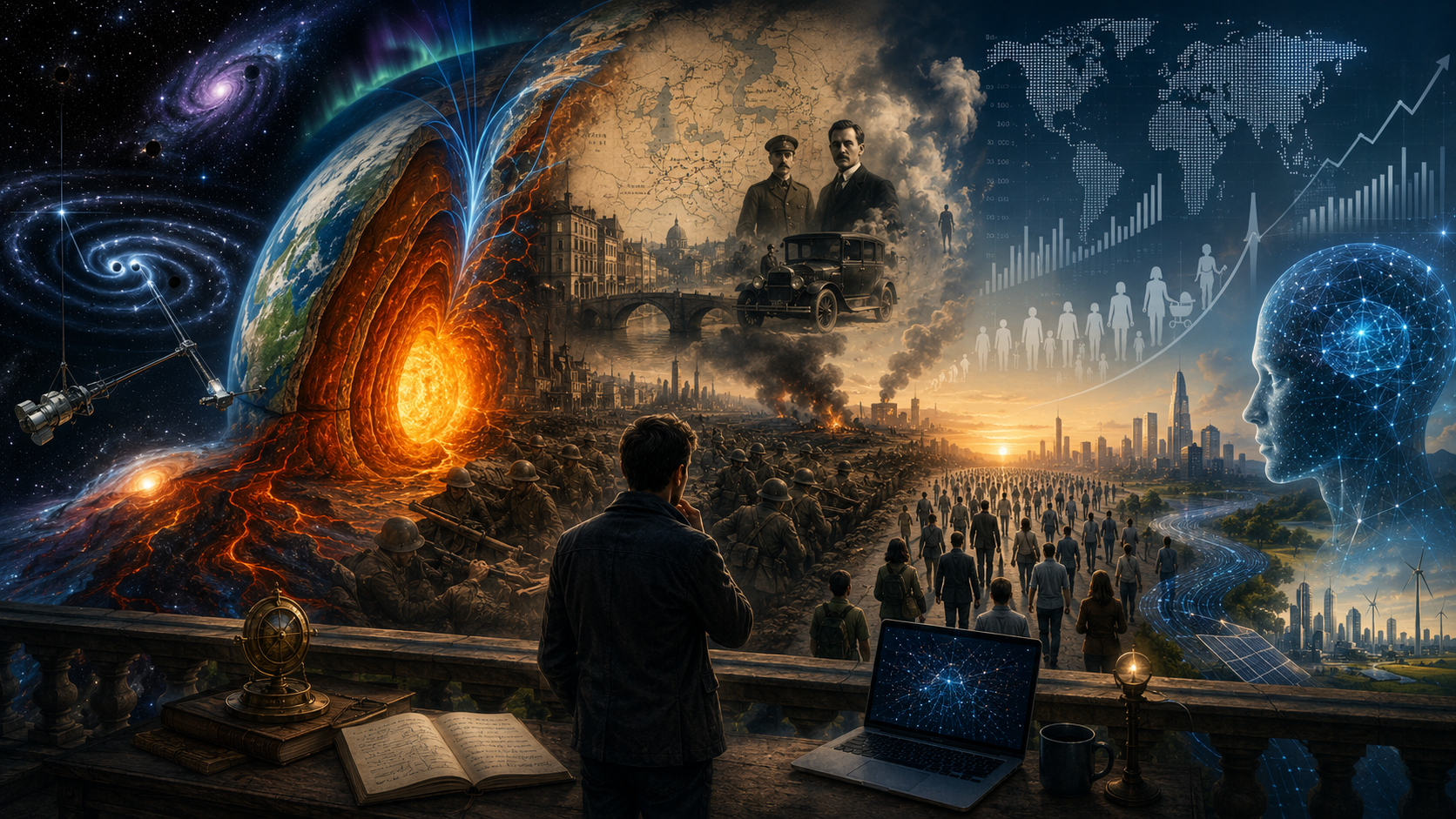
Over the past three columns, we have traveled from the edge of the observable universe to the fluid dynamics of Earth’s molten core to the birth rate statistics of countries whose demographic futures are already sealed. We have watched gravitational waves carry billion-year-old messages across the cosmos, tracked magnetic poles accelerating toward Siberia on a schedule no human authority can renegotiate, and traced the consequences of two bullets fired in Sarajevo in 1914 still propagating through geopolitical institutions today.

The through-line connecting every signal in this series is the same: the future is not an empty space awaiting our decisions. It is a populated space, already in motion, already carrying consequences, already transmitting at frequencies ranging from the subatomic to the civilizational. The question this final column addresses is both the most practical and the most personal in the series: what does it actually mean to be a reader of those signals? What do the people who see what’s coming do differently from everyone else? And in an age when artificial intelligence can process more data than any human mind will ever hold, what remains irreplaceably human about the act of genuine foresight?

Continue reading… “The Future Is Already in Motion – Part 4: The Futurist as Signal Reader”

The Future Is Already in Motion – Part 3: The Human Waves

Election Cycles, Demographic Tides, Economic Long Waves — The Social Future Is Already in the Numbers

By Futurist Thomas Frey

One Shot in Sarajevo

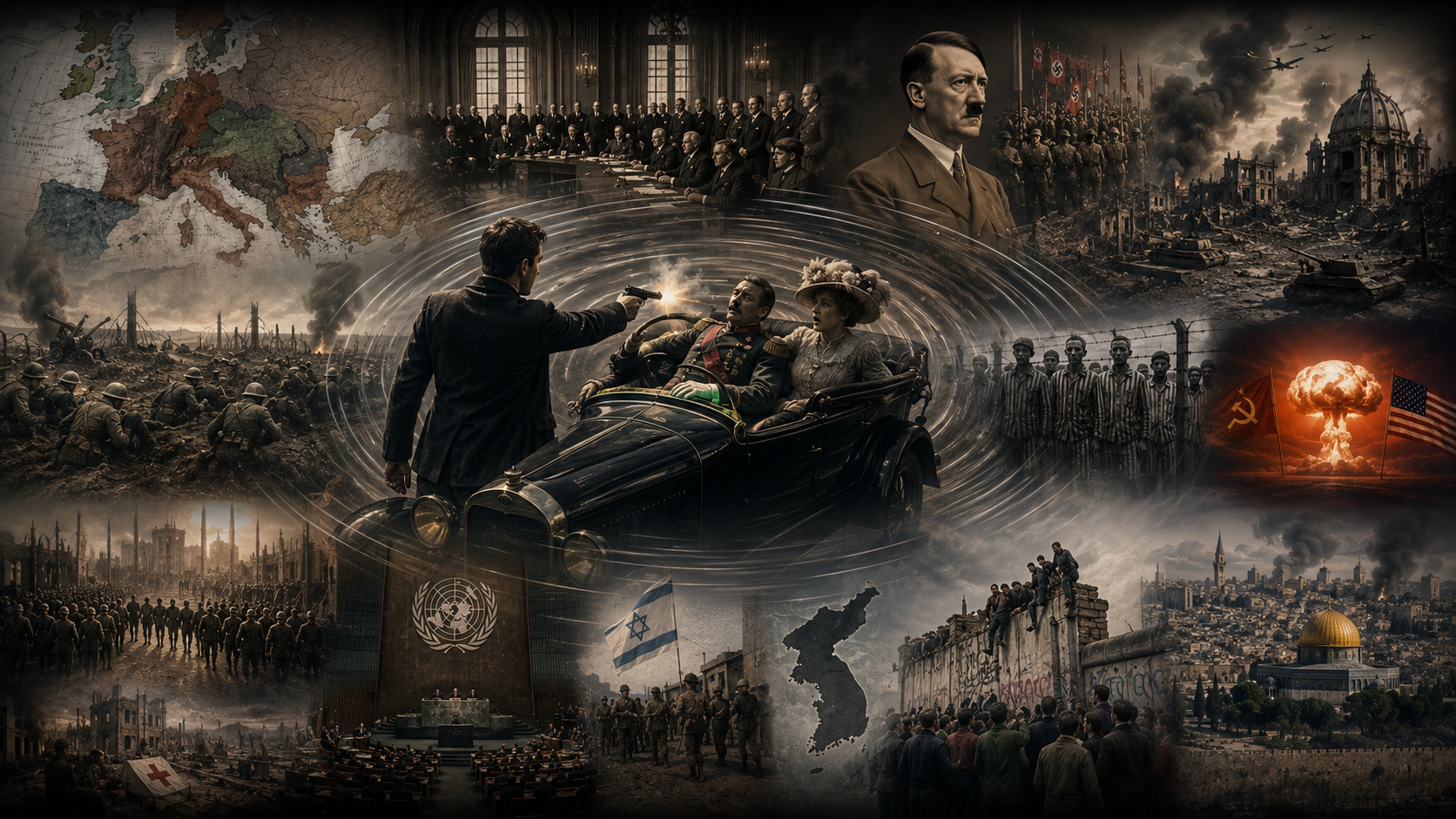
On the morning of June 28, 1914, a nineteen-year-old Bosnian Serb nationalist named Gavrilo Princip stepped off a curb in Sarajevo and fired two shots at a passing car. The first struck Archduke Franz Ferdinand, heir to the Austro-Hungarian throne. The second struck his wife, Sophie. Both were dead within the hour.

What followed from those two bullets is almost impossible to hold in a single frame of comprehension. Within six weeks, the major powers of Europe were at war. By November 1918, when the guns finally stopped, 20 million people were dead, four empires had collapsed, the map of Europe had been redrawn from scratch, and the conditions had been set — the humiliation of Germany, the punishing terms of Versailles, the economic chaos of the 1920s — for the rise of Adolf Hitler, the Second World War, the Holocaust, the Cold War, the founding of Israel, the partition of Korea, the creation of the modern Middle East, and the geopolitical architecture that still shapes the world you woke up in this morning.

Two bullets. One morning. A century of consequences still propagating.

This is the butterfly effect made historically concrete, and it illustrates the third category of signal this series is tracing: the human waves. Not cosmic. Not geological. But social, demographic, economic, and political forces already in motion — already set, already traveling, already carrying consequences that will arrive whether or not we have built instruments to receive them.

Continue reading… “The Future Is Already in Motion – Part 3: The Human Waves”

The Future Is Already in Motion – Part 2: The Earth Doesn’t Ask Permission

Polar Shifts, Tectonic Forces, Ocean Currents — The Planet’s Future Is Already Written in Its Physics

By Futurist Thomas Frey

The Planet Has Its Own Agenda

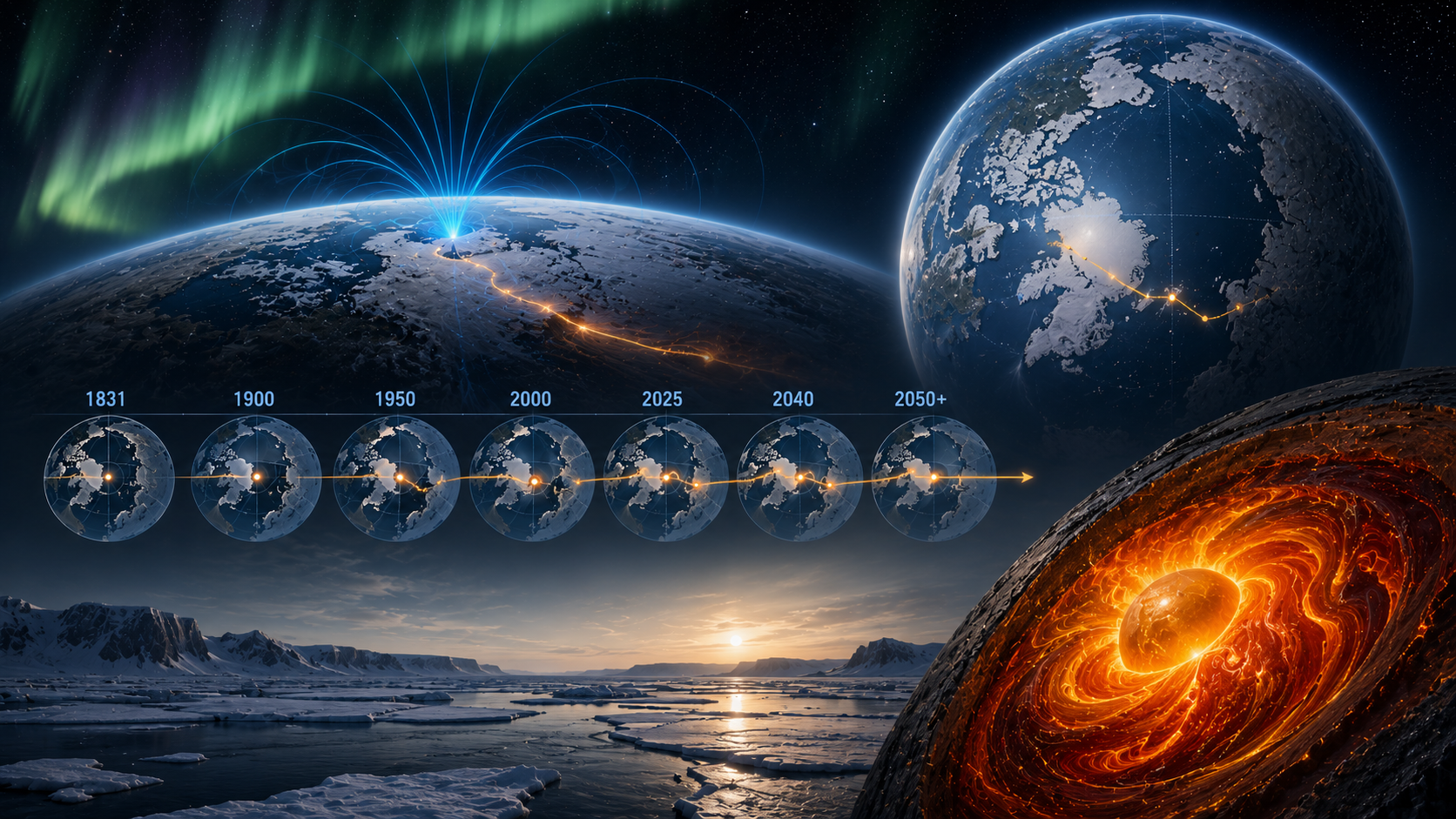
Sometime in the next few decades — possibly sooner, possibly later, but with a geological certainty that no committee vote or policy decision will alter — the magnetic North Pole will continue its accelerating journey across the Arctic. It has already moved more than 1,400 miles since systematic tracking began in 1831, when explorer James Clark Ross planted a flag in the Canadian Arctic and declared he had found it. Today that flag would be underwater, hundreds of miles behind the pole’s current position somewhere over the Arctic Ocean, racing toward Siberia at a pace that has nearly tripled since the 1990s.

Nobody caused this. Nobody can stop it. No election will reverse it, no technology will pause it, no economic cycle will slow it. The movement of the magnetic pole is driven by fluid dynamics in Earth’s outer core — churning rivers of molten iron thousands of kilometers below our feet, operating on timescales and by physics that have nothing to do with human civilization. It was in motion before our species existed. It will be in motion long after whatever we build on the surface has been erased.

This is the second signal we need to learn to read in this series about a future already in motion: the planet itself. Earth is not a stable stage on which human events are performed. It is a dynamic, layered system of forces with its own trajectories, its own timelines, and its own complete indifference to our plans. The futurist who ignores Earth’s signals in favor of exclusively human ones is reading only half the score.

Continue reading… “The Future Is Already in Motion – Part 2: The Earth Doesn’t Ask Permission”

The Future Is Already in Motion – Part 1: Signals From the Deep

The Universe Has Been Sending Us Messages for Countless Years. Most of Them Haven’t Arrived Yet.

By Futurist Thomas Frey

A Message Sent Before Earth Existed

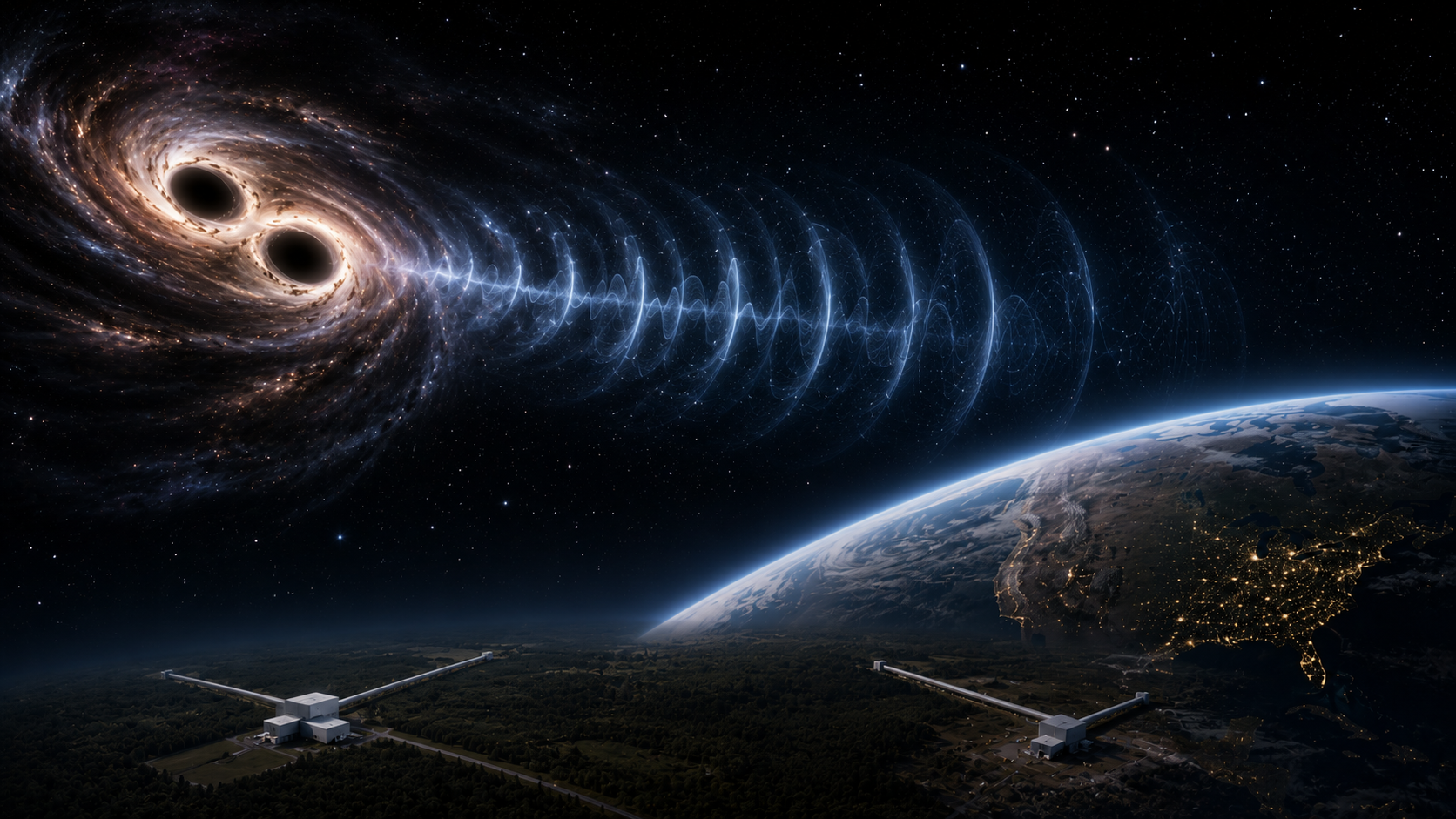
On September 14, 2015, a pair of detectors in Louisiana and Washington State registered a disturbance so small it measured a fraction of the width of a proton. The instruments — two L-shaped tunnels each four kilometers long, built at a cost of over a billion dollars and decades of scientific labor — had detected a ripple in the fabric of spacetime itself. The signal had traveled 1.3 billion light-years to reach us. It was generated by two black holes, each roughly thirty times the mass of the sun, spiraling into each other and merging in a collision of incomprehensible violence. That event happened when the most complex life on Earth was a single-celled organism drifting in a shallow sea. The signal from that collision spent more than a billion years crossing the universe before it passed through the Louisiana pine forests and registered on a human-built instrument for the first time in history.

We called it GW150914. We called it a discovery. But it wasn’t a discovery in the conventional sense. The event had already happened. The signal was already in transit. What changed on that September morning was not the universe — it was us. We finally built an instrument sensitive enough to receive what had been traveling toward us for longer than multicellular life has existed on this planet.

That is the foundational insight of this series, stated in its most cosmic form: the future is not something that happens to us. It is something already traveling toward us. Our relationship to it is determined entirely by the quality of our instruments and the sophistication of our ability to read what those instruments receive.

Continue reading… “The Future Is Already in Motion – Part 1: Signals From the Deep”

The Last Minute Economy

Amazon Just Launched a 30 Minute Delivery Service and, in Doing so, Declared That Waiting Is a Design Flaw.

By Futurist Thomas Frey

The Clock Just Reset

There is a threshold in consumer psychology that rarely gets named directly — the point at which delivery speed stops being a logistical convenience and starts replacing the decision to go somewhere yourself. For most of retail history, that threshold was measured in days. Amazon spent two decades systematically dismantling it: two days, then one day, then same day, then hours. On Tuesday, with the official launch of Amazon Now, the threshold collapsed to thirty minutes — and when it crosses that line, something fundamental changes about how people relate to physical stores, to planning, and to the nature of need itself.

Amazon Now allows customers to shop across thousands of items, including fresh groceries, household essentials, and other locally relevant items, with delivery in 30 minutes or less. This is not an incremental improvement in shipping speed. It is a category shift — the moment delivery becomes faster than driving.

Continue reading… “The Last Minute Economy”