Researchers at James Cook University (JCU) have made a groundbreaking advancement in the fight against microplastic pollution by developing a method to convert microplastics into graphene, a highly valuable material. The findings were published in the journal Small Science.
Professor Mohan Jacob from JCU highlighted the persistent threat posed by microplastics, which degrade into tiny, water-insoluble fragments that are harmful to marine life, animals, and humans. “These microplastics are notorious for their non-degradable and insoluble nature in water and are an evolving threat to fish, animals, and humans,” said Professor Jacob.
Dr. Adeel Zafar, a researcher at JCU, explained that microplastics have the ability to absorb organic pollutants, making them a dangerous presence in aquatic environments. “Once they are in water, they are ultimately integrated into both marine and human food chains. Disturbingly, microplastics disrupt marine life and coral reproduction,” Dr. Zafar noted.
Recycling microplastics has been challenging due to labor-intensive separation processes and high costs, resulting in low resource recovery rates globally. Dr. Zafar emphasized the need for upcycling, a process that transforms plastic waste into higher-value materials rather than merely breaking it down.
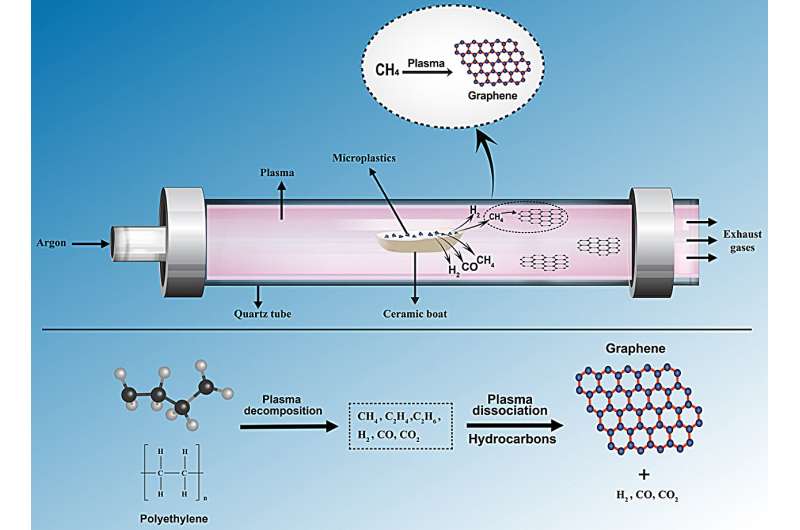
In their study, the JCU team ground plastic bottles into microplastics and then applied an innovative Atmospheric Pressure Microwave Plasma synthesis technique to convert the debris into graphene. Graphene, a one-atom-thick carbon material, is harder than diamond, 200 times stronger than steel, and five times lighter than aluminum. Its applications are rapidly expanding across various industries.
“Approximately 30 mg of microplastics produced nearly 5 mg of graphene in 1 minute. This production rate is remarkably higher than achieved previously, and offers a simpler, more environmentally friendly alternative to current techniques,” Dr. Zafar explained.
The graphene produced from this process has potential applications in manufacturing sensors and water purification systems, including the absorption of harmful substances like PFAS. Professor Jacob emphasized the broader impact of the research, stating, “The research not only pioneers a novel approach to graphene synthesis but also contributes to the broader goal of mitigating the adverse effects of microplastic pollution on our ecosystems.”
This breakthrough represents a significant step forward in both the fields of graphene production and environmental sustainability.
By Impact Lab