A team of physicists at the SLAC National Accelerator Laboratory in Menlo Park, California, has successfully generated the highest-current, highest-peak-power electron beams ever recorded. Their groundbreaking research, published in Physical Review Letters, marks a significant step forward in the development of high-powered electron beams, a field with potential applications ranging from fundamental science to industrial uses.
For years, scientists have pushed the boundaries of high-powered laser light, exploring its ability to split atoms and recreate conditions found on other planets. However, the SLAC team’s focus was on advancing the power of electron beams, aiming to give them similar capabilities as high-powered lasers.
The idea behind the team’s new achievement was relatively simple: pack as much charge as possible into the shortest amount of time. However, as the researchers point out, the challenge lay in actually making this idea a reality. In their experiment, the team achieved a staggering 100 kiloamps of current in a pulse lasting just one quadrillionth of a second.
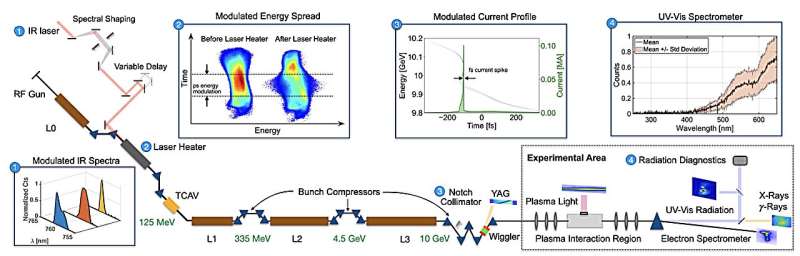
The team’s work involved accelerating high-energy electron beams around a particle accelerator, where powerful magnets push the electrons to nearly the speed of light. Inside the accelerator, the electrons ride along radio waves in a vacuum, gaining speed with each wave. The researchers liken the process to a race car speeding around an oval track, but with one crucial challenge: when the electrons approach a turn, they need to adjust their paths, which slows them down.
To overcome this, the team designed a way to make the electrons take a straighter path through the turn, allowing them to maintain more energy and take the turn more quickly. This is where the concept of “chirping” comes into play—electrons at the front of the beam move through a less-steep section of the radio wave, coming out of the turn with less energy.
The team then used magnets to direct the electrons in a series of left-right-left swerves, which allowed the lower-energy electrons to take a slightly longer path. This gave the higher-energy electrons a chance to catch up, effectively compressing the electron beam and boosting its energy. To enhance this effect, the researchers added another magnet to convert energy into light, amplifying the chirp even further.
Through multiple passes around the accelerator, the researchers managed to make the electron beam progressively more powerful while reducing its duration. At its peak, the pulse was just 0.3 micrometers long—extremely short by any standard.
The team’s innovative technique holds significant potential for a wide range of applications. The researchers suggest that their approach could lead to advances in chemical processes, the creation of new types of plasma, or even a deeper understanding of the fundamental nature of empty space.
As this technology continues to evolve, it could open up new avenues of research and development, enabling scientists to explore new frontiers in physics, chemistry, and materials science. The SLAC team’s work represents a major leap forward in the realm of electron beam technology, with the potential to transform industries and scientific fields alike.
By Impact Lab