

Technology, Community, and the Art of Raising Citizens
By Futurist Thomas Frey
Part 2 of 6: The Architecture
A vow is only as strong as the infrastructure behind it.
If we are serious about asking women to take on the most consequential work in the world as a full-time profession, we have an obligation to build the support system that makes the promise keepable — not symbolic, not aspirational, but real enough to sustain on a Tuesday morning with a sick toddler, a newborn who didn’t sleep, and an older child who needs help with math before the school bus arrives.
In the first column of this series I made a claim at the level of principle: that bearing and raising children can function as a full-time vocation — compensated, supported, and culturally recognized with the seriousness the work deserves. Now I want to make it at the level of practice. What does the daily life of a Vitalist actually look like? What is the role of technology, and where does technology end and irreplaceable human presence begin? Who is in the community around the Vitalist, what do they contribute, and what does she owe them in return?
These are design questions. And they matter because the history of every well-intentioned but ultimately unsuccessful effort to support family formation is littered with proposals that addressed the economics of having a child without addressing the lived reality of raising one. A one-time payment does not solve the problem of 3am with a sick infant and no one to call. A tax credit does not solve the problem of a toddler who needs constant presence while a curriculum still needs to be designed and an older child’s homework demands attention and a community that has not been organized to support any of it.
The Vitalist framework addresses all of this. This column is where that ambition gets specific.
The Three Layers
The Vitalist’s support system operates in three distinct layers that work together rather than substituting for each other. The first is technological. The second is professional. The third is communal. Each handles a different category of need, and the design principle across all three is the same: protect and amplify the Vitalist’s most irreplaceable resource.
That resource is not her time or her energy in isolation. It is her focused, present, loving attention directed at her children during the hours when that attention matters most. Everything in the support stack exists in service of that one goal.
The robot does not replace the mother. The nanny does not replace the mother. The volunteer does not replace the mother. They replace the tasks that do not require the mother — so that when she is present, she is truly present. Not simultaneously managing household logistics, monitoring a sleeping infant, preparing a meal, and answering messages with her attention fractured into a state of permanent partial engagement that serves none of them well.
The three layers look like this:
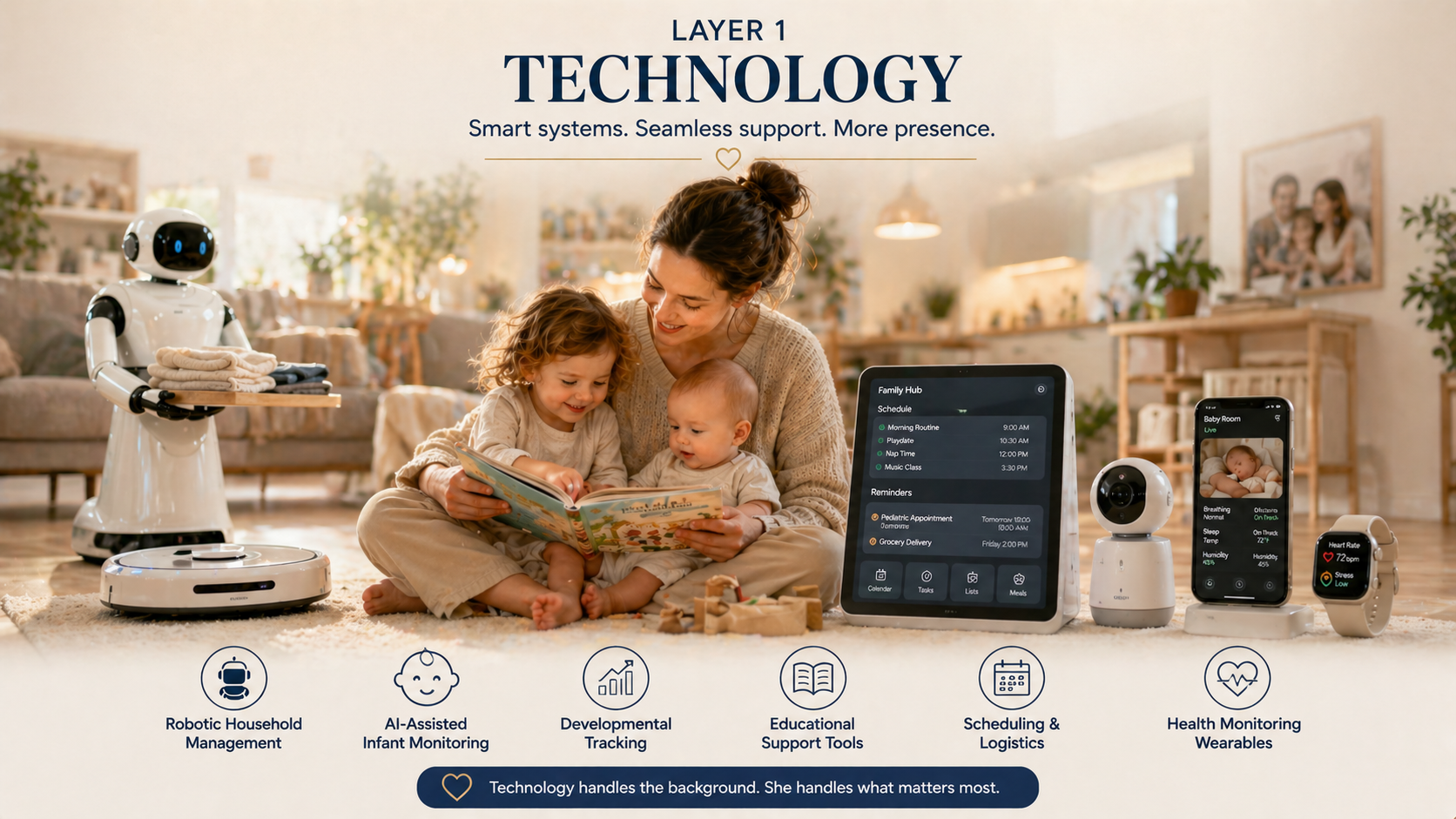
Layer 1 — Technology: Robotic household management, AI-assisted infant monitoring, developmental tracking systems, educational support tools, scheduling and logistics coordination, health monitoring wearables for mother and child.
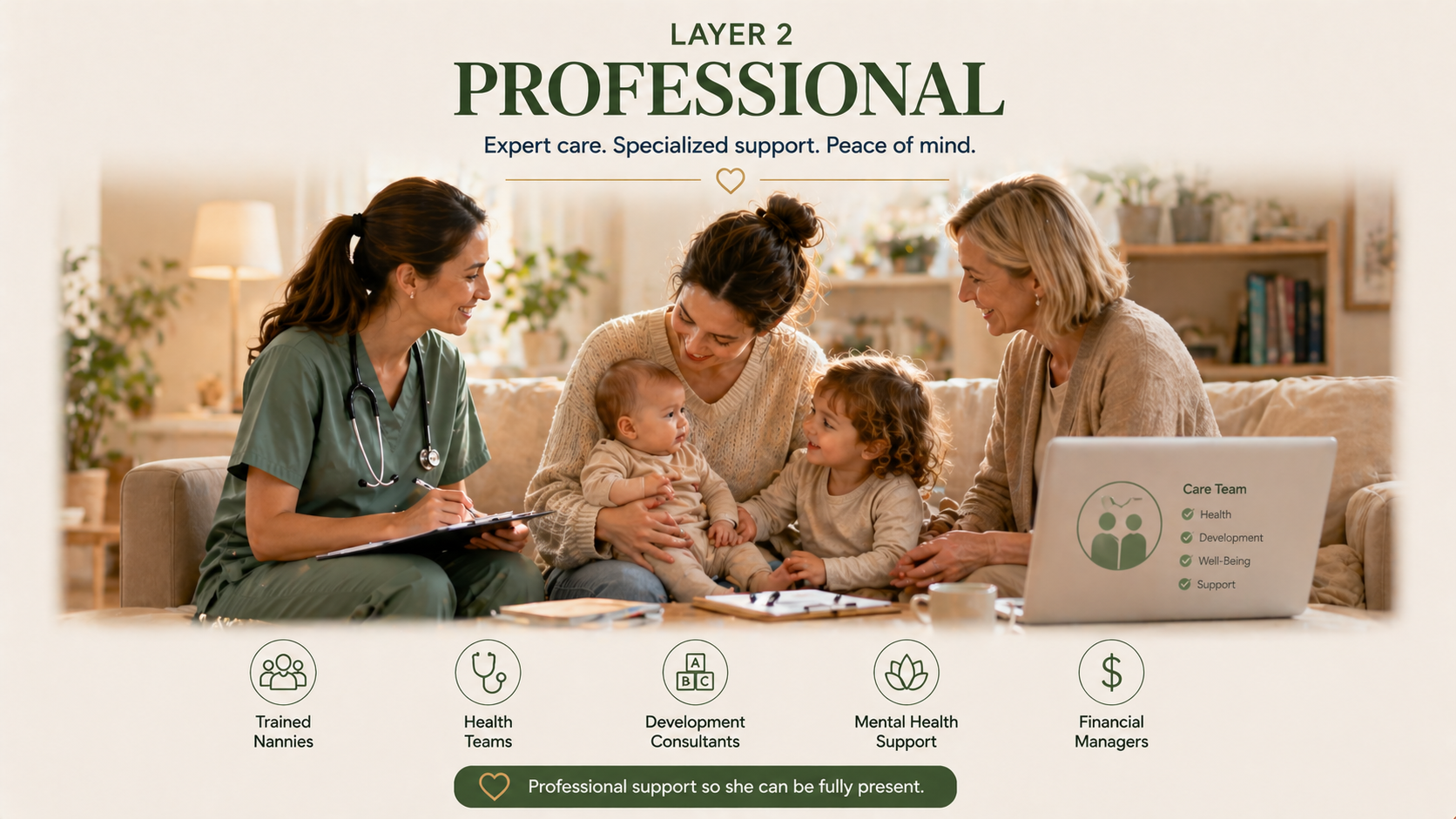
Layer 2 — Professional: Trained human nannies for dedicated coverage hours, pediatric and maternal health teams, early childhood development consultants, mental health support for the Vitalist herself, financial managers for the compensation structure.
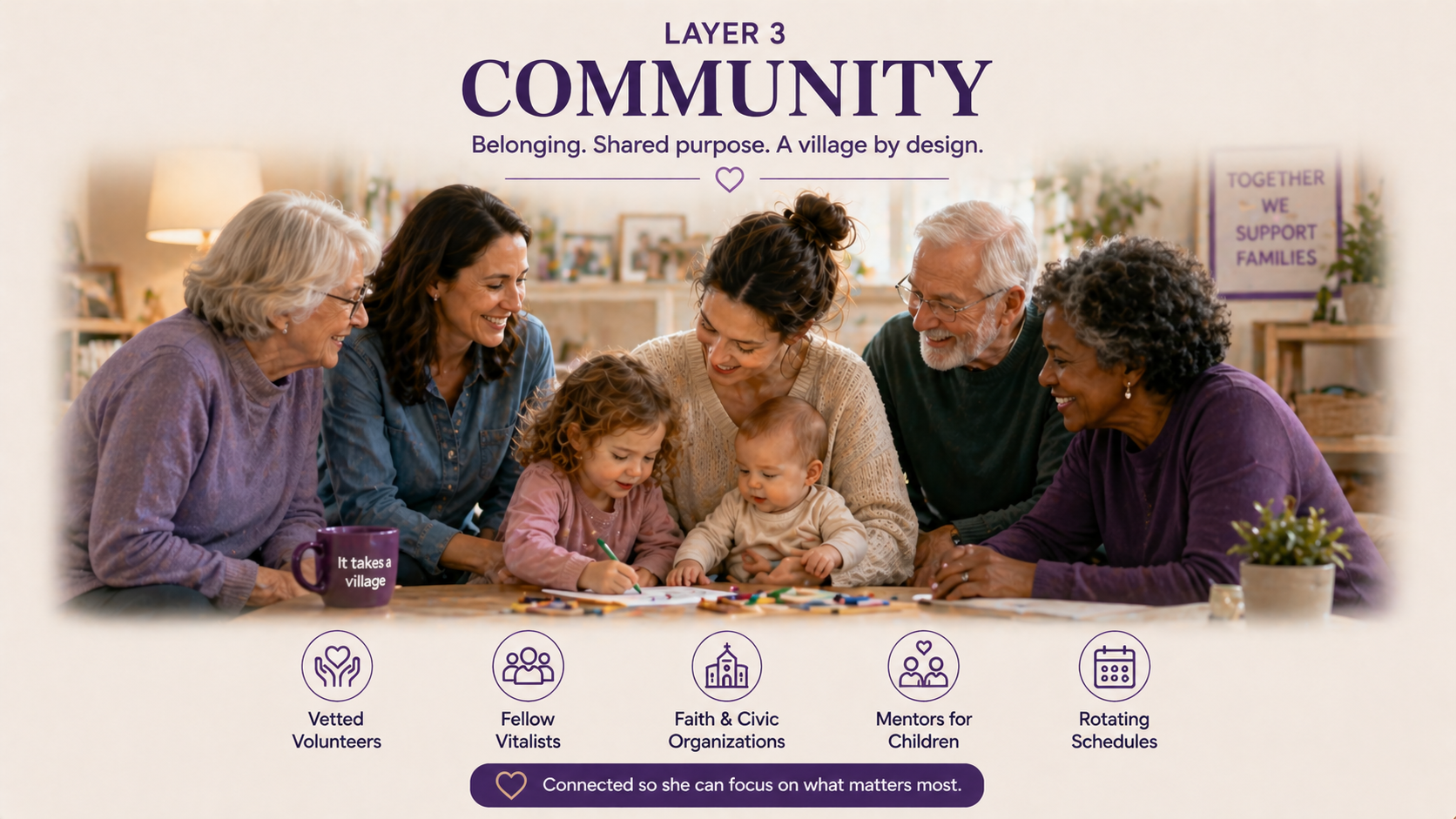
Layer 3 — Community: Vetted volunteers — retired teachers, grandparents, civic-minded neighbors — in organized rotating schedules; fellow Vitalists in mutual support networks; faith and civic organizations; mentors for older children.
What Technology Actually Does — and What It Doesn’t
I want to spend a moment on the technology layer because it is the one most likely to be either oversold or dismissed, and neither reaction serves the design well.
The robotic systems available right now — not in five years, not in a speculative future, but available and deployable today — are capable of handling a significant fraction of the logistical burden of running a household with young children. Meal preparation, laundry, floor cleaning, inventory management, monitoring the sleep environment of an infant and alerting the parent to anomalies: all of this is within the current capability envelope of consumer and light commercial robotics.
More sophisticated AI systems can track developmental milestones, flag early indicators that warrant a conversation with a pediatrician, curate age-appropriate educational content, and manage the scheduling complexity of a household with multiple children at different developmental stages. These are not replacements for parental judgment. They are information systems that make parental judgment better-informed and parental attention better-allocated.
What technology cannot do — and I want to be unambiguous — is provide the thing that actually shapes a child. The research on early childhood development is remarkably consistent on this point: the single most powerful determinant of a child’s cognitive, emotional, and social trajectory is the quality of the attachment relationship with a primary caregiver in the first three years of life. Quality of attachment is not a function of hours logged. It is a function of presence — genuine, undistracted, emotionally available presence — during the interactions that matter.
Technology serves the Vitalist precisely by clearing the field for those interactions to happen at full quality rather than in the fractured, distracted state that is the default condition of an unsupported parent managing everything at once.
The Professional Nanny — Partnership, Not Luxury
The professional nanny has been, historically, a signal of wealth. The Vitalist framework reframes this entirely.
A trained professional nanny working designated hours within a Vitalist household is not a luxury. She is the equivalent of the medical assistant who enables the physician to practice medicine rather than managing the waiting room. The Vitalist’s work is raising children. The nanny’s work is supporting the conditions under which that work can be done at its highest level — including, critically, providing the Vitalist with the hours of genuine rest, personal development, and community engagement that make sustained excellence in any demanding vocation possible over years and decades.
The best thing you can give a child is a parent whose own life is not collapsing under the weight of everything they’re trying to manage alone.
The nannies who serve within the Vitalist system are trained professionals with credentials in early childhood development. They are not babysitters. They are collaborative partners in the developmental project the Vitalist has committed to, with clear roles, clear boundaries, and a shared understanding of the outcomes they are both working toward.
The Volunteer Network — Community as Infrastructure
Here is something that modern life has almost completely obscured: there are millions of people who want to be involved in the raising of children and currently have no organized way to do so.
- Retired teachers with decades of accumulated expertise in child development spending their afternoons watching television
- Grandparents who live twenty minutes from grandchildren they see twice a year because no one built the bridge between their availability and the family’s need
- Neighbors who would read to a child for two hours on a Saturday morning if someone organized it and made it easy
- Faith communities and civic organizations whose members have given time and care to collective projects their entire lives and would extend that instinct to the raising of children if they were invited to do so in a structured way
The Vitalist community volunteer network is that structure. It is vetted, organized, scheduled, and matched to the specific needs and ages of the children involved. It is not charity dispensed to an isolated family. It is civic participation in the most fundamental project a community can undertake.
Every volunteer who reads to a child for two hours is investing in a citizen. Every retired teacher who works through a math concept with a ten-year-old is passing forward the accumulated knowledge of a career. The Vitalist framework makes this possible by creating the organizational container that turns diffuse, available goodwill into coordinated, reliable support.
Communities already have the people. What has been missing is the structure. Organize that goodwill, and child-raising becomes a shared civic effort rather than an isolated burden.
A Day in the Life
It is worth making this concrete. A Vitalist with three children — an infant, a toddler, and a seven-year-old — wakes in a household where the robotic systems have already prepared breakfast, monitored the infant’s overnight sleep data and flagged nothing concerning, and queued the day’s schedule.
The professional nanny arrives for the morning shift. The Vitalist spends the first two hours in what might be called deep presence time — the meal, the play, the conversation, the physical affection and eye contact that are the irreplaceable substance of early attachment. The nanny takes over logistical management. A volunteer arrives at nine to work with the seven-year-old on reading. The Vitalist uses the freed attention for her own development — exercise, education, participation in the Vitalist community network, or simply the rest that makes the afternoon’s deep presence possible at full quality.
The afternoon mirrors this structure. Deep presence time anchors the day at both ends. The support layer fills the space between, handling everything that does not require the mother so that the time that does require her is fully available.
This is not a life of leisure. It is a life of professional discipline applied to the most consequential work available. The structure is not a concession to difficulty. It is the design that makes the vow sustainable — not for a season, but for the full arc of a childhood.
Because that is the actual commitment. Not to start well. To finish well. And finishing well requires an architecture strong enough to bear the weight of the work over the years it takes to do it right.
Next: Part 3 — The Incentive Structure. A vocation without compensation is a hobby. What does the financial, legal, and social architecture of Vitalist compensation actually look like — and which countries are already building pieces of it that the rest of the world should be paying attention to?
Related Reading
Serve and Return: The Science of Early Brain Development
Harvard Center on the Developing Child — The most accessible summary of the peer-reviewed science establishing that responsive, present interaction between caregiver and child in the early years is the single most powerful determinant of lifelong cognitive and emotional health — the scientific foundation for the Vitalist’s irreplaceable role
How Domestic Robotics Is Reshaping Household Labor
Brookings Institution — A rigorous economic and sociological analysis of how robotic and AI household tools are redistributing the burden of domestic labor — the empirical context for understanding what the technology layer of the Vitalist support stack can realistically deliver today and in the near term
The Long-Run Impacts of Early Childhood Programs
American Economic Review · Heckman et al. — Nobel laureate James Heckman’s landmark economic analysis demonstrating that investment in the quality of early childhood caregiving produces the highest return on investment of any human capital intervention — the most powerful economic argument for treating the Vitalist’s work as a funded profession