

What They Are, Why They Matter, and Why the World Needs Them Now
By Futurist Thomas Frey
Part 1 of 6: The Definition
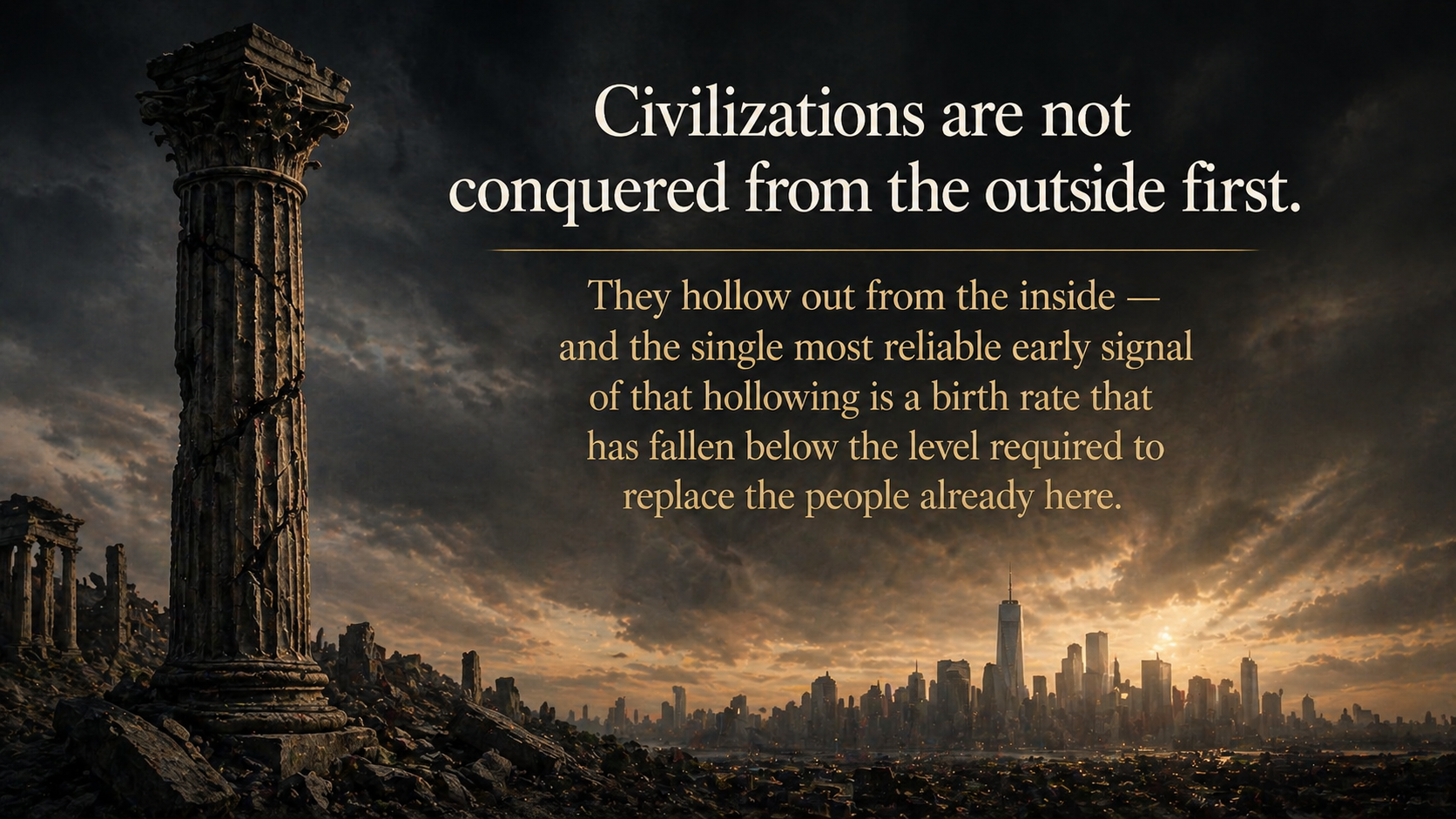
Civilizations are not conquered from the outside first. They hollow out from the inside — and the single most reliable early signal of that hollowing is a birth rate that has fallen below the level required to replace the people already here.
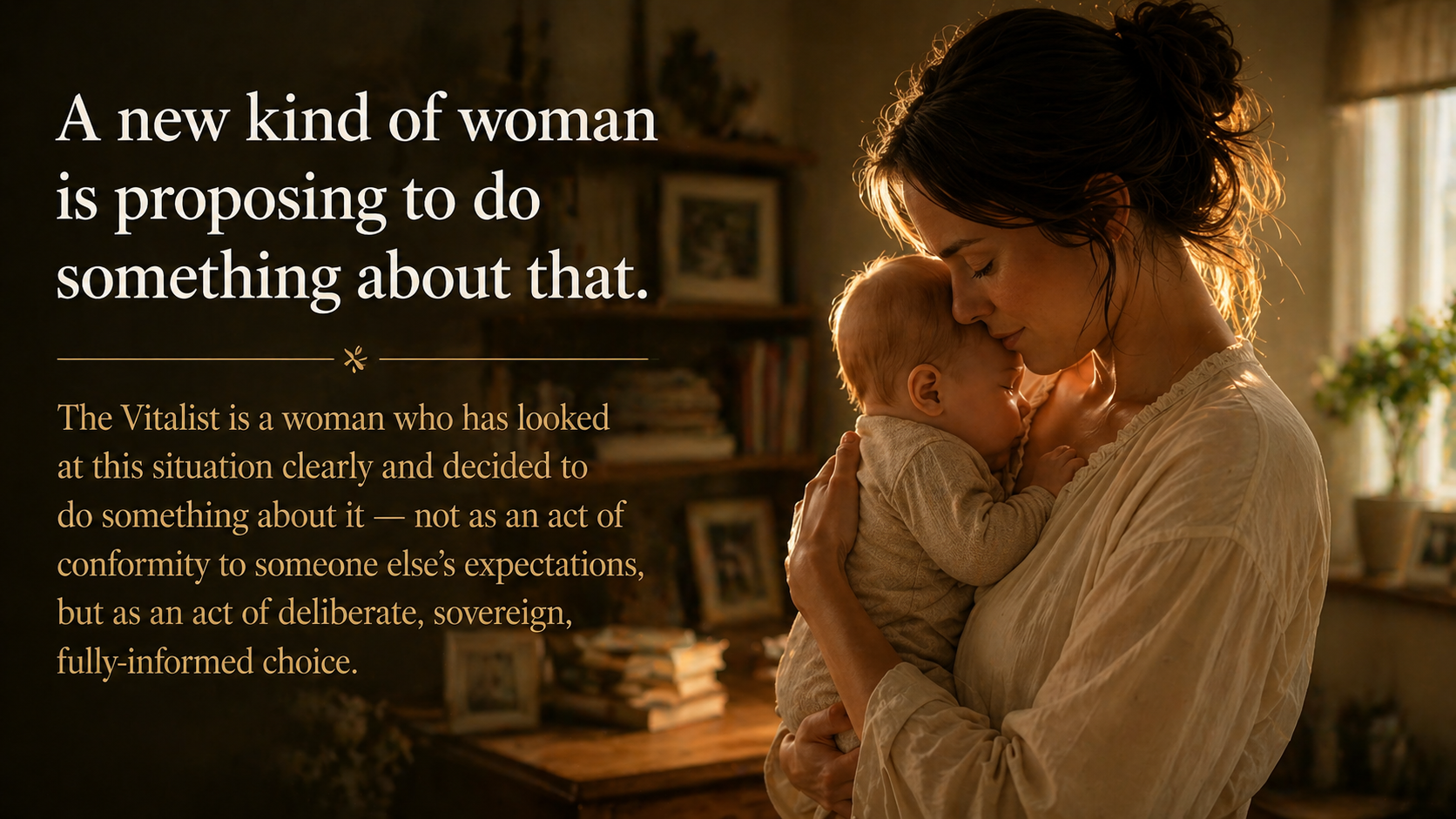
A new kind of woman is proposing to do something about that.
I have been running this thought experiment for several years now, and I want to start with it because it reframes everything that follows. Imagine the most important job in the world — a job whose output determines whether a civilization persists, whether its culture survives, whether its accumulated knowledge and values have anyone to inherit them. Imagine that this job requires extraordinary physical resilience, sustained emotional intelligence, years of uninterrupted commitment, and a depth of love that most forms of human endeavor never ask of us. Now imagine that despite all of this, the culture surrounding this job has spent the last fifty years systematically communicating to the women best positioned to do it that choosing it as a primary vocation is something between a consolation prize and a personal failure.
We have been engaged, as a civilization, in the prolonged and apparently serious project of talking ourselves out of our own continuation.
The Vitalist is a woman who has looked at this situation clearly and decided to do something about it — not as an act of conformity to someone else’s expectations, but as an act of deliberate, sovereign, fully-informed choice. She has identified the bearing and raising of children as her primary vocation, her deepest contribution, and the legacy she most wants to leave in the world. She has chosen this with her eyes open, with the full support of a new set of institutions and incentives being built around her, and with the conviction — which the evidence strongly supports — that there is no more consequential work available to a human being in the twenty-first century than the work of producing and raising the next generation of citizens capable of carrying civilization forward.
The Birth Rate Crisis — By the Numbers
The scale of the problem is not yet widely felt even though its causes are already decades old. The numbers are worth stating plainly:
- South Korea’s total fertility rate has fallen to 0.72 — the lowest ever recorded for any country in human history
- Japan loses the equivalent of a mid-sized city from its population every single year
- Every country in the European Union is now below the 2.1 replacement rate, most significantly so
- The United States fell below replacement level in 2010 and has not recovered
- A country with a sustained fertility rate below 1.5 has never, in recorded history, recovered without dramatic policy intervention
A population that does not replace itself does not merely shrink — it ages, and an aging population without a sufficient base of younger workers and taxpayers cannot fund the pension systems, the healthcare infrastructure, or the military capacity that its own social contract promises. This is not a distant hypothetical. Japan is living it now. South Korea is living it now. Large parts of southern and eastern Europe are living it now. The economic and social consequences of a sustained birth rate collapse arrive slowly and then, once a demographic tipping point is crossed, very fast indeed.
Every serious demographer studying this problem arrives at the same uncomfortable conclusion: financial incentives alone have proven insufficient to reverse the trend. Hungary has spent more than five percent of its GDP on pro-natalist policies for years and has moved its fertility rate only marginally. The cash payment addresses the economics of having a child. It does not address the deeper cultural problem, which is that the bearing and raising of children has been progressively devalued as a vocation in exactly the societies where it is most urgently needed.
The Vitalist framework proposes something more fundamental than a cash incentive. It proposes a complete reframing — a new identity, a new set of supporting institutions, and a new cultural recognition for women who choose to make the bearing and raising of children the primary work of their lives.
A Superpower, Not a Sacrifice
The word that keeps coming up when I describe the Vitalist to women I have discussed this concept with is superpower. Not in the vague motivational-poster sense, but in the precise literal sense: the capacity to do something that nothing else in the known universe can do, and that everything else depends on. The continuation of the human species requires human bodies — specifically, female human bodies — and no technology on the horizon changes that fundamental biological reality. Every civilization that has ever existed was produced by women who bore children and raised them. That is not a sentimental observation. It is the most important empirical fact in the history of the world.
The bearing and raising of children is not a retreat from ambition. It is the most consequential ambition available to a human being.
The Vitalist reclaims this power as power — not as duty imposed from outside, not as a limitation on her other possibilities, but as a genuine vocation chosen freely from among the full range of vocations available to her. She may be married or unmarried. She may conceive naturally with a partner or through a sperm bank. The path to the vocation is hers to design. What defines her as a Vitalist is not the mechanism of conception but the commitment she makes afterward: to bear children, to raise them with deliberate excellence, to deploy every tool available to her in doing so, and to produce citizens who are loyal to their country and their community, committed to continuous improvement of themselves and the world around them, and capable of carrying forward the cultural inheritance that their parents and grandparents have spent their lives building.
The Full-Time Vocation — and What Makes It Viable
The central practical claim of the Vitalist framework is this: with the right incentives and the right infrastructure, bearing and raising children can function as a full-time occupation — compensated, supported, and socially recognized with the same seriousness that we extend to every other profession whose output society depends on.
What does that infrastructure look like? It begins with direct financial compensation — not a one-time birth payment but an ongoing income that reflects the ongoing nature of the work. It includes access to a full support stack:
- Robotic assistance for the physical demands of early childcare
- Professional human nannies for the hours when the Vitalist needs rest or development time
- A network of community volunteers — grandparents, neighbors, civic organizations — who want to participate in the raising of children and currently have no organized way to do so
- Housing designed around families rather than single occupants
- A healthcare system that treats maternal health as a national priority rather than an afterthought
- A cultural recognition structure — titles, ceremonies, civic honors, and community roles — that communicates unambiguously that this work is not second-tier but first
The technology piece deserves particular attention, because it is changing faster than most people tracking this policy space have recognized. The robotic systems available today for household management, infant monitoring, early childhood education support, and logistical coordination are not replacements for human love and attention. They are force multipliers. They extend the range of what a single devoted parent can manage. They handle the tasks that are necessary but not irreplaceable by human presence, freeing the Vitalist’s attention for the irreplaceable work: the eye contact, the stories, the discipline, the modeling of values, the ten thousand daily interactions through which a child learns what it means to be a person.

The Vow — and What It Means
What distinguishes a Vitalist from a woman who simply has children is the same thing that distinguishes a physician from a person who knows some medicine: the public commitment, the professional identity, and the ongoing accountability to a standard of practice.
The Vitalist makes a vow — not to a husband, not to a church, not to a state — but to her children and to her community. She vows to raise the best children she is capable of raising. She vows to use every tool available to her in that work. She vows to produce citizens — people who are loyal to something larger than themselves, committed to the improvement of their families and communities, and capable of passing forward the values and the vitality that the vow was made to protect.
This is not a small thing to ask. It is, arguably, the largest thing that can be asked of any human being.
There is a useful parallel in the work of Muhammad Yunus and the Grameen Bank. When Yunus began extending micro-loans to the poorest women in Bangladesh, he didn’t simply hand them money and wish them well. He asked them to commit. Borrowers were required to memorize and recite the Sixteen Decisions — pledges covering health practices, education of children, refusal of dowry, investment in the family’s future, and commitment to the community. The loan came with a vow. The vow was the point. Yunus understood that transformation requires not just resources but a framework of commitment that orients the recipient toward a different kind of future. The resources alone accomplish very little. The commitment changes everything.
The Vitalist framework operates on the same logic. The compensation and the infrastructure are necessary but not sufficient. What makes them transformative is the commitment that shapes how they are used — the vow that turns a life with children into a vocation for civilization.
The Vitalist framework is built on the conviction that there are women in every country and every culture who are ready to be asked — who are hungry, in fact, for a framework that matches the scale of what they already intuitively know their potential vocation deserves.
The world has been waiting for this word. It is time to give it to them.
Next: Part 2 — The Architecture of a Vitalist Life. If raising children is a full-time vocation, it needs a full-time design. What does the daily life of a Vitalist actually look like — the technology, the community, the rhythms, and the support structures that make the vow not just honorable but achievable?
Related Reading
Population and Fertility Data — Global Overview
The World Bank — The most authoritative and continuously updated international dataset on fertility rates, population projections, and demographic trends — the empirical foundation for understanding the birth rate crisis that makes the Vitalist moment not merely interesting but urgent
Rising Share of U.S. Adults Are Living Without a Spouse or Partner
Pew Research Center — The detailed sociological portrait of how partnership and family formation patterns have shifted in the United States — essential context for understanding why the Vitalist framework must accommodate both married and unmarried paths to the vocation
Why Countries with Better Work-Life Balance Are More Productive
Harvard Business Review — The economic case that investing in the conditions of family life — rather than extracting maximum labor hours from every adult regardless of family responsibilities — produces superior long-run economic outcomes, directly supporting the Vitalist compensation model