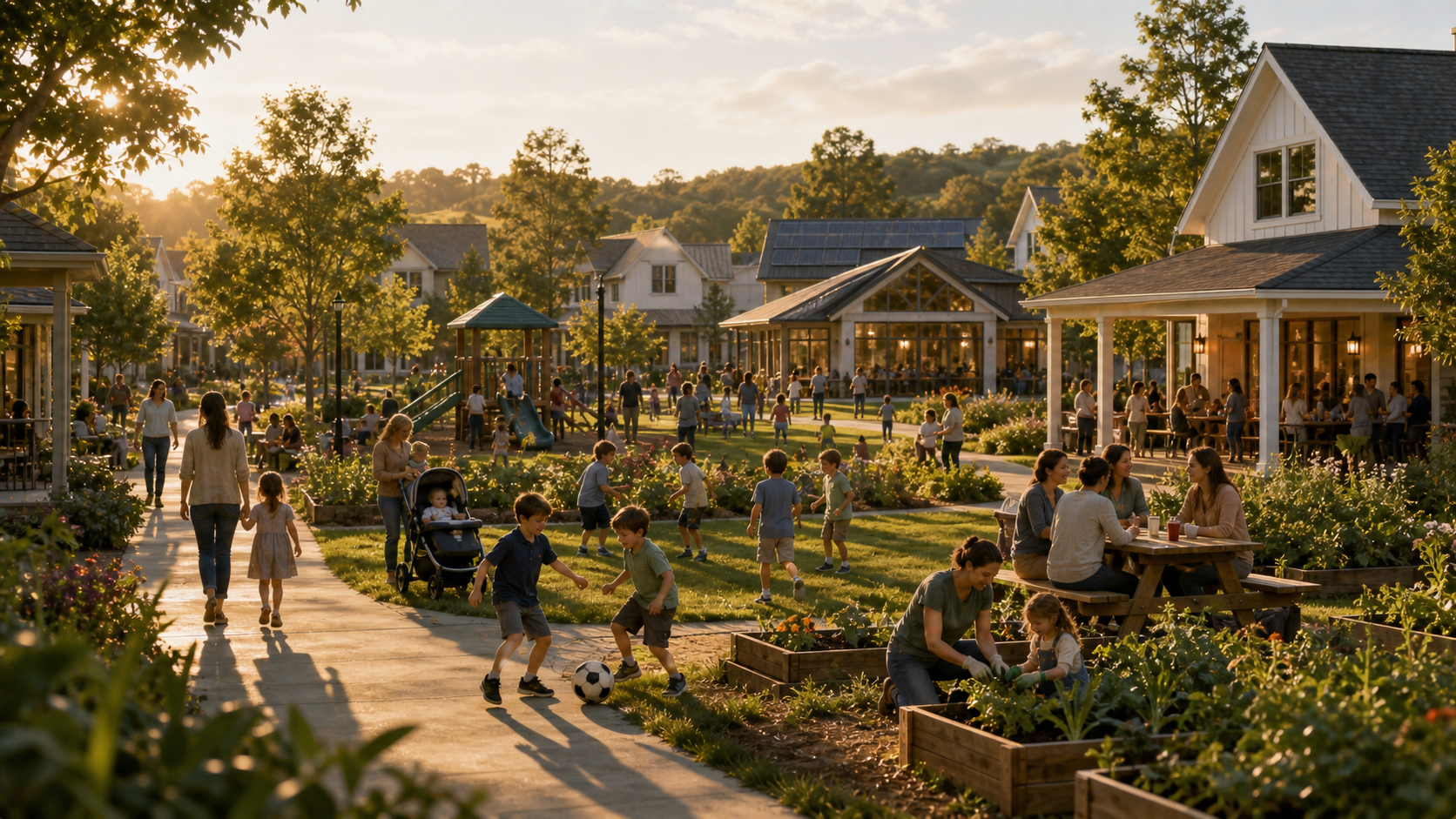
The Vitalists Part 6 – The Vitalist Colony

What happens when the vow becomes the neighborhood — and the neighborhood becomes the proof of concept

By Futurist Thomas Frey

Part 6 of 6: The Colony

Every transformative idea in human history has had a moment when it stopped being a philosophy and became a place.

The Puritan settlers didn’t write treatises about the ideal community and wait for governments to implement them. They built the community, in a specific geography, with specific people, under specific rules they had chosen together. The kibbutz movement didn’t lobby the Israeli government for agricultural reform before demonstrating what communal farming could produce. It built farms, on actual land, and let the results make the argument. The Shakers, the Oneida community, the Hutterite colonies, the cooperative villages of Scandinavia — whatever their specific ideology, they shared a recognition that ideas about how to live together only become real when someone actually lives together that way.

The Vitalist Colony is that moment for this series.

Not a policy proposal. Not a cultural advocacy campaign. Not an institutional framework waiting for governments to adopt it. A place — a designed, intentional, physically real community where the Vitalist vocation is the organizing principle of daily life, where the infrastructure described in the preceding five columns is built and operational, and where the results are visible and measurable and available to anyone who wants to evaluate them.

The Colony is the proof of concept. And proof of concepts, in the history of social transformation, have a track record that no amount of policy argument can match.

Continue reading… “The Vitalists Part 6 – The Vitalist Colony”
The Vitalists Part 1 – An Introduction

What They Are, Why They Matter, and Why the World Needs Them Now

By Futurist Thomas Frey

Part 1 of 6: The Definition

Civilizations are not conquered from the outside first. They hollow out from the inside — and the single most reliable early signal of that hollowing is a birth rate that has fallen below the level required to replace the people already here.

A new kind of woman is proposing to do something about that.

I have been running this thought experiment for several years now, and I want to start with it because it reframes everything that follows. Imagine the most important job in the world — a job whose output determines whether a civilization persists, whether its culture survives, whether its accumulated knowledge and values have anyone to inherit them. Imagine that this job requires extraordinary physical resilience, sustained emotional intelligence, years of uninterrupted commitment, and a depth of love that most forms of human endeavor never ask of us. Now imagine that despite all of this, the culture surrounding this job has spent the last fifty years systematically communicating to the women best positioned to do it that choosing it as a primary vocation is something between a consolation prize and a personal failure.

We have been engaged, as a civilization, in the prolonged and apparently serious project of talking ourselves out of our own continuation.

The Vitalist is a woman who has looked at this situation clearly and decided to do something about it — not as an act of conformity to someone else’s expectations, but as an act of deliberate, sovereign, fully-informed choice. She has identified the bearing and raising of children as her primary vocation, her deepest contribution, and the legacy she most wants to leave in the world. She has chosen this with her eyes open, with the full support of a new set of institutions and incentives being built around her, and with the conviction — which the evidence strongly supports — that there is no more consequential work available to a human being in the twenty-first century than the work of producing and raising the next generation of citizens capable of carrying civilization forward.

Continue reading… “The Vitalists Part 1 – An Introduction”

Top 30 best places in the world to be a mother

Norway

Norway ranks number 1 as the best place in the world to be a mom.

The joy of motherhood is a universal emotion no matter where you are in the world. However, the conditions in which women raise their children vary from country to country. As part of the 2012 State of the World’s Mothers report, Save the Children has released their 13th annual Mothers’ Index.

Continue reading… “Top 30 best places in the world to be a mother”

Majority of births among under 30 are to unmarried women

birth

Motherhood without marriage has settled deeply into middle America.

Birth to unmarried women used to be called illegitimacy, now it is the new normal.  The share of children born to unmarried women has crossed a threshold after steadily rising for five decades: more than half of births to American women under 30 occur outside marriage.

Continue reading… “Majority of births among under 30 are to unmarried women”

Single Moms at Risk of Poor Health Later in Life

single mom

Stress and financial strain may take toll.

Moms who had children outside of marriage may be at risk for poor health later in life.  Thousands of mothers who participated in a 30-year study, but the ones who had delivered children outside of marriage reported being less healthy when they reached their 40s than the ones who had postponed motherhood until after marriage.


Continue reading… “Single Moms at Risk of Poor Health Later in Life”