Today’s robots are pretty extraordinary. There are ones that can paint incredible works of art, run lettuce farms, and even act like us. The newest of these is BeeHex. Beehex can 3D-print any type of pizza.
Jason Ray thinks the culture of “disaster prepping” is misunderstood. Thanks in part to National Geographic’s Doomsday Preppers, a reality TV show about preppers, the term conjures images of far-flung, paranoid woodsmen hoarding Borax under their floorboards, a caricature of prepping that does no favors to Ray, whose main concern is taking care of his family.
The construction industry itself is dominated by huge corporations with equally huge budgets, many small startups and even one-man businesses. Among them is Alex Le Roux, a Houston, Texas-based student who has just reached a remarkable milestone. Using his own V2 Vesta 3D printer, he has just completed the first 3D printed livable structure in the US.
The 3D printing pancake robot you’ve been waiting for is now on the market. PancakeBot retails for a cool $299.98 on Amazon. A bit expensive, yes, but can a traditional skillet cook up a pancake breakfast in the shape of Steve Wozniak’s head?
3D printing technology will revolutionize architecture in the near-future and allow designers to literally click-and-print complex buildings at a lower cost and faster speed than traditional construction methods allow. Another step forward in the field comes via Dubai, where what’s hailed as the world’s first 3D-printed office was recently completed.
The Liberty Science Center in Jersey City, New Jersey, will have a special guest taking selfies and playing “Simon Says” with visitors, courtesy of the Hoboken-based Stevens Institute of Technology. The LSC recently approached the school about 3D printing an interactive and educational robot for a new exhibition. Together, they settled on 3D printing the open sourced InMoov robot project created by French designer and sculptor Gael Langevin, and created what could be the fastest 3D printed full-upper-torso robot ever.
All futurists agree that consumer electronics of the future will be flexible, wearable and packed with sensors and antennas to perform a wide range of biomedical functions. This sound great, but unfortunately today’s production techniques are suitable for little more than flat, bulky and rigid devices.
With the major advances in 3D printing technology, companies are looking to take it past the bounds of earth and start 3D printing in space. Opportunities like asteroid mining, cheaper repair parts for orbiting equipment, and even building extraterrestrial bases are becoming increasingly likely.
If two hands are better than one, then think of how much better it would be to have eight, especially when it comes to mass production. Engineers from electronics manufacturer Siemens have protyped a 3D-prinitng robot, that looks like a spider, and could be used to build car bodies and airplane fuselages. These robots could cut costs and speed up production on large scale projects.
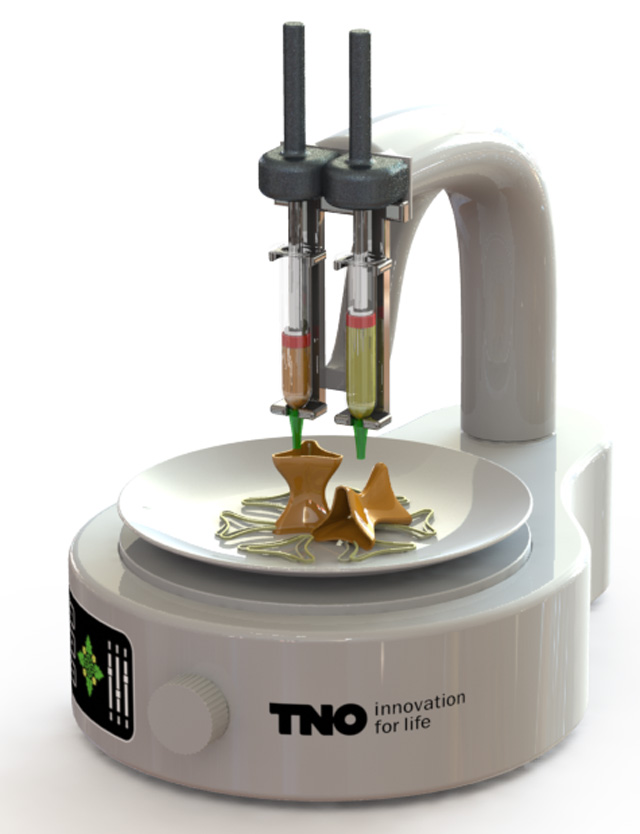
3d printing food is talked about a lot, but few sighting. No one really knows if its real or not. The idea is to take a 3D printer replace the non-edible material with something edible and delicious like food purée or mixes, etc. The results have been less than amazing with taking perfectly good food and turning it into odd shapes designs. Still, a few companies are still trying to pave the way to real business in this space.
New research has shown that a 3D-printed scaffolding could restore function to mice that had their ovaries removed. The scientists presented their research last week at the annual Endocrine Society meeting in Boston. The mice they were testing gave birth to healthy pups. Hopefully, in the future, this procedure can restore functionality to women who have lost their ability to give birth through age, chemotherapy, or other issues.
We’re heading for a future where we can start 3D print our own shoes and our own dinners, but so far the hype has not met the expectations. The technical challenge of consistently printing, quality, objects, in multiple colors and materials at once has been very difficult to overcome. But Stratasys, the largest 3D-printing company in the world, says its newest industrial printer does both, marking what it says is an “industry breakthrough.”