Right now, it prints proteins. In the far future, it could print human babies on Mars. Craig Venter and Elon Musk have even discussed how printed life could help terraform Mars.
Dentists and patients alike want to know how to make dental work less traumatic — and one possible solution may be to combine it with virtual reality. That’s why researchers in the UK enlisted 80 people who needed a cavity filled or a tooth pulled, and separated them into three groups. They gave the first two groups VR headsets, but not the unlucky third control group.
The VR groups either got to explore a beach or navigate a city. The people in the control group just stared at the ceiling while the dentist yanked on their teeth. (Everyone in the study got pain meds or sedation if they needed it.) Patients were surveyed both immediately after their appointments, and a week later.
Ray Kurzweil, Google’s director of engineering, is a well-known futurist who seems to have a penchant for accurate predictions. Most recently, he has again reiterated his prediction that the so-called technological singularity will happen by 2045. For Kurzweil, this doesn’t translate to an end-of-the-world-as-we-know-it scenario courtesy of artificially intelligent (AI) machines. Rather, it means human beings will become powered by machines.
Brain surgery is precision business, and one slip can spell doom for affected patients. Even in one of the most skilled jobs in the world, human error can still be a factor.
Researchers from the University of Utah are looking to provide less opportunity for those errors to occur. A robot that the team is developing is able to reduce the time it takes to complete a complicated procedure by 50 times.
There’s a revolution happening in biology, and its name is CRISPR.
CRISPR (pronounced “crisper”) is a powerful technique for editing DNA. It has received an enormous amount of attention in the scientific and popular press, largely based on the promise of what this powerful gene editing technology will someday do.
By this time next year, if all goes according to plan, the world’s first human head transplant will have taken place, Italian surgeon Sergio Canavero has revealed.
In early 2015, Canavero made headlines around the world when he announced that he would perform the ground-breaking surgery within two years. Now, he has revealed in an interview with German magazine OOOM that it’s going to take place within 10 months, in China.
In this sequence, a spinach leaf is stripped of its plant cells, a process called decellularization, using a detergent. The process leaves behind the leaf’s vasculature. Researchers at Worcester Polytechnic Institute (WPI) were able to culture beating human heart cells on such decelluralized leaves. Credit: Worcester Polytechnic Institute
Researchers face a fundamental challenge as they seek to scale up human tissue regeneration from small lab samples to full-size tissues, bones, even whole organs to implant in people to treat disease or traumatic injuries: how to establish a vascular system that delivers blood deep into the developing tissue.
Current bioengineering techniques, including 3-D printing, can’t fabricate the branching network of blood vessels down to the capillary scale that are required to deliver the oxygen, nutrients and essential molecules required for proper tissue growth. To solve this problem, a multidisciplinary research team at Worcester Polytechnic Institute (WPI), the University of Wisconsin-Madison, and Arkansas State University-Jonesboro have successfully turned to plants. They report their initial findings in the paper “Crossing kingdoms: Using decelluralized plants as perfusable tissue engineering scaffolds” published online in advance of the May 2017 issue of the journal Biomaterials.
We have learned how to manipulate the code of life. Why this hasn’t received more attention is beyond me.
Synthetic Biology is a multidisciplinary field that often defies definition. Yet despite its complexity, it is a remarkably easy field to apply once you’ve learned the science behind it. From a computer, you can input your desired genetic sequence, print it out, glue it together, put it into a cell and then watch whatever you have created sprout.
The World Health Organization says we need to step up the fight against a dozen bacteria that are growing resistant to all the antibiotics we have to treat them.
One of the scariest features of the antibiotic resistance crisis — which has been accelerated by how we overuse these drugs — is that pharmaceutical companies aren’t developing new antibiotics quickly enough. They also often place profits ahead public health when choosing which drugs to develop.
When you use something so much, your body becomes accustomed to it, and it no longer has the same effect that it once did. This is exactly what’s happening with antibiotics. Our bodies are becoming immune to their effects and building an antibiotic resistance. Statistics show that at least 2 million people are infected every year by antibiotic-resistant bacteria just in the US alone; out of the 2 million around 23,000 people die because of it. Some researchers have even estimated that if no action is taken by 2050 as many as 10 million people will die each year from superbugs, costing the nation around $100 trillion trying to treat.
Imagine that you could have superhero vision, seeing in not only what we know as the visible spectrum, but using wavelengths that allow you to see through fog, and detect black ice. Or imagine a Star Trek-like medical tricorder that could take a tiny bit of body fluid and determine what was ailing you.
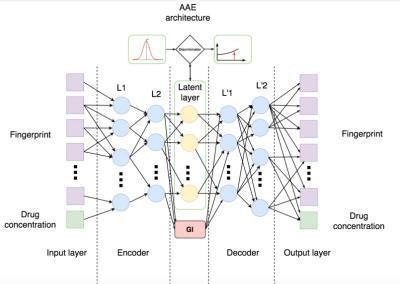
Scientists at the Pharmaceutical Artificial Intelligence (pharma.AI) group of Insilico Medicine, Inc, today announced the publication of a seminal paper demonstrating the application of generative adversarial autoencoders (AAEs) to generating new molecular fingerprints on demand.


:format(webp)/cdn0.vox-cdn.com/uploads/chorus_image/image/53446241/GettyImages_680790463.1488221646.jpg)