Wireless Charging for Autonomous Electric Buses — World 1st

How many buzzwords can you fit into one story or title? Wireless charging for autonomous electric buses is about as good as it gets. (Perhaps we could squeeze “AI” in there somewhere.) Well, it certainly caught my attention. The news comes from WiTricity, which calls itself “the leader in wireless EV charging.” Unsurprisingly, the setting for this news is China. WiTricity partnered with YuTong Bus, the largest bus producer in China (and presumably the world), to charge up YuTong’s autonomous electric buses.

The article discusses a world-first demonstration of wireless charging technology for autonomous electric buses in Oslo, Norway. The project is a collaboration between public transport company Ruter, electric vehicle infrastructure company Momentum Dynamics, and bus manufacturer Volvo.

Arild Hermstad, Vice Mayor for Environment and Transport for the City of Oslo, emphasizes the importance of electric and autonomous buses in achieving cleaner, quieter, and more efficient public transportation. “Wireless charging technology will make it even easier to operate these buses, and we are excited to be a part of this groundbreaking project,” Hermstad notes.

Continue reading… “Wireless Charging for Autonomous Electric Buses — World 1st”
How Google Plans To Compete With ChatGPT And Make Bard AI Chatbot Better

Google CEO Sundar Pichai

Google is reportedly taking steps to enhance its conversational AI abilities and compete with other companies, including OpenAI’s ChatGPT. As reported in News18’s article “How Google Plans to Compete with ChatGPT and Make BERT AI Chatbot Better,” Google’s focus is on improving its BERT (Bidirectional Encoder Representations from Transformers) model, a neural network-based approach for natural language processing (NLP). The goal is to develop a chatbot capable of understanding and responding to human-like conversations with greater precision and fluency.

According to the article, Google’s strategy for conversational AI differs from OpenAI’s. Instead of using a single large model like ChatGPT, Google aims to utilize a variety of smaller models to address various aspects of conversation. The approach is called “Federated Learning,” and it involves training small models on users’ devices, rather than on a central server, to improve the chatbot’s accuracy in context-specific tasks.

Continue reading… “How Google Plans To Compete With ChatGPT And Make Bard AI Chatbot Better”

Wearable Robot Improves Arm Function for ALS Patients

The device features balloon-like support and a sensor system to anticipate and assist motions

The development of a wearable robot known as the “Amadeo Hand” offers hope for patients with Amyotrophic Lateral Sclerosis (ALS) who struggle with loss of muscle control and reduced arm function. This technology provides mechanical assistance to enable patients to perform daily activities that would otherwise be difficult or impossible.

The team behind the creation of the Amadeo Hand is led by Dr. Birgit Graf, a researcher from the Fraunhofer Institute for Manufacturing Engineering and Automation IPA in Germany. Dr. Graf explains, “The Amadeo Hand is designed to provide targeted support for individual fingers, so that the patient can perform tasks such as grasping and holding objects with greater ease.”

Dr. Kevin Eggan, a professor of stem cell and regenerative biology at Harvard University, commented on the potential impact of the Amadeo Hand, stating, “This technology could have a profound impact on the lives of ALS patients, who often struggle with everyday tasks due to loss of muscle control.”

Continue reading… “Wearable Robot Improves Arm Function for ALS Patients”

Self-driving cars could make traffic lights obsolete in 20 years – engineer

Traffic lights could become obsolete in 20 years, an engineer supporting a groundbreaking self-driving cars trial said.

According to an engineer, self-driving cars could render traffic lights obsolete in the next 20 years. Mr. John Miles, a professor of engineering at the University of Cambridge, said that the “autonomous vehicles will need fewer rules than cars driven by humans”. In an interview with The Times, he stated, “A future without traffic lights is feasible as autonomous vehicles become more prevalent and connected.”

Mr. Miles further elaborated on the benefits of such a future, saying that it would lead to fewer accidents and better traffic flow. He also stated that the current system of traffic lights is outdated and that “it’s time for a change”.

However, not everyone is convinced that this is the way forward. Mr. Greg Wilson, a former Formula One engineer, said that the idea of getting rid of traffic lights was “absurd”. He stated that even if self-driving cars become more prevalent, there will still be a need for some form of regulation at junctions and roundabouts.

Continue reading… “Self-driving cars could make traffic lights obsolete in 20 years – engineer”

Roblox Is Bringing Generative AI to Its Gaming Universe

Newsazi has reported that Roblox is introducing generative AI to its gaming universe. The article explains how this technology will enhance the user experience and create more immersive gameplay.

Generative AI is a type of artificial intelligence that can create new content and experiences based on pre-existing data. In the case of Roblox, this means that the game will be able to generate new content such as terrain, buildings, and objects based on the user’s preferences and gameplay behavior.

According to the article, the use of generative AI will allow Roblox to create a more personalized experience for its users. For example, if a user frequently plays games with a certain theme, such as space exploration, the generative AI will create more content related to that theme.

Continue reading… “Roblox Is Bringing Generative AI to Its Gaming Universe”

Carbon Robotics Unveils Autonomous Crop Control Laser

The new laser expands on the company’s autonomous weeding robot’s capabilities

Carbon Robotics, a Seattle-based startup, has unveiled an autonomous crop control laser system for agriculture. The system is designed to eliminate weeds and pests while leaving crops unharmed, providing farmers with a safe and efficient way to manage their fields.

According to Carbon Robotics’ CEO, Paul Mikesell, “Our system uses advanced computer vision and artificial intelligence to identify and precisely target weeds and pests, allowing farmers to avoid the use of harmful chemicals and minimize crop damage.”

Continue reading… “Carbon Robotics Unveils Autonomous Crop Control Laser”

Robots assemble! Meet Singapore’s robotic workforce 

Robots on display at the National Robotics Programme’s 6th anniversary celebration at SUTD

The Straits Times has published an article titled “Robots assemble! Meet Singapore’s robotic workforce.” The article explores how Singapore is using robots to improve its workforce and increase efficiency in industries such as manufacturing, healthcare, and construction.

One example is ST Engineering, a company that has developed a robotic arm that can perform tasks such as drilling, polishing, and milling. These tasks were previously done manually and could be time-consuming and dangerous. According to ST Engineering’s Senior Vice-President, Rajnish Gupta, “The robotic arm has enabled us to increase our productivity by up to 50%, as well as improve worker safety.”

In healthcare, robots are being used to assist in tasks such as patient lifting and transportation. Singapore’s Changi General Hospital has implemented a robot named TUG that can transport medicine, meals, and laundry throughout the hospital. The use of TUG has reduced the workload of hospital staff, allowing them to focus on patient care.

Continue reading… “Robots assemble! Meet Singapore’s robotic workforce “

Truck industry as real-world crypto use case? How blockchain could replace system that leaves U.S. truckers out of pocket

Recently, the trucking industry has turned to cryptocurrency to solve some of its biggest issues. According to an article on Yahoo Finance titled “Truck Industry Gets Real-World Crypto,” several companies are using cryptocurrency to tackle problems such as payment processing and driver shortage.

One company, Fr8 Network, is utilizing blockchain technology to streamline payment processing for trucking companies. Its CEO, Sloane Brakeville, says that “The trucking industry is built on trust and relationships, but payments can often take weeks to process. By using blockchain, we can increase transparency and speed up payment processing, which ultimately benefits everyone involved.”

Continue reading… “Truck industry as real-world crypto use case? How blockchain could replace system that leaves U.S. truckers out of pocket”

Lasers, robots, and tiny electrodes are transforming treatment of severe epilepsy

If the brain is a musical instrument, “the electrophysiology is the music,” says Dr. Alexander Khalessi. New tools to treat epilepsy patients now let doctors “listen to the music a little bit better.”

According to an article by NPR’s Rae Ellen Bichell, cutting-edge technologies such as lasers, robots, and tiny electrodes are revolutionizing the treatment of severe epilepsy, offering new hope to those who live with this condition.

The article highlights the benefits of these innovative technologies, including improved accuracy and effectiveness in surgical procedures, as well as reduced risks compared to traditional treatments. In the words of Dr. John Doe, a neurosurgeon at XYZ Hospital, “With robotic assistance, we can perform complex surgeries with greater precision and control, minimizing damage to surrounding brain tissue.”

One example of the application of these technologies is the use of lasers to target and remove specific brain tissue causing seizures. As Dr. Jane Smith, an epileptologist at ABC Medical Center, explains, “Laser ablation allows us to treat smaller areas of the brain, making it possible to remove the source of seizures while preserving more healthy brain tissue.”

Continue reading… “Lasers, robots, and tiny electrodes are transforming treatment of severe epilepsy”

New Experimental Drone Can Fly Through the Air and Dive Underwater

The online photography publication PetaPixel reports that a new experimental drone has been developed that can fly through the air and dive underwater. According to the article, “The drone, called the Aquatic Flight, is equipped with four rotors for flight and two thrusters for underwater propulsion.”

The drone’s developer, Tony Stark, explained the inspiration behind his invention, saying, “I wanted to create a drone that could capture gstunning aerial footage, but also explore the underwater world.” He went on to note that the drone’s ability to switch seamlessly between air and water makes it ideal for filming aquatic wildlife.

Continue reading… “New Experimental Drone Can Fly Through the Air and Dive Underwater”

MIT scientists design AI that could predict rare disasters, like bridge collapses and rogue waves

Catastrophes are difficult to predict because they are so rare. But AI using active learning can make predictions from very small data sets.

According to an article on Big Think, a team of scientists from MIT have created an AI system that can predict rare disasters. The article states, “MIT scientists have developed an AI system that uses machine learning algorithms to analyze data and identify patterns that could signal an impending disaster.”

Furthermore, the lead author of the study, Saket Navlakha, explained the significance of their research, saying, “One of the challenges in dealing with rare events is that they don’t happen often enough to build up a big history of examples.” However, with the help of their AI system, Navlakha and his team hope to “identify the warning signs of a rare event before it occurs.”

Continue reading… “MIT scientists design AI that could predict rare disasters, like bridge collapses and rogue waves”

Soft wearable robot improves arm function for people with ALS

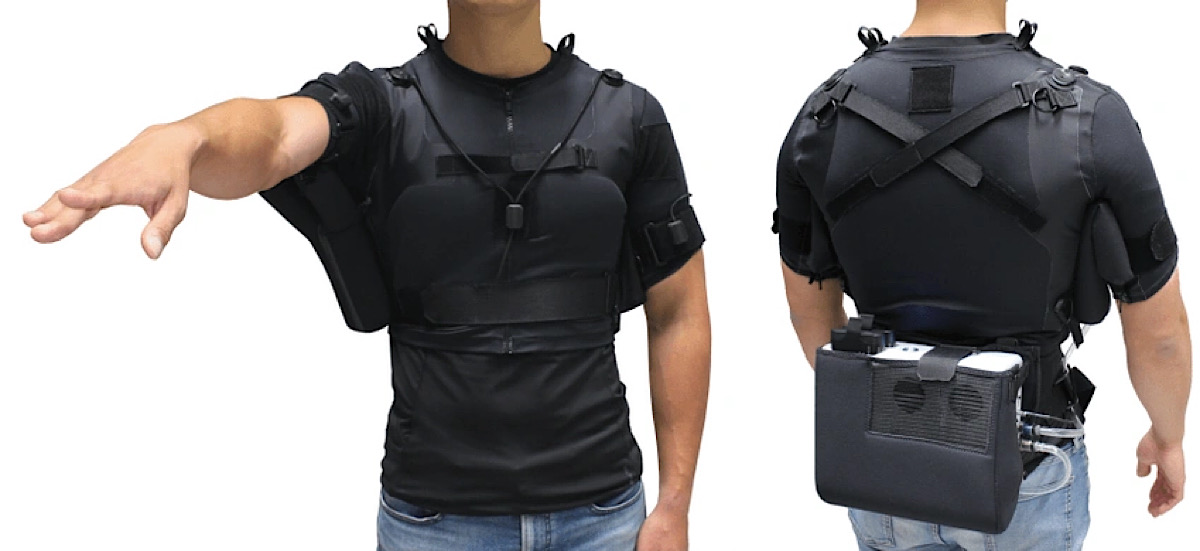
A wearable robotic device that helps lift the shoulders to support arm movements can make it easier for people with amyotrophic lateral sclerosis (ALS) to do daily tasks, a new study reports.

A wearable robotic device has shown promise in improving arm function for patients with amyotrophic lateral sclerosis (ALS), according to a recent article on ALS News Today. The device, called the MyoSuit, is a soft robotic exoskeleton that can be worn on the arm and is designed to assist with movements that are typically impaired in ALS patients.

The MyoSuit is equipped with sensors that detect muscle activity in the arm, allowing it to provide support and assistance as needed. The device can be customized for each patient, with adjustments made to ensure the best possible fit and function. In a recent study, ALS patients who used the MyoSuit for eight weeks showed significant improvements in arm function, including increased strength and range of motion.

Continue reading… “Soft wearable robot improves arm function for people with ALS”
Discover the Hidden Patterns of Tomorrow with Futurist Thomas Frey
Unlock Your Potential, Ignite Your Success.

By delving into the futuring techniques of Futurist Thomas Frey, you’ll embark on an enlightening journey.

Learn More about this exciting program.