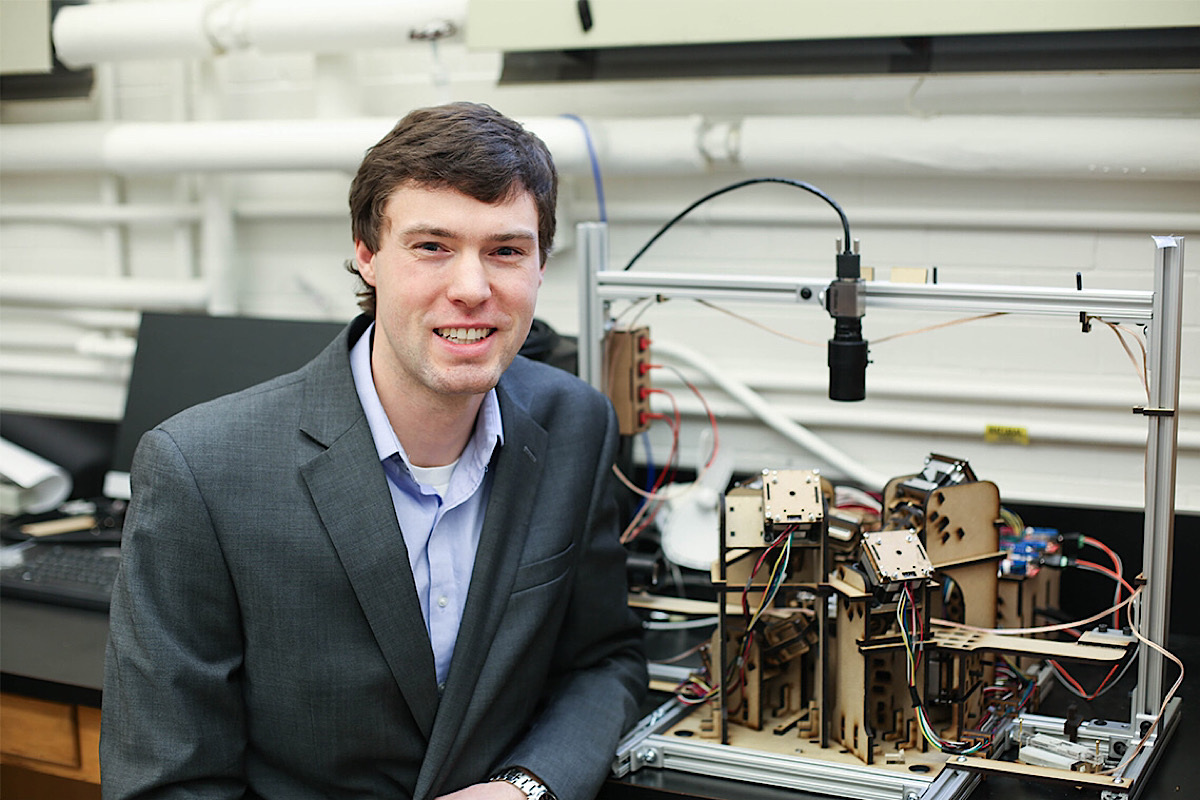
Eric Diller of U of T’s Faculty of Applied Science & Engineering is collaborating with medical researchers to develop dexterous, magnetically controlled microrobots that could perform minimally invasive brain surgery on children
Researchers at the University of Toronto are developing microrobots, precisely controlled by magnetic fields, that could one day be used to perform minimally invasive brain surgery on children.
The research team – co-led by Eric Diller, an associate professor of mechanical engineering in the Faculty of Applied Science & Engineering, and James Drake, a professor in the department of surgery in the Temerty Faculty of Medicine and a pediatric neurosurgeon at the Hospital for Sick Children (SickKids) – says the technology represents a departure from the rigid, wired designs of most micro-surgical tools.
“Advancing surgery through an endoscope in the pediatric brain requires miniaturized versatile tools which can be precisely controlled,” says Drake. “This novel concept of using tiny, magnetized tools, controlled by robotic external magnets, shows great promise in addressing this need for both pediatric and adult patients.”
Each year 24,000 malignant brain tumours are detected in the United States. These tumours are the most common form of solid cancer in children, and surgery to remove the tumour is often the first recommended course of treatment. The surgeries can be highly invasive with a long recovery process. In some cases, when surgery via endoscope is possible, the tools may not be small or dexterous enough to perform the treatment.
Continue reading… “U of T researchers develop microrobots to conduct minimally invasive brain surgery”