Cosmic comms: How the first humans on Mars will communicate with Earth

By Georgina Torbet

If you think it’s a pain to get cell reception when you visit your relatives in another state, just imagine trying to communicate with people who are at least 40 million miles away and are constantly moving relative to you. That’s what we’ll have to deal with if we plan to send humans to Mars, when communications won’t just be important – they’ll be vital.

To find out how to create a communications network that covers Mars and beyond, and how current systems are being upgraded to meet the challenge of ever-increasing amounts of data, we spoke to two experts who work on NASA’s current communications system – one on the Earth side and one on the Mars side.

This article is part of Life On Mars, a 10-part series that explores the cutting-edge science and technology that will allow humans to occupy Mars

Continue reading… “Cosmic comms: How the first humans on Mars will communicate with Earth”

China’s digital currency adds support for AliPay – the Alibaba payment app with over 700 million users

And just like that, the Digital Yuan has its route into the mainstream

Simon Sharwood, APAC Editor

Alibaba’s controversial financial services arm, the Ant Group, has been welcomed into trials of China’s digital currency.

China’s state-controlled media on Monday reported that the Alipay app has added a feature allowing transactions in the Digital Yuan. Alipay has over 700 million monthly active users in China alone.

State-backed journal China Securities Journal reports that functionality to link to a bank is currently limited, and that no merchants are listed. Nor has the feature been made available to all users. But the Journal reports that real-time, anonymous, transactions are possible.

A second Journal piece reports that an Ant-Group-backed bank has also linked accounts to the Digital Yuan, as have some other banks.

Continue reading… “China’s digital currency adds support for AliPay – the Alibaba payment app with over 700 million users”

World’s First Electric Seaglider Will Cruise the Seas at 180 MPH

By Cristina Mircea

Regent plans to take the seas by storm and revolutionize maritime transportation with a new concept of electric vehicle that’s part aircraft, part boat.

The Seaglider is Regent’s new project that promises to combine the technology, speed, and comfort of an aircraft with the convenience and affordability of a boat, as stated in a recent press release (attached below the article). This hybrid vehicle will be an all-electric flying machine capable of reaching speeds of 180 mph (approximately 290 kph). It will be suitable for both passenger transportation and cargo.

The Seaglider will use the wing-in-ground effect and fly at low altitudes, staying within one wingspan of the surface of the water. It will have double the range of an electric aircraft, promising to cover 180 miles (290 km) at the aforementioned speed, with the existing battery technology. But Regent hopes routes will extend to up to 500 miles (805 km), with next-gen batteries.

Also, with the Seaglider being fully electric, it means it will also be a clean, zero-emissions vehicle.

Continue reading… “World’s First Electric Seaglider Will Cruise the Seas at 180 MPH”

Researchers Have Developed A Way To Wirelessly Charge Vehicles On The Road

By Lawrence Hodge

One of the barriers to EVs right now is the hassle of charging. In fact, one fifth of all EV buyers go back to gas vehicles, mainly because of charging issues.But charging infrastructure and technology keep getting better. 

According to Business Insider, researchers at Cornell University, led by Associate Professor of Electrical and Computer Engineering Khurram Afridi, have developed technology that would allow vehicles to be charged on the road while in motion. It would essentially turn U.S. roadways into wireless chargers. 

Afrindi says he has been working on the tech for the last seven years. Here’s how it would work, according to Afrindi via Insider: 

Continue reading… “Researchers Have Developed A Way To Wirelessly Charge Vehicles On The Road”

Why we need to colonize Mars as soon as possible

It’s our best chance to save the human race

STORY BY The Cosmic Companion

Exploring the wonders of the Cosmos, one mystery at a time.

Exploring other worlds and moving humans onto the Moon and Mars may seem foolish in light of the significant challenges we face as a species. On the surface, it might seem superfluous to bring humans to the Moon and start living on Mars, while hunger, disease, and poverty affect billions of people worldwide.

This feeds a dangerous trend, however — an anti-scientific backlash against space exploration. Some memes traveling the interwebs call for ending the exploration of other worlds, in order to “fix Earth,” or “plant trees.”

These are noble goals, vital to the survival of life (human and otherwise — let’s not forget cats). However, these significant, even existential, challenges (global warming, I’m looking in your direction) must be met with the best, most powerful tool humankind has ever devised to overcome obstacles — science.

Continue reading… “Why we need to colonize Mars as soon as possible”

Drone mass production is taking off with 3D printing

How Skydio, Digital Aerolus, Quantum Systems, Kespry and Dive Technologies are printing hundreds of parts

 By Davide Sher

Personal and unmanned mobility is rapidly changing as drones bring us closer and closer to humanity’s long-standing vision of flying cars.

Amolak Badesha, CEO of Orbital Composites, a specialist in large-scale composites additive manufacturing, once pointed out to 3dpbm that this new generation of mobility products will not be able to exist without composites enabling the production of extremely light parts. And mass manufacturing with composites materials cannot truly exist without 3D printing.

The same is true for more short-term products, such as unmanned drones for consumer and commercial use, both in the sky and under the sea: drone mass production via AM is coming.

Continue reading… “Drone mass production is taking off with 3D printing”

Israelis to get smart manicures from robots that combine 3D imaging and AI

BY AYUB DAWOOD

Getting an appointment, waiting for your turn and then going through a time consuming process makes manicure a hassle for people across the globe. But in an age when technology has accelerated the pace of all daily tasks, taking care of yourself shouldn’t be such a painstaking procedure.

Hospitality chains in the UAE have launched apps to book spa treatments while ensuring contactless service, and now friendly robots have also been rolled out to provide care for people at home. In the post-pandemic era when visits to the salon won’t be the same for a while, an Israeli startup has created a gadget that performs manicures at the push of a button.

Continue reading… “Israelis to get smart manicures from robots that combine 3D imaging and AI”

Self-driving truck startup Plus to go public through $3.3 billion SPAC deal

(Reuters) -Plus said on Monday it would go public through a merger with blank-check company Hennessy Capital Investment Corp. V in a deal that values the self-driving truck technology startup at $3.3 billion.

The combined company will get proceeds of $500 million from the deal, including a private investment of $150 million. Investors in the deal include BlackRock and D.E. Shaw group, among others.

In February, Plus raised $200 million in a funding round, co-led by brokerage Guotai Junan International and private equity firm CPE, according to data from Pitchbook.

Continue reading… “Self-driving truck startup Plus to go public through $3.3 billion SPAC deal”

Researchers develop artificial intelligence that can detect sarcasm in social media

by University of Central Florida

Computer science researchers at the University of Central Florida have developed a sarcasm detector.

Social media has become a dominant form of communication for individuals, and for companies looking to market and sell their products and services. Properly understanding and responding to customer feedback on Twitter, Facebook and other social media platforms is critical for success, but it is incredibly labor intensive.

That’s where sentiment analysis comes in. The term refers to the automated process of identifying the emotion—either positive, negative or neutral—associated with text. While artificial intelligence refers to logical data analysis and response, sentiment analysis is akin to correctly identifying emotional communication. A UCF team developed a technique that accurately detects sarcasm in social media text.

The team’s findings were recently published in the journal Entropy.

Continue reading… “Researchers develop artificial intelligence that can detect sarcasm in social media”

UK postal service tests autonomous drone deliveries to remote islands

The drones will be used to carry COVID testing kits and assorted mail. 

By S. Shah

It’s not just online and big-box retailers that are exploring deliveries by drone. Following in the footsteps of the Swiss Post, the UK’s Royal Mail is the latest postal service to trial drone flights. The company has announced a landmark project to deliver packages — including personal protective equipment, COVID testing kits and assorted mail — to a UK island using an autonomous Uncrewed Aerial Vehicle (UAV). 

As part of the government-backed project, a large drone will take off from the mainland and fly to the Scilly Isles (a remote archipelago off the Cornish coast in southwest England). The twin-engine UAV can carry up to 100kg of mail of all shapes and sizes, which the Royal Mail said is equivalent to a typical delivery round. Thereafter, a smaller vertical take-off and landing drone will be used to fly parcels between the islands to recipients.

Continue reading… “UK postal service tests autonomous drone deliveries to remote islands”

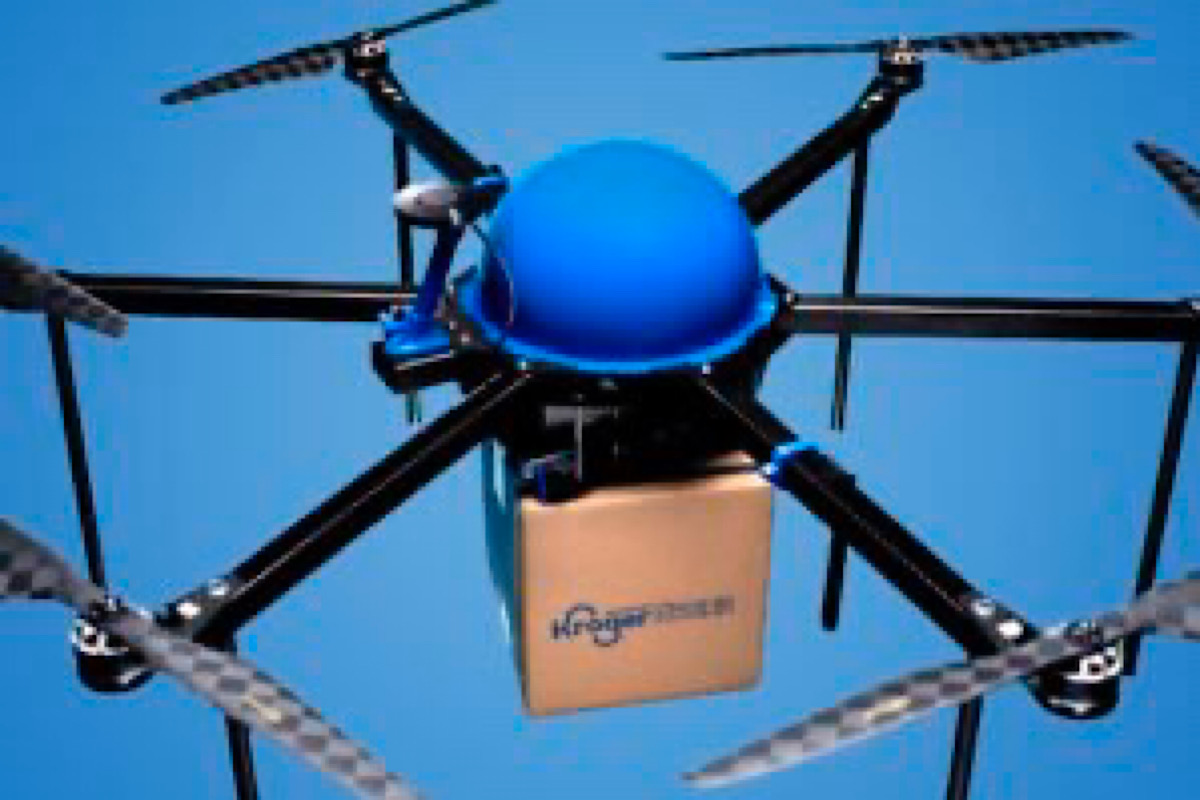
Kroger, Drone Express Begin New Drone Grocery Delivery Program

Posted By: Miriam McNabb

Drone Express and Kroger begin testing drone grocery delivery in a pilot program – part of the retailer’s goal of providing customers with “anything, anytime, anywhere,” says a company press release.

The Kroger Co. (NYSE: KR) and Drone Express, a division of TELEGRID Technologies, Inc., will offer package delivery near the Kroger Marketplace in Centerville, Ohio.

“Kroger’s new drone delivery pilot is part of the evolution of our rapidly growing and innovative e-commerce business – which includes pickup, delivery, and ship and reached more than $10 billion in sales in 2020,” said Kroger’s Jody Kalmbach, group vice president of product experience. “The pilot reinforces the importance of flexibility and immediacy to customers, powered by modern, cost-effective, and efficient last-mile solutions. We’re excited to test drone delivery and gain insights that will inform expansion plans as well as future customer solutions.”

Continue reading… “Kroger, Drone Express Begin New Drone Grocery Delivery Program”

Chinese unicorn’s robot waiters ready to serve the world

Workers assemble robots at a Keenon factory in Jiaxing, Zhejiang Province.

By SHIN WATANABE, Nikkei staff writer

Keenon to have bases in 10 overseas markets this year.

SHANGHAI — As the pandemic propels restaurants and other businesses to keep their distance from customers, Shanghai-based Keenon Robotics looks to bring its automated helpers to markets across the globe.

At a Zui Hui Huang Chinese restaurant chain location here, Keenon’s robotic servers wait by the kitchen for meals to come out. Staffers load them up and tell them which tables to go to via touchscreen. Then they roll off, deftly avoiding obstacles in their way.

Built-in obstacle sensors are a major selling point of the robots. “They have an easier time carrying heavy things and can help ease labor shortages,” a representative of the restaurant chain said.

Keenon aims to have local units set up in at least 10 countries by the end of 2021. It opened a Japan arm in March with just under 10 staffers and is looking at South Korea and Singapore, as well as markets in Europe, North America and the Middle East.

Production capacity was roughly doubled in 2020 to prepare for overseas expansion. “Our factories all have extra space, and we can increase capacity to up to 200,000 units,” said Chi Xiaomin, who heads Keenon’s public relations — about triple current levels.

Continue reading… “Chinese unicorn’s robot waiters ready to serve the world”