Amazon is using self-driving trucks developed by Embark to haul some cargo on the I-10 interstate highway, CNBC has learned.
CNBC has learned that Amazon is hauling some cargo in self-driving trucks from Embark.
Embark and other firms working on autonomous systems aim to alleviate industry pains by making existing truck drivers safer and more efficient.
The trucks were previously noticed by a Reddit user, who photographed and shared images this week showing tractors emblazoned with the Embark logo and trailers painted with the Amazon Prime logo.
It seems clear that driverless vehicles are coming, although the timeline for their arrival remains unclear. David Beede, Regina Powers and Cassandra Ingram of the Economics and Statistics Administration at the US Department of Commerce look at one aspect, “The Employment Impact of Autonomous Vehicles,” in ESA Issue Brief #05-17 (August 11, 2017). They set the stage this way:
“In September 2016, the U.S. Department of Transportation and the National Highway Traffic Safety Administration (NHTSA) published policy guidelines for AVs [autonomous vehicles], recognizing their potential as “the greatest personal transportation revolution since the popularization of the personal automobile nearly a century ago” (NHTSA 2016). … The worldwide number of advanced driver-assistance systems (ADAS), such as backup cameras and adaptive cruise control, increased from 90 million to 140 million units between 2014 and 2016. Consumers have indicated a willingness to pay $500-$2,500 per vehicle for ADAS. Sensor technologies are rapidly advancing to provide sophisticated information to vehicle operating systems about the surrounding environment, such as road conditions and the location of other nearby vehicles. However, slower progress has been made in developing software that can mimic human driver decision-making, so that fully autonomous vehicles may not be introduced for another ten or more years …”
Cars without steering wheels will be allowed under certain conditions, the U.S. National Highway Traffic Safety Administration (NHTSA) said today in an 80-page report.
The report gives guidelines, which are voluntary. Precise rules, which are binding, have yet to be spelled out. But the policy clearly is to cut rules whenever possible while reserving the right to tighten regulation if problems should emerge. “When regulation is needed, USDOT [U.S. Department of Transportation] will seek rules that are as non-prescriptive and performance-based as possible,” the report says.
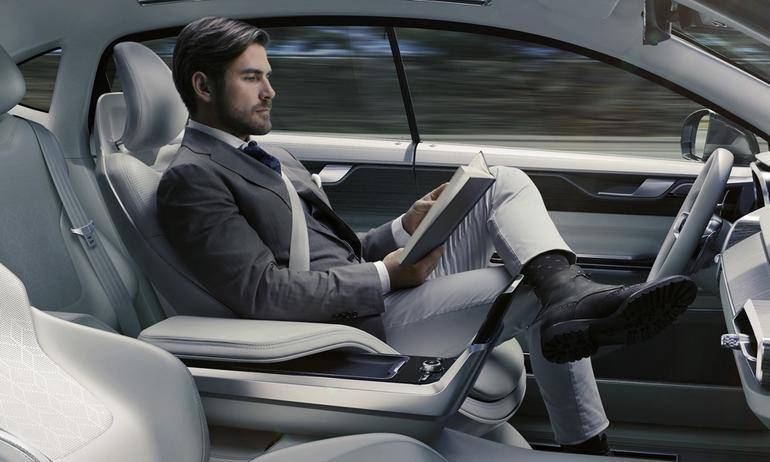
When you think about the amount of time we spend behind the wheel today, whether in congestion or helping friends and family getting to and forth, being able to spend this time on other activities whilst on the move opens up a whole host of possibilities.
But not only will we have more free time, driverless cars also promise to make our roads safer and make our journeys faster.
Driverless cars are set to arrive on UK roads by 2021 according to the government and are predicted to change the face of personal mobility forever. Looking past the obvious benefits, Select Car Leasing have looked into the less predictable consequences of driverless cars.
A self-driving vehicle made by Uber has struck and killed a pedestrian. It’s the first such incident and will certainly be scrutinized like no other autonomous vehicle interaction in the past. But on the face of it it’s hard to understand how, short of a total system failure, this could happen, when the entire car has essentially been designed around preventing exactly this situation from occurring.
Driverless vehicle use worldwide could lower traffic congestion and emissions contributing to climate change by 50 percent or more in 2050, according to a 2017 report led by global transport expert Lewis Fulton at the Institute of Transportation Studies at UC Davis (ITS-Davis).
All machines eventually break down. Self-driving vehicles are no exception.
Autonomous vehicles pose two problems for the future of vehicles. The removal of the driver means there is no person providing feedback on how the vehicle performs over time. You are removing the point-person who says “something feels wrong, this needs to be checked out.” An autonomous truck could easily arrive at its destination with one fewer wheels than it left with at its origin without recognizing there is a problem.
Tesla and SpaceX CEO Elon Musk may think flying cars are a bad idea, but several companies are working to make them a reality as early as next year.The vehicles these companies are working on aren’t the same from flying cars from “Back to the Future.” Rather, they are pursuing electric, vertical take-off and landing (VTOL) aircraft for shorter urban commutes.
Like the name suggests, these are vehicles that can take off without needing a runway.
Competition is mounting when it comes to the flying-car moonshot — here are 7 companies working on their own VTOL aircrafts:
Over the last decade, the stock price of Domino’s Pizza has crushed that of Apple, Google, Amazon, and Facebook mainly because it stopped making pizza that tasted like cardboard. Now it’s innovating on the labor front with plans to test robots as substitutes for your friendly pizza delivery guy. “With our growth plans over the next five to 10 years, we simply won’t have enough delivery drivers if we do not look to add to our fleet through initiatives such as this,” Domino’s chief executive said in a statement announcing the pilot program.
Right now, you can head over to a local Volvo dealership and test drive a 2017 Volvo S90. With the push of a button, drivers can watch the car take over steering to stay within a lane, slow itself down in rush-hour traffic and accelerate — up to 80 mph — on the highway. It’s the first Volvo to include the second-generation Pilot Assist as a standard feature.
But, even equipped with radar and a 360-degree camera that can distinguish humans from deer, bicyclists and other cars, the $47,000 S90 sedan is not an autonomous vehicle. A driver must be in the seat and frequently touch the steering wheel. Otherwise, the car slows down.