Over 13% of the homes in Japan are abandoned

2BA14C10-B458-46A5-BDB0-FA6AC99ABF19

Japan’s population is shrinking. Last year it fell by nearly 450,000 people. Not since records began in 1899 had so few babies been born (921,000). Before that, 2017 had also set a record. Meanwhile the number of people passing away last year set a post-war record. The figures are part of a larger pattern in which births have declined and deaths increased steadily for decades.

Less noticed is another alarming figure that’s been growing. According to the latest government statistics, the number of abandoned homes in Japan reached a record high of 8.5 million as of Oct. 1, 2018, up by 260,000 from five years earlier. As a proportion of total housing stock, abandoned homes reached 13.6%.

Continue reading… “Over 13% of the homes in Japan are abandoned”

Forget about artificial intelligence, extended intelligence is the future

FE33F7FE-6054-4FD4-AE64-E122EBAD8E84

Last year, I participated in a discussion of The Human Use of Human Beings, Norbert Weiner’s groundbreaking book on cybernetics theory. Out of that grew what I now consider a manifesto against the growing singularity movement, which posits that artificial intelligence, or AI, will supersede and eventually displace us humans.

The notion of singularity – which includes the idea that AI will supercede humans with its exponential growth, making everything we humans have done and will do insignificant – is a religion created mostly by people who have designed and successfully deployed computation to solve problems previously considered impossibly complex for machines.

Continue reading… “Forget about artificial intelligence, extended intelligence is the future”

Walmart unveils an AI-powered store of the future, now open to the public

76866275-F43F-4FDC-B42F-FBAC9003ACE4

Walmart this morning unveiled a new “store of the future” and test grounds for emerging technologies, including AI-enabled cameras and interactive displays. The store, a working concept called the Intelligent Retail Lab — or “IRL” for short — operates out of a Walmart Neighborhood Market in Levittown, N.Y.

The store is open to customers and is one of Walmart’s busiest Neighborhood Market stores, containing more than 30,000 items, the retailer says, which allows it to test out technology in a real-world environment.

Similar to Amazon Go’s convenience stores, the store has a suite of cameras mounted in the ceiling. But unlike Amazon Go, which is a grab-and-go store with smaller square footage, Walmart’s IRL spans 50,000 square feet of retail space and is staffed by more than 100 employees.

Continue reading… “Walmart unveils an AI-powered store of the future, now open to the public”

Expert warns against forming emotional attachments with robots


78A09DED-BA57-4601-AEB9-53C30DD3EC84

 Faking It

No matter how cute present-day robots are designed to look, no matter how smiley their virtual faces and chipper their beeps and boops, they will never love you back.

The stories of people mourning robots like Jibo, a smart home assistant that announced its own “death” when its servers were scheduled to get shut down last month, are heartwarming. But they also reveal a way, according to the Associated Press, that marketers could exploit the emotions of people — especially kids — by programming robots to seem more emotionally savvy than they really are.

Continue reading… “Expert warns against forming emotional attachments with robots”

A 23-year excavation into the life of Leonardo da Vinci

115EB7C8-9EEA-4F96-AD47-B1DE94F8EACB

Met curator Carmen Bambach reveals what she has learned about the world’s most famous Renaissance man.

Carmen Bambach, curator in the Department of Drawings and Prints at the Metropolitan Museum of Art in New York, spent 23 years studying the life and work of Leonardo da Vinci. The culmination of her research, a 2,200-page, four-volume book, Leonardo da Vinci Rediscovered, will be published by Yale University Press this summer.

Continue reading… “A 23-year excavation into the life of Leonardo da Vinci”

Amazon’s system for tracking its warehouse workers can automatically fire them

 B3A74600-B5EC-4670-B965-50C14032284E

A world where people are monitored and supervised by machines isn’t confined to the realms of sci-fi. It’s here now.

Tough conditions: There have been many reports over recent years about unpleasant conditions workers face at Amazon warehouses. Employees are under pressure to pack hundreds of boxes per hour, and face being fired if they aren’t fast enough.

What’s new: Documents obtained by The Verge show that it’s far more common for people to be fired due to lack of productivity than outsiders realize. Roughly 300 people were fired at a single facility between August 2017 and September 2018 for that reason. And crucially, the documents show that much of the firing process is automated.

Continue reading… “Amazon’s system for tracking its warehouse workers can automatically fire them”

Chinese brands rule Indian smartphone market with 66% share: Report

B7F4EFF3-447D-4B6A-A7B9-6F170B819BEA

Xiaomi’s India shipments fell by 2% over last year, but the Beijing-based company was still the biggest smartphone brand in the country, followed by Samsung Electronics

Chinese brands rule Indian smartphone market with 66% share: Report Chinese brands controlled a record 66% of Indian smartphone market in the first quarter, led by Xiaomi, a report showed, with volumes rising 20% on the back of popularity for brands like Vivo, RealMe and Oppo.

Xiaomi’s India shipments fell by 2% over last year, but the Beijing-based company was still the biggest smartphone brand in the country, followed by Samsung Electronics, according to Hong-Kong based Counterpoint Research.

Continue reading… “Chinese brands rule Indian smartphone market with 66% share: Report”

Just 10% of U.S. plastic gets recycled. A new kind of plastic could change that

89F472F1-9BE3-412C-9CCF-90C8C2397644

Most plastics have a chemical history that makes starting a new life a challenge. The dyes and flame retardants that make them perfect for say, a couch cushion or a bottle of detergent, make them tough to transform into a desirable end product—one of the reasons just 10% of plastic in the United States gets recycled. Now, researchers have created a plastic with a special chemical bond that helps it separate out from those additives, turning it back into a pure, valuable product that can be reused again and again.

To make the new material, researchers tweaked a type of vitrimer, a glasslike plastic developed in 2011, by adding molecules that change the chemical bonds holding it together. These new bonds, called dynamic covalent diketoenamine bonds, require less energy to break than those in traditional plastics.

Continue reading… “Just 10% of U.S. plastic gets recycled. A new kind of plastic could change that”

Waymo picks Detroit factory for self-driving fleet, to be operational by mid-2019

2C1818AF-E393-412E-A36A-D679054226BDWaymo CEO John Krafcik speaks on stage during the annual Google I/O developers conference in Mountain View, California, May 8, 2018. REUTERS/Stephen Lam

SAN FRANCISCO (Reuters) – Alphabet Inc’s Waymo said on Tuesday it had chosen a factory in Detroit to mass produce self-driving cars, looking to the historical heart of the auto industry to build the vehicles of the future.

The company’s chief executive, John Krafcik, said in a blog post that Waymo would partner with American Axle & Manufacturing to lease and repurpose an existing Detroit facility that will be operational by mid-2019.

Waymo said in January it had chosen Michigan for its first production facility, adding it would receive incentives from the public-private partnership agency, the Michigan Economic Development Corporation, and create up to 400 jobs over time exclusively related to self driving.

Continue reading… “Waymo picks Detroit factory for self-driving fleet, to be operational by mid-2019”

Breakthrough research to revolutionize internet communication

6A8628CD-B425-4A80-9EC8-A59409408194

Breakthrough research to revolutionize internet communication

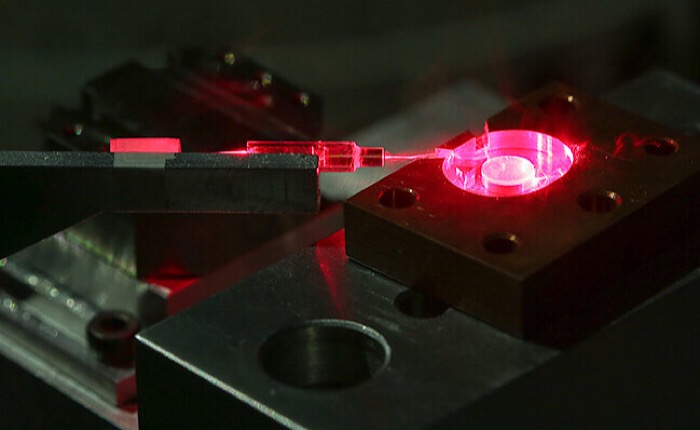
A team of University of Otago/Dodd-Walls Centre scientists have created a novel device that could enable the next generation of faster, more energy efficient internet. Their breakthrough results have been published in the world’s premiere scientific journal Nature this morning.

The internet is one of the single biggest consumers of power in the world. With data capacity expected to double every year and the physical infrastructure used to encode and process data reaching its limits, there is huge pressure to find new solutions to increase the speed and capacity of the internet.

Principal Investigator Dr. Harald Schwefel and Dr. Madhuri Kumari’s research has found an answer. They have created a device called a microresonator optical frequency comb made out of a tiny disc of crystal. The device transforms a single color of laser light into a rainbow of 160 different frequencies – each beam totally in sync with each other and perfectly stable. One such device could replace hundreds of power-consuming lasers currently used to encode and send data around the world.

Continue reading… “Breakthrough research to revolutionize internet communication”

Advance in CAR T-cell therapy eliminates severe side effects

9462BBC5-4F9E-44BE-8060-D2F28918C5AAScanning electron micrograph of a human T lymphocyte (also called a T cell) from the immune system of a healthy donor. Credit: NIAID

An advance in the breakthrough cancer treatment known as CAR T-cell therapy appears to eliminate its severe side effects, making the treatment safer and potentially available in outpatient settings, a new USC study shows.

“This is a major improvement,” said Si-Yi Chen of the USC Norris Comprehensive Cancer Center, professor in the Department of Molecular Microbiology and Immunology at the Keck School of Medicine of USC, and senior author of the study appearing online April 22 in Nature Medicine. “We’ve made a new CAR molecule that’s just as efficient at killing cancer cells, but it works more slowly and with less toxicity.”

Continue reading… “Advance in CAR T-cell therapy eliminates severe side effects”

Sweden is building a road that recharges electric buses that drive over it

2B659B87-413B-4001-BE60-02C8DA483589

One of the biggest hassles for electric car owners is having to charge them. To get around the problem of needing to provide myriad electric charging stations, the Swedish transport administration is exploring the idea of having special roads which charge vehicles’ batteries as they drive over them.

To showcase the concept, the Smart Road Gotland consortium will be building an initial 1 mile stretch of road between the town of Visby and the airport on Gotland Island in Sweden. The road will be used to charge an electric truck and bus, using technology developed by the company Electreon, which will be carrying out construction. The majority of the $12.5 million project is funded by the Swedish government.

Continue reading… “Sweden is building a road that recharges electric buses that drive over it”

Discover the Hidden Patterns of Tomorrow with Futurist Thomas Frey
Unlock Your Potential, Ignite Your Success.

By delving into the futuring techniques of Futurist Thomas Frey, you’ll embark on an enlightening journey.

Learn More about this exciting program.