The AI Business Multiplication Question: Can Machines Change the Math?

By Futurist Thomas Frey

The Impossible Math Meets the Possible Machine

Here’s a thought experiment that sounds absurd until you realize technology might have changed the equation: Could someone condition themselves to start one new business every single day for the rest of their life?

Not as a metaphor. Actually launch a business—entity formation, operational setup, market positioning—every twenty-four hours, indefinitely.

The math on human-operated businesses is brutal. Richard Branson has launched roughly 400 companies over fifty years. That’s eight per year. One business per day would require operating at 45 times that pace. The constraints are biological: attention dilutes beyond three to five simultaneous ventures, cognitive load becomes catastrophic, capital scales linearly, and time remains finite. A human entrepreneur simply cannot operate 365 businesses effectively, let alone 10,000 over a lifetime.

But here’s where the question gets interesting: What if you weren’t running the businesses yourself? What if AI agents were?

We’re now entering an era where AI agents can operate certain types of businesses with minimal human oversight. The question shifts from human capacity to system design. Could someone using AI realistically create one autonomous business per day, indefinitely?

The answer depends entirely on what kind of business we’re talking about. And more importantly, what we mean by “business.”

Continue reading… “The AI Business Multiplication Question: Can Machines Change the Math?”

The Awakening Series Part 2: Graft and Corruption—When the Small Stuff Adds Up to Everything

By Futurist Thomas Frey

When most people think of corruption, they picture dramatic scenes: briefcases full of cash, secret offshore accounts, conspiracies hatched in smoke-filled rooms. But the corruption that’s about to be exposed by AI isn’t primarily the Hollywood version. It’s far more mundane, far more pervasive, and in aggregate, far more costly.

It’s the systematic gaming of systems that nobody was watching closely enough. And AI is about to watch everything.

Continue reading… “The Awakening Series Part 2: Graft and Corruption—When the Small Stuff Adds Up to Everything”

The Awakening Series: When AI Becomes the Ultimate Auditor

By Futurist Thomas Frey

We’re entering what historians will likely call “The Awakening”—a period when artificial intelligence doesn’t just automate tasks, but systematically reveals inefficiencies, inequities, and outright fraud that have been hiding in plain sight for decades.

This isn’t about technology replacing jobs. It’s about technology revealing truth.

For generations, certain industries have operated behind walls of complexity so dense that even insiders couldn’t see the full picture. Healthcare billing codes so Byzantine that no human could track them all. Defense contracts so layered with subcontractors that accountability disappears. Educational credentialing systems so opaque that their actual value remains unmeasurable. Financial services so deliberately complicated that “nobody really understands how it works” became an acceptable answer.

AI doesn’t get tired of looking. It doesn’t accept “that’s just how it’s always been done.” It doesn’t have a career to protect or relationships to preserve. It simply processes patterns, identifies anomalies, and generates reports that can’t be ignored.

Continue reading… “The Awakening Series: When AI Becomes the Ultimate Auditor”

Social Anchors: What Will Draw Us Together in the Age of Automation

By Futurist Thomas Frey

We stand at a peculiar threshold. As artificial intelligence, robotics, and automation reshape the employment landscape, forcing millions into career transitions, a counterintuitive truth emerges: our hunger for human connection will only intensify. The question isn’t whether people will venture out—they will. The question is: what will draw them out?

The experiences that thrive in the next decade won’t simply survive automation; they’ll offer something automation fundamentally cannot replicate. They’ll serve as social anchors in turbulent times, providing the very things that make us human: connection, spontaneity, and the irreplaceable texture of being physically present with others.

Continue reading… “Social Anchors: What Will Draw Us Together in the Age of Automation”

Watching our Systems Unravel: Why Our Institutions Can’t Keep Pace with Machine-Speed Innovation

By Futurist Thomas Frey

We’re witnessing something unprecedented in human history—not just technological disruption, but a fundamental mismatch in operating speeds between the systems that govern us and the systems that are replacing them.

The institutions we depend on—government agencies, universities, healthcare systems, regulatory bodies—were architected for a world where change arrived in decades, not days. That world has vanished. And the collision between old-world infrastructure running at human speed and new-world systems operating at machine speed represents the defining challenge of our era.

Continue reading… “Watching our Systems Unravel: Why Our Institutions Can’t Keep Pace with Machine-Speed Innovation”

Data Wars Update: Why the Battle for Training Data Became a Battle for Civilization

By Futurist Thomas Frey

The War That Changed Its Objective Mid-Battle

In 2023, I wrote about the coming data wars—a looming conflict where nations and corporations would battle for novel data sources to train increasingly powerful AI systems. I envisioned spy agencies competing for quantum fluctuation data, microbiome sequences, dream interpretation streams, and atmospheric electromagnetic readings. The victor in this data arms race would hold decisive strategic advantage through AI supremacy.

Two years later, the data wars are absolutely happening. But they’ve evolved into something far more profound than a competition for exotic datasets. Those novel data sources I predicted may still arrive—quantum sensors, neural dust, smart fabric readings—but they’ve been eclipsed by a more fundamental question that nobody saw coming.

The data wars aren’t really about data anymore. They’re about whose culture, whose morality, whose language, and whose values become embedded in the AI systems that will mediate human experience for generations to come. This isn’t a competition with a finish line—it’s a forever battle for the soul of machine intelligence.

Continue reading… “Data Wars Update: Why the Battle for Training Data Became a Battle for Civilization”

Silent Speech: The Wearable That Types Your Thoughts Arrives This Summer

By Futurist Thomas Frey

The Question That Changes Everything About Communication

What if you could compose emails, send messages, control your home, and communicate complex ideas without speaking a single word—or even moving your hands?

That’s not distant future speculation. It’s summer 2026. And the technology enabling it costs less than a pair of headphones.

Non-invasive brain-computer interfaces—comfortable wristbands and lightweight headbands reading your neural signals through EEG sensors—are moving from research laboratories to consumer products this year. They translate your thoughts into text, voice commands, and device controls with 80% accuracy for basic commands. No implants. No surgery. No needles piercing your skull. Just wear the device, think the command, and watch it execute.

“Turn on the lights.” Email drafted. Avatar controlled. All accomplished silently, internally, without your vocal cords vibrating or your fingers touching a keyboard.

Let me walk you through why this represents fundamental transformation in human-computer interaction, what becomes possible when thought directly controls technology, and why most people have no idea this capability is months away from mass market availability.

Continue reading… “Silent Speech: The Wearable That Types Your Thoughts Arrives This Summer”

Atlas Stands Up: The Moment Humanoid Robots Stop Being Research and Start Being Real

By Futurist Thomas Frey

The Performance Nobody Expected to See

For the first time ever, a major robotics company did something unthinkable: they demonstrated a humanoid robot live, in public, without editing, without safety nets, where failure would be witnessed by hundreds of industry analysts and instantly amplified across global media.

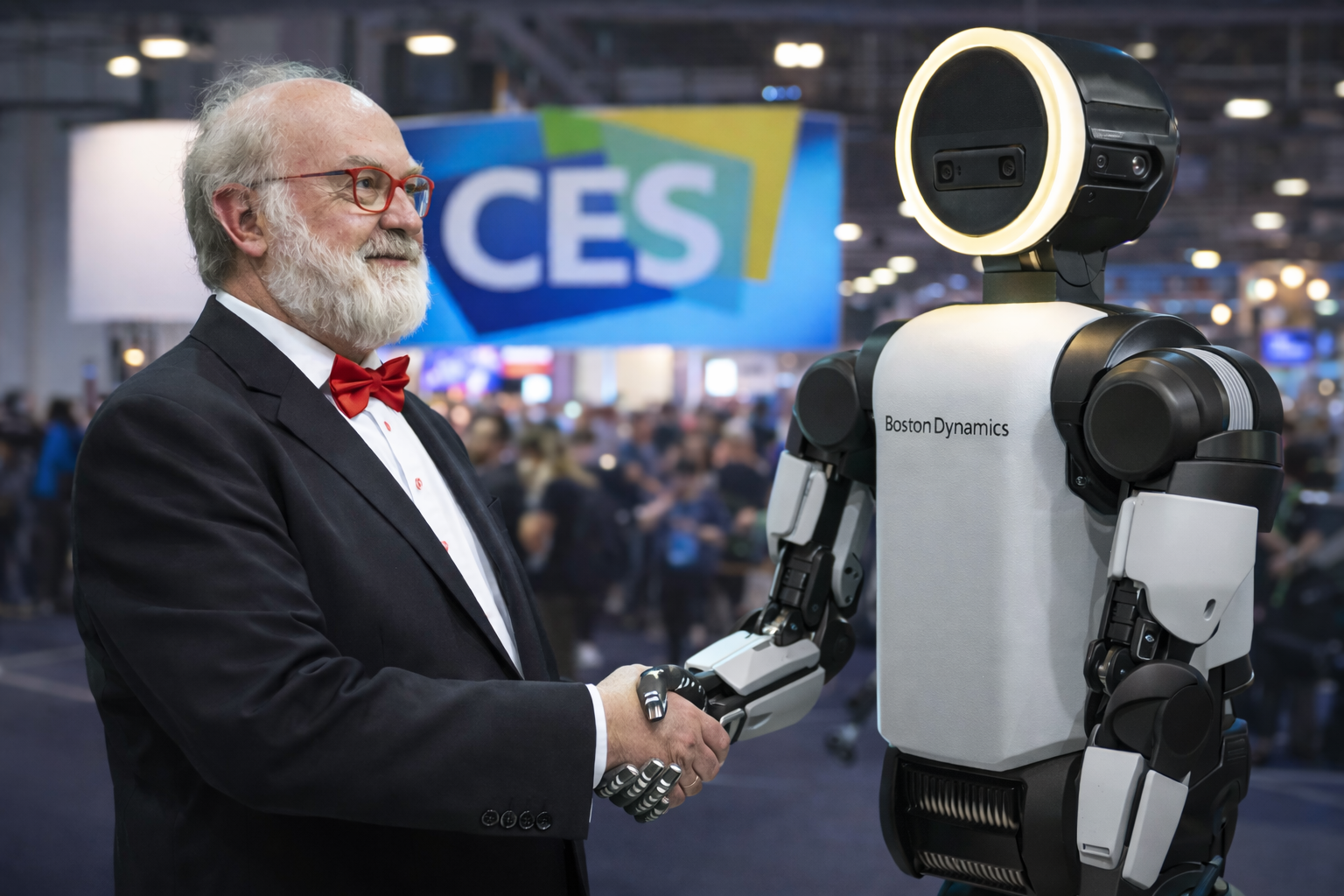
“For the first time ever in public, please welcome Atlas to the stage,” said Boston Dynamics’ Zachary Jackowski at CES 2026 in Las Vegas. The life-sized robot picked itself up from the floor, walked fluidly across the stage for several minutes, waved to the crowd, and swiveled its head like an owl. No stumbles. No falls. No frantic engineers rushing to intervene.

The demonstration itself was modest—Atlas was remotely piloted for the showcase. But the symbolism was massive. Robotics companies almost never demonstrate humanoids live because fumbles attract catastrophic attention. Russia’s first humanoid face-planted in November. That’s why everyone releases carefully edited videos on social media—maximum control, zero risk.

Boston Dynamics just threw that playbook away. And by doing so, they signaled something fundamental: Atlas isn’t a research prototype anymore. It’s becoming a product. And Hyundai isn’t experimenting with humanoid labor—they’re committing to it at industrial scale.

Continue reading… “Atlas Stands Up: The Moment Humanoid Robots Stop Being Research and Start Being Real”

Talking to the Defect: When Your Disease Becomes Your Diagnostic Partner

By Futurist Thomas Frey

The Question Nobody Thought to Ask

What if instead of analyzing your cancer, you could interview it? Not metaphorically—literally ask your tumor what it needs to survive, why it’s growing, what would kill it most effectively. What if your autoimmune disease could explain exactly why your immune system is attacking your body and what would make it stop?

This isn’t science fiction. It’s the logical endpoint of AI-powered diagnostic systems that can simulate complex biological processes and translate them into conversational interfaces. And it changes everything about how we diagnose, treat, and understand disease.

The concept comes from software engineering: “talking to the defect.” When code fails, instead of manually debugging thousands of lines, AI systems can simulate the defect’s behavior and explain—in plain language—what’s wrong, why it’s happening, and how to fix it. AI business developer Dave Blundin articulated this breakthrough in diagnostic methodology: give the problem a voice.

Now extend that concept to medicine. Your illness becomes your diagnostic partner. The defect in your body explains itself. The disease that’s killing you tells you how to kill it first.

Let me walk you through why this represents fundamental transformation in medical diagnosis, what becomes possible when diseases can explain themselves, and how quickly this shifts from theoretical to clinical reality.

Continue reading… “Talking to the Defect: When Your Disease Becomes Your Diagnostic Partner”

The $2 Billion Daily Question: Where’s Your Piece of the AI Future?

By Futurist Thomas Frey

The Investment Nobody’s Talking About

Every single day, $2 billion flows into AI, robotics, drones, and automation. Not annually—daily. Large tech companies, sovereign wealth funds, and ultra-wealthy family offices are pouring unprecedented capital into technologies that will reshape every industry, eliminate millions of jobs, and create trillions in new wealth.

And if you’re reading this wondering where your piece of that future is, you’re asking exactly the right question at exactly the wrong time. Because the window for broad participation is closing faster than most people realize.

This isn’t wealth redistribution. It’s wealth concentration on a scale that makes previous economic transitions look egalitarian. The automation wave isn’t lifting all boats—it’s building yachts for people who already own fleets while everyone else watches from shore.

Let me walk you through why this $2 billion daily investment represents the greatest wealth divergence in modern history, why traditional pathways to prosperity won’t work this time, and what options remain for people locked out of the AI gold rush.

Continue reading… “The $2 Billion Daily Question: Where’s Your Piece of the AI Future?”

Gluing Deserts Together: How China’s Blue-Green Algae Is Terraforming Sand Into Soil

By Futurist Thomas Frey

The Question Desertification Forces Us to Answer

Deserts are expanding. Climate patterns shift, rainfall decreases, vegetation dies, and sand reclaims land that once supported agriculture and communities. Traditional approaches—planting trees, building barriers, pumping water—struggle against the fundamental problem: shifting sand won’t stay put long enough for anything to take root.

This forces an uncomfortable question: what if we’re fighting desertification wrong? What if instead of trying to grow plants in sand, we first turn the sand into something that can support plant life? What if we literally glue the desert floor together using organisms that have survived in extreme conditions for eons?

Chinese researchers at the Shapotou Desert Experimental Research Station have answered this question with a solution that sounds like science fiction: deploy massive quantities of blue-green algae to create an “ecological skin” that binds shifting dunes into stable substrate. Not in decades—in one year. Not as small-scale experiment—across 6,667 hectares in Ningxia province over the next five years, with plans to scale globally.

Let me walk you through why this blue-green algae approach represents a fundamental shift in how we reclaim deserts, what it means for global desertification battles, and why microbial geoengineering might be humanity’s best tool for reversing landscape degradation.

Continue reading… “Gluing Deserts Together: How China’s Blue-Green Algae Is Terraforming Sand Into Soil”

The World’s First Flying Car Race Just Happened (And Changed Everything)

By Futurist Thomas Frey

The Moment Personal Aviation Became Sport

Four electric vertical take-off aircraft screaming through a pylon course in formation flight. Pilots banking hard around checkpoints. The crowd roaring as Jetson’s founder Tomasz Patan pulls a solo aerial display that looks like something from a science fiction movie. This wasn’t a concept demonstration or computer simulation—it was the world’s first competitive flying car race, held at UP.Summit 2025, and it marks the exact moment personal aviation stopped being experimental technology and became legitimate sport.

The “Jetson Air Games” concept unveiled at UP.Summit represents more than clever marketing for Jetson’s ONE personal electric aircraft. It’s the declaration that we’ve crossed a threshold: the technology works reliably enough, the pilots are skilled enough, and the aircraft are safe enough to race competitively. And once you can race something, once you can turn it into spectacle and competition, mass adoption accelerates exponentially.

Let me walk you through why this demonstration matters far beyond the impressive aerial acrobatics, and what it signals about the timeline for personal aviation becoming accessible reality rather than futuristic fantasy.

Continue reading… “The World’s First Flying Car Race Just Happened (And Changed Everything)”