Korea’s Hydrogen-Powered Tech: Farming Goes Off-Grid

Forget the tractor. The new icon of agriculture might just be a hydrogen fuel cell.

At a 660-square-meter greenhouse in Jeonju, South Korea, tomatoes are being cultivated in what could only be described as a technological fortress—one that produces its own power, reuses its own heat, and doesn’t flinch when the weather turns hostile. This isn’t a science fiction set. It’s a real, functioning smart farm powered by a fusion of hydrogen fuel cells, solar collectors, heat pumps, and adsorption chillers.

Built by the Korea Institute of Machinery and Materials (KIMM), this isn’t just another green experiment. It’s a declaration of energy independence for agriculture—a self-contained, AI-optimized, weather-proof growing system that slashes operating costs by over a third and cuts emissions by more than half.

Continue reading… “Korea’s Hydrogen-Powered Tech: Farming Goes Off-Grid”

The Cannibal Machines Are Coming—and They’re Evolving Without You

For decades, we’ve been focused on building smarter robot minds. Now, scientists have unlocked the next frontier: bodies that grow, heal, and scavenge.

In a stunning leap out of Columbia University, researchers have created robots that can physically rebuild themselves—not in a factory, but in the wild, using parts from their surroundings or even other robots. Dubbed “Robot Metabolism,” this new form of machine autonomy marks the beginning of self-sustaining, self-improving machines that blur the line between design and evolution.

Continue reading… “The Cannibal Machines Are Coming—and They’re Evolving Without You”

Plastic’s Replacement Is Alive—and It’s Spinning

The age of dead materials may be coming to a close. In a quietly radical experiment at the University of Houston, scientists have figured out how to grow a material strong enough to rival plastic—not from oil, but from living bacteria. And not just any bacteria. These microscopic workers are being trained, spun, and coaxed into building a future where plastic is obsolete.

At the heart of this breakthrough is bacterial cellulose—a naturally occurring biopolymer that’s strong, flexible, and fully biodegradable. Until now, it’s been treated more like a scientific curiosity than a global solution. But researcher Maksud Rahman and his team just changed that by teaching bacteria to spin stronger, smarter versions of this material in a rotating culture chamber that behaves more like a bioreactor than a petri dish.

Continue reading… “Plastic’s Replacement Is Alive—and It’s Spinning”

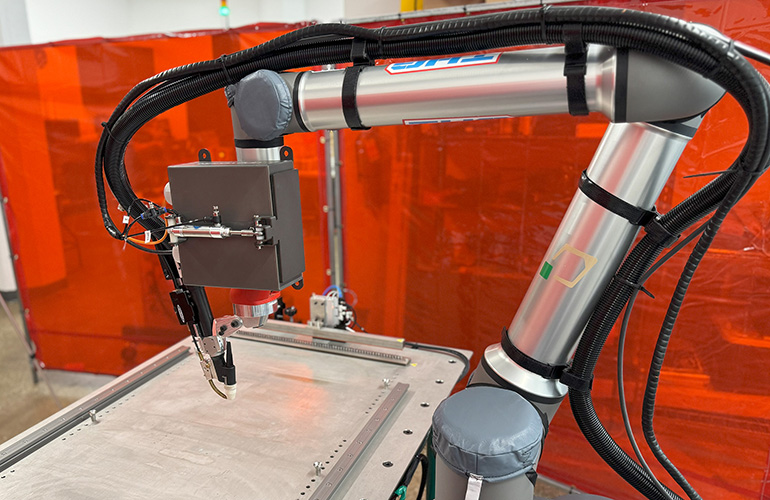
Welding Without Welders: The Smart Workcell That Doesn’t Need You

Welders used to rule the shop floor.

Their sparks were the signature of a skilled trade—equal parts craftsmanship, grit, and danger. But what happens when the torch passes to a machine that doesn’t sweat, doesn’t miss, and doesn’t complain?

This week, Cohesive Robotics answered that question loud and clear with the launch of its Smart Welding Robotic Workcell, a fully autonomous welding system that doesn’t just automate tasks—it replaces the art of welding with code, cameras, and algorithms.

Welcome to the new frontier of fabrication, where the welder’s helmet is traded for a machine-learning model, and experience is measured in training data—not decades on the job.

Continue reading… “Welding Without Welders: The Smart Workcell That Doesn’t Need You”

The Molecule That Fights Stroke—and Might Rewrite the Future of Brain Health

Imagine a drug that protects your brain six hours after a stroke. Now imagine that same molecule quietly holds the key to reversing Alzheimer’s and other neurological killers—without the usual side effects, without the heartbreak, and without the ticking clock.

That’s the promise behind GAI-17, a small molecular disruptor developed by researchers in Japan that may become one of the most important brain interventions of our time.

And no one saw it coming.

Continue reading… “The Molecule That Fights Stroke—and Might Rewrite the Future of Brain Health”

Reprogramming Nature: How Gene Editing Could Rescue the Species We’ve Already Failed

For decades, conservation has been about slowing the bleeding—captive breeding, protected habitats, desperate triage for species spiraling toward extinction. But what if we stopped trying to preserve nature like a museum exhibit and started engineering its comeback?

A new wave of scientists thinks we can. And they’re not talking about protecting animals—they’re talking about reprogramming them.

In a landmark paper published in Nature Reviews Biodiversity, an international team of researchers argues that gene editing—yes, the same tech used to make drought-resistant corn and revive mammoths—can now be applied to rescue endangered species. Not metaphorically. Literally.

This isn’t about keeping a few more pandas alive. This is about restoring lost genetic diversity, reversing evolutionary collapse, and using 21st-century tools to solve problems we created in the 20th.

Let that sink in: We may soon edit animals back to health.

Continue reading… “Reprogramming Nature: How Gene Editing Could Rescue the Species We’ve Already Failed”

The 12 most dangerous superbugs, ranked by the WHO


The World Health Organization says we need to step up the fight against a dozen bacteria that are growing resistant to all the antibiotics we have to treat them.

One of the scariest features of the antibiotic resistance crisis — which has been accelerated by how we overuse these drugs — is that pharmaceutical companies aren’t developing new antibiotics quickly enough. They also often place profits ahead public health when choosing which drugs to develop.

Continue reading… “The 12 most dangerous superbugs, ranked by the WHO”

11 amazing pairs of futuristic shoes

futuristic-shoes

Fashion designers are starting to use all kinds of technology in their garments.  Scientific progress has always been an important part of shoe design — the invention of vulcanized rubber by Charles Goodyear directly led to boots that could climb Mount Everest, for example — and pro athletes consistently turn to Nike, Reebok, and other companies to create performance-enhancing footwear.

Here are 11 pairs of shoes for the future, some that heal themselves, give you directions, and even generate electricity.

Continue reading… “11 amazing pairs of futuristic shoes”

XPrize’s Peter Diamandis and Google Venture’s Bill Maris discuss the future of technology

bill maris peter diamandis

Both Google Ventures’ Bill Maris and XPrize head Peter Diamandis discussed a gamut of subjects, including life extension research, sentient robots, and self-driving cars versus those that can fly at the Wall Street Journal Live conference in Laguna Beach, California this week.

Continue reading… “XPrize’s Peter Diamandis and Google Venture’s Bill Maris discuss the future of technology”

MoveMor Lower Body Trainer is the first-ever multi-directional resistance system

movemor

MoveMor™ Lower Body Trainer is the first-ever multi-directional resistance system that provides gentle strengthening of hips, knees, ankles and feet for better physical function and falls reduction.

MoveMor™ Lower Body Trainer is one of the featured exhibitors at the DaVinci Inventor Showcase. The Inventor Showcase will take place October 10-11, 2015 at the NoCo Maker Faire. You will have a chance to take a look at the MoveMor™ and many other amazing inventions.

Continue reading… “MoveMor Lower Body Trainer is the first-ever multi-directional resistance system”

Discover the Hidden Patterns of Tomorrow with Futurist Thomas Frey
Unlock Your Potential, Ignite Your Success.

By delving into the futuring techniques of Futurist Thomas Frey, you’ll embark on an enlightening journey.

Learn More about this exciting program.