
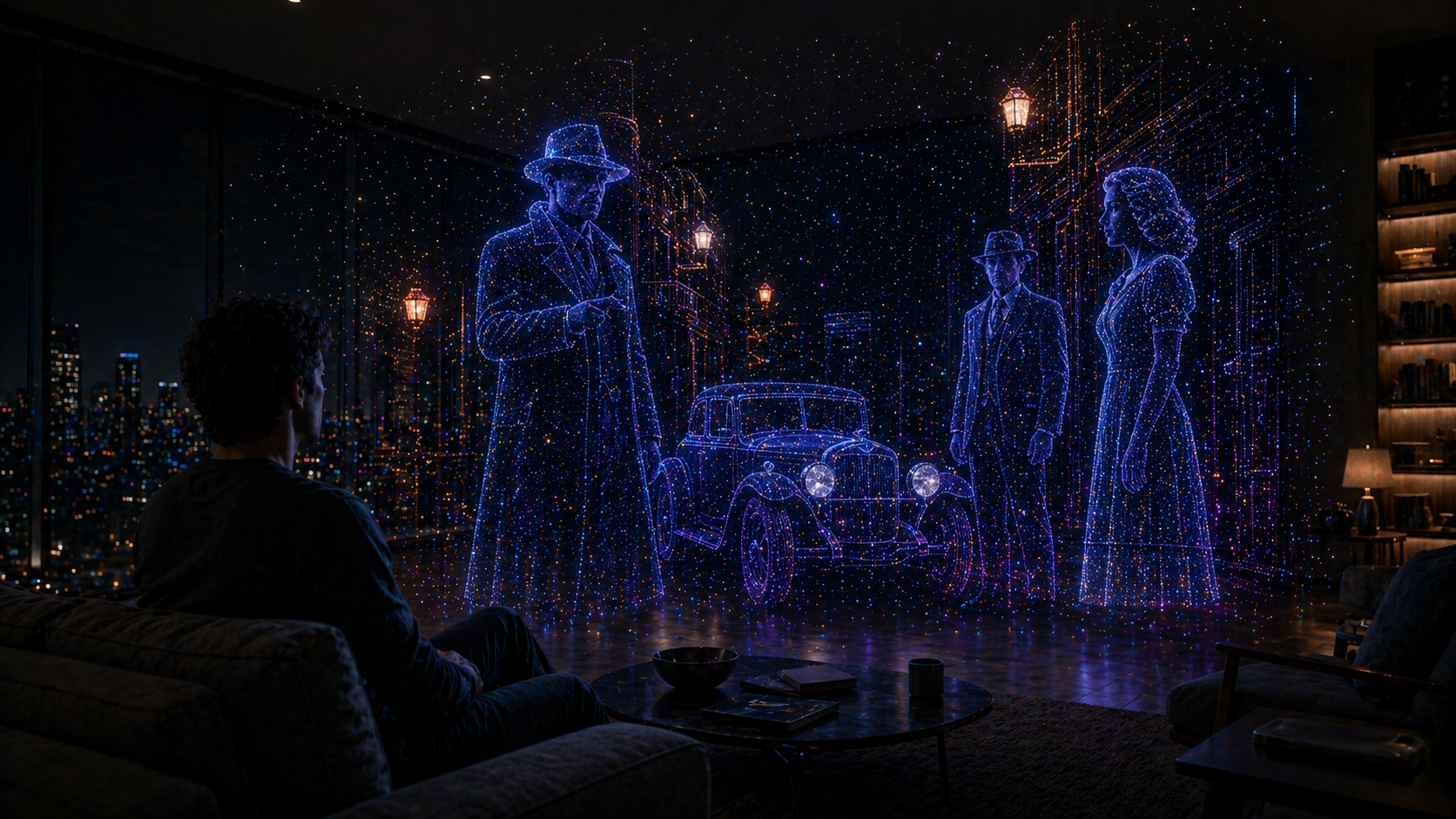
The display that fills the room will not arrive as a better television. It will arrive as the end of television.
By Futurist Thomas Frey
Part 2 of 3: The 3D Video Room
Every generation inherits a rectangle and mistakes it for reality.
For most of the twentieth century, the rectangle was the cinema screen — a wall-sized surface in a darkened room where the world of moving images lived. Then the rectangle shrank to the television in the living room. Then it migrated to the laptop, then the phone, compressing the entire universe of visual storytelling into a glass slab small enough to hold in one hand. Each transition felt, at the time, like the final form. Each time, we adapted so completely that the previous rectangle started to seem primitive almost immediately.
The rectangle is about to disappear.
Not shrink. Not become more portable. Disappear — replaced by something that has no screen at all, no surface to project onto, no frame to contain it. A display that exists in the volume of a room the way furniture exists in a room, except that it occupies no physical space and can be summoned or dismissed in an instant. A display made of millions of floating points of light, each one positioned precisely in three-dimensional space by intersecting fields of energy, collectively forming images and scenes and presences that exist in the room with you rather than behind a pane of glass.
In Part 1 of this series, I traced the physics of this idea from a twenty-year-old thought experiment to the laboratory demonstrations that have proven it real. The floating point of light is not theoretical. It exists in research settings today, produced by femtosecond lasers ionizing air molecules at precise locations, by two-photon excitation in fluorescent media, by acoustic levitation of illuminated particles. The physics works. The engineering is the remaining challenge.
In this column I want to think about what happens to entertainment when the engineering catches up. Because the implications aren’t incremental. When the display escapes the screen and fills the room, the entire architecture of how we experience stories, watch sports, attend performances, and share visual information with other people changes simultaneously.
Continue reading… “When the Screen Disappears”