The Great Transformation: How Humanity Redefines Itself Over the Next 30 Years

By Futurist Thomas Frey

We’re not just facing another economic cycle or technological wave. We’re entering a civilizational inflection point that will unfold across distinct phases over the next three decades. Understanding these phases isn’t about prediction—it’s about preparation. The communities, organizations, and individuals who recognize which phase they’re in will navigate this transformation far more successfully than those caught off-guard.

What makes this transformation different from previous technological disruptions is its scope and simultaneity. The Industrial Revolution unfolded over roughly a century, giving societies time to adapt incrementally. This time, AI, robotics, drones, and automation are converging at once, across all sectors, in all regions. There’s no “later” geography that can learn from “earlier” adopters. We’re all early adopters now, whether we’re ready or not.

The phases I’m describing aren’t rigid boundaries but overlapping waves. By the time one phase becomes dominant, seeds of the next are already visible. Smart organizations and forward-thinking communities are already positioning themselves for Phase Three while most are still denying Phase One. That gap—between those who see what’s coming and those who don’t—will be the defining factor in who thrives and who struggles over the next generation.

Continue reading… “The Great Transformation: How Humanity Redefines Itself Over the Next 30 Years”

The Global Robotics Integration Program: One Billion Robots Joining Human Society by 2040

By Futurist Thomas Frey

By 2035, Japan will have more citizens over 65 than under 18. Germany’s workforce will have shrunk by 15 million people. China will face a demographic cliff with too few young workers supporting too many retirees. Across the developed world, the same crisis looms: not enough humans to care for the elderly, staff hospitals, deliver goods, or teach the next generation.

The Global Robotics Integration Program is humanity’s response—a $3 trillion megaproject to deploy one billion humanoid and autonomous robots across healthcare, logistics, and education sectors by 2040, all connected through an international “Robot Internet” that enables coordination, learning, and continuous improvement.

This isn’t replacing humans. It’s augmenting human civilization with machine partners designed to work alongside us, handle tasks humans can’t or won’t do, and prevent societal collapse as demographics invert. By 2040, human-robot co-societies won’t be science fiction—they’ll be how civilization functions.

Continue reading… “The Global Robotics Integration Program: One Billion Robots Joining Human Society by 2040”

From Designer Babies to Super Humans: How AI and Robotics Are Rewriting Human Evolution

By Futurist Thomas Frey

When I first wrote about designer babies and genetic enhancement in 2012, the technology was theoretical and the ethics were abstract. CRISPR hadn’t revolutionized gene editing yet. AI couldn’t design proteins. Robots couldn’t perform microsurgery with superhuman precision.

Now, in 2025, everything has changed. The conversation isn’t about whether we can enhance humans—it’s about which enhancements are already happening, which are coming next, and whether we can stop the process even if we wanted to.

But the real story isn’t just genetic engineering anymore. It’s the convergence of AI, robotics, genetic modification, and brain-computer interfaces creating enhancement possibilities that make “designer babies” look quaint. We’re not just designing better humans—we’re redesigning what “human” means.

Continue reading… “From Designer Babies to Super Humans: How AI and Robotics Are Rewriting Human Evolution”

The Evolution of Robots: When the Lines Between Human and Machine Disappear Completely

By Futurist Thomas Frey

We’re approaching a threshold that will fundamentally change what it means to be human. Not because robots are becoming more human-like—though they are—but because humans are becoming more machine-like, and the distinction between the two is evaporating faster than anyone predicted.

When I first wrote about the blurring lines between people and machines, humanoid robots were clumsy prototypes and brain-computer interfaces were experimental medical devices. That was then. Now we’re watching those lines dissolve in real-time, and the implications are staggering.

Continue reading… “The Evolution of Robots: When the Lines Between Human and Machine Disappear Completely”

The Printer Has Entered the Construction Site — And Nothing Will Ever Be the Same

Forget bricks. Forget mortar. Forget the months-long grind of scaffolding, dust storms, and crews working dawn to dusk just to complete a single floor.

In a quiet corner of Metzingen, Germany, a new era of construction just roared to life—and it did so one printed layer at a time.

ZÜBLIN and INSTATIQ didn’t just build apartments. They printed them. Using the Instatiq P1—an on-site 3D concrete printer that moves like a robotic boom on steroids—they completed the entire top floor of a four-story residential building without traditional crews, scaffolding, or even specialized materials. It’s the first time in Germany (and one of the first times anywhere) that a structural load-bearing floor of this scale has been fabricated directly on-site using nothing but concrete and code.

Continue reading… “The Printer Has Entered the Construction Site — And Nothing Will Ever Be the Same”

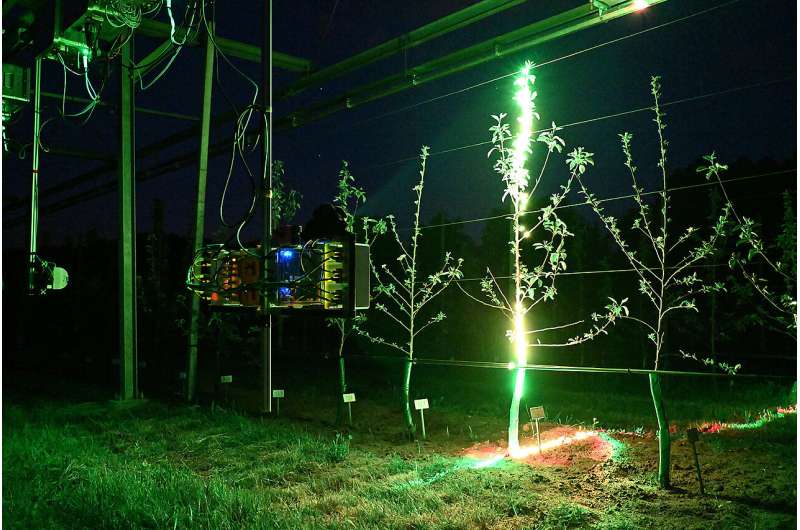
Robots Are Learning to Taste: How 3D Laser Scanners Are Teaching Machines to Harvest Like Humans

The future of farming isn’t about bigger tractors—it’s about smarter sensors. And now, robots are getting their first real taste of fruit.

In a field outside Potsdam, Germany, something unusual is happening. A robotic system, armed with a 3D laser scanner developed by Professor Andreas Nüchter’s team at Julius-Maximilians-Universität Würzburg, is circling rows of apple trees—not to observe, but to understand. This isn’t your typical machine vision. It’s multispectral precision scanning designed to read water content, analyze ripeness, and make nuanced decisions that were once the exclusive domain of skilled human pickers.

And that’s exactly the point.

Continue reading… “Robots Are Learning to Taste: How 3D Laser Scanners Are Teaching Machines to Harvest Like Humans”

The PowerRay drone is an aquatic spyglass for playboy fishermen

Who needs fishing prowess when you have a remote-controlled, sonar-equipped, bait-dropping, mini-submersible at your disposal? Because with the new PowerRay underwater drone, that’s exactly what you get.

The PowerRay UUV comes from Beijing-based drone manufacturer PowerVision, makers of the PowerEgg UAV that we saw last August. While the Ray officially debuted back at CES in January, a technical issue with their display (read: their tank sprung a leak) prevented the company from showing off the device in its natural environment.

Continue reading… “The PowerRay drone is an aquatic spyglass for playboy fishermen”

Toyota’s new robot leg brace can help those with partial paralysis walk again

Toyota is introducing a new robotic leg brace called the Welwalk WW-1000 that can help patients with partial paralysis affecting one side of their body walk again. The robotic exoframe is worn on the affected leg, with a large motor component at the knee joint that provides just enough assistance to the patient, letting them recover their own walking ability therapeutically over time.
Continue reading… “Toyota’s new robot leg brace can help those with partial paralysis walk again”

Tarzan the swinging robot could be the future of farming

tarzan-sloth-robot-1

Some farmers already use drones to monitor their crops, but a team of researchers from Georgia Tech have created a far more interesting alternative. Instead of designing yet another drone, they created a robot inspired by Kristen Bell’s favorite animal: the sloth. However, they named it “Tarzan” after the most recognizable character who moves by swinging from vine to vine.

Their machine was designed to move like the fictional jungle dweller. Tarzan will be able to swing over crops using its 3D-printed claws and parallel guy-wires stretched over fields. It will then take measurements and pictures of each plant with its built-in camera while suspended.
Continue reading… “Tarzan the swinging robot could be the future of farming”

This bricklaying bot could be the architect of the future

If you want curves like this, you’ll need a robot. Designed by architects Archi-Union, the undulating exterior of the Chi She Gallery in Shanghai was made using an adapted car-manufacturing robot. “We used digital tools to transform geometry data to digital-fabrication data,” says Li Han, chief architectural designer at Archi-Union, who spent five years making the cyborg helper.

Continue reading… “This bricklaying bot could be the architect of the future”

Scientists just made electronic skin that’s better than human skin

Scientists at the University of Glasgow have invented a robot skin that surpasses human flesh.

Professor Ravinder Dahiya and his team created a silicone and graphine skin which provides haptic feedback to the user. The thin layer of graphine acts as a sensor, making the electronic skin (e-skin) very sensitive to touch. It’s also flexible and cheap to manufacture.

Continue reading… “Scientists just made electronic skin that’s better than human skin”

Stephen Hawking calls for creation of world government to meet AI challenges

In a book that’s become the darling of many a Silicon Valley billionaire — Sapiens: A Brief History of Humankind — the historian Yuval Harari paints a picture of humanity’s inexorable march towards ever greater forms of collectivization. From the tribal clans of pre-history, people gathered to create city-states, then nations, and finally empires. While certain recent political trends, namely Brexit and the nativism of Donald Trump would seem to belie this trend, now another luminary of academia has added his voice to the chorus calling for stronger forms of world government. Far from citing some ancient historical trends though, Stephen Hawking points to artificial intelligence as a defining reason for needing stronger forms of globally enforced cooperation.

Continue reading… “Stephen Hawking calls for creation of world government to meet AI challenges”

Discover the Hidden Patterns of Tomorrow with Futurist Thomas Frey
Unlock Your Potential, Ignite Your Success.

By delving into the futuring techniques of Futurist Thomas Frey, you’ll embark on an enlightening journey.

Learn More about this exciting program.